© 2020 G.N. Jacobs

Sometimes, I don’t get to sleep quickly. The mask to deal with the blinky lights on the surge strips and morning sunlight through the window goes on and I’m still awake. I switched over to decaf except when I hunt other people’s coffee out of the house. I exercise when I remember. So most days, I’ve eliminated the usual suspects and still…

Well, to cut through the build up, I think a lot on those nights when it may take a few extra hours to nod off. About story material. Or my own halting attempts at music, which lands these thoughts here in this music column instead of the Scribbler’s Saga. The most recent skull session screaming behind my eyes that kept me awake involved my most recent eschewing of my superhero/spandex characters as the subject for the opera that I have so famously claimed in this column give me ten years, Ducky (see post).

As you may recall, I didn’t want to do The Tales of the Angel Association as an opera, despite really wanting to see someone do Batman in the style of Siegfried or something. I fretted about the stagecraft required to put a soprano as the girl in the iron suit and a mezzo as the actual suit on the same flying rig. Dark litigious nightmares referencing the ill-fated Spider-man musical froze me in the door. All you need to know is that these fully conscious spitball sessions that happen between Lights Out and Get Up It’s Almost Brunch simply don’t give a shit.

Of course there are trigger cues for spending an unknown number of hours going over and over with what your children will do when you immortalize them in ink. I was at my regular writers group with a couple guys talking about music, including what we like, the resources available and how we learned. I’m pretty much slowly on track to learn the rock star way; pick up a guitar and go.

In the conversation, I mentioned Thomas Adès and Tom Cairns’ opera The Exterminating Angel mentioning and exaggerated the A over High C hit by the second female lead on the Met Stage as a G over High C. One of the guys said something like, “really, and she still has her throat?” And there was an inevitable reference to Spinal Tap that even in the opera world – “Ours goes up to eleven!”

So I get home after the session and I get to thinking about how I need the time asserted in the previous post to make sure I use all my music tools to do the notes up nice. But, Just Another Drunken Dwarf, which at the moment is just a title from story dice, is either going to be an opera or just another goofy idea in my list of ideas. I prefer the former so I get myself asking – “what’s my first step?” The word LIBRETTO promptly flashes before my eyes in red neon.

Ah, right, the same advice I give myself when contemplating a huge in scope screenplay or novel…write the pig and let the producers figure it out. I was just going to start Dwarf with the libretto, easy-peasy, lemon squeezy. But, I haven’t actually seen a libretto. Yes, Google is my friend; I find a PDF online where someone posted instructions for kids probably at music camp or something. I save it as a place to start and go to bed.

And you heard the part about how the night time story session doesn’t always give a shit? I roll to the right. I roll to the left. Am I composing/creating the drinking song that, by definition, defines the main theme of Just Another Drunken Dwarf? Without hitting too much of the obviousness of The Student Prince? Absolutely not. Characters that speak to you in the dead of night don’t take turns or wait in line.

Still, I roll right. And back over to the left. What I see on the screen made by my sleep mask isn’t fantasy dwarves raising steins and slaying orcs. I kept seeing my spandex people. I heard the blended part of Metal Goddess flying around stage; their duet admittedly still running towards the goofy like Kill the Wabbit (it’s early, I have time to shake off Wagner as interpreted by Bugs Bunny, or not).

I straighten out my posture sleeping on top the bed (Southern California during a scorching August, Ducky). I roll over yet again. I see an interesting duet for the secondary characters of Metal Goddess’ parents, a man that used to be Cicero and a woman that used to be Athena’s body. This is a marriage that has lasted a long time and somehow what I’m seeing is a tandem hug and something like Leo Delibes’ Flower Duet (again it’s early, we’ll see).

Finally, I sleep and get to enjoy the regular old and typically forgettable three-reel movies we call dreams. I don’t know how long the session went; I can’t tell time with my eyes closed and my watch on the table. It felt like it could have been hours. I woke up at the same time I would’ve had my spandex characters not shouted at me. I didn’t feel any obvious sleep deprivation. It could just have easily been forty-five minutes on a hot evening fighting for just a little more breeze.

So what does this mean? Did I just cave to the voices and agree to put Tales of the Angel Association on paper as the superhero opera the world seems to cry out for? I don’t know. I do all kinds of strange shit. But, in looking over the PDF for the libretto I realize that I could just write the libretto just in case I never do get my shit together to do the notes properly…

As always, we’ll see when we see.

© 2019 G.N. Jacobs

Now that I’ve burned the ships behind me on the Trojan beach, it’s perhaps high time to inventory what I can actually do to get started, not counting, of course, the actual process of Ass Flopped on Couch, Stare at iPad Music App Until Something Makes Me Tap Keys. Most composers should have a basic idea of what their work might sound like before starting. And arbitrary as hell, I will start with the sounds that might be everywhere just under the surface of all of our lives, environmental sounds (or noise from the perspective of the people below me).

Typewriters.

One benefit of starting my journey as a wordsmith arrogantly porting over the voices from his muse (I facetiously assert mine as Calliope and note that she gets stereotypically PMS when I don’t work for more than 24 hours) to the currently frightening world of untapped musical possibilities, typewriters. I have four, including two manuals, because in my ongoing appeasement and propitiation of Sweet Callie as a novelist there just ain’t no excuses for not pounding keys, Baby! Not even a failure to pay the electric bill or the end of Post-Industrial Civilization as we know it.

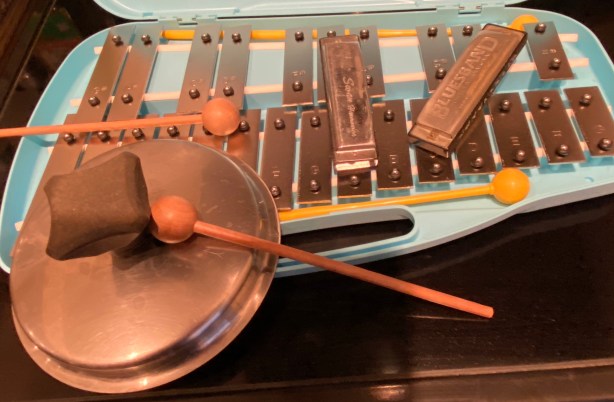
Not all typewriters are created equal. I don’t mean this the way I might get snobby nostalgic about my harmonicas, bell kit, recorder, Chinese flute, or even the out of tune banjo atop a key bookcase (all stories for a later post). Depending on how the factory gnomes put it together hoping to assist the next Hemingway or Faulkner beat the stuffing out of the literary world; Qwerty the Office Dragon (or merely Office Ogre for those that can really type) will sound different from machine to machine.

My favorite of the quartet is my white Olympia. This manual was sold to me when I surrendered a Royal portable that had the kind of mechanical flaws that suggest put a bullet in the horse it’s the only humane thing to do. The man at the typewriter repair store said things like “built in Germany, mechanically solid and recently refurbished” and got $300 out of me. On the writing side of this equation, even not using Ollie because those newfangled ‘puters still put out a siren call, I feel reassured having her ready for either an attack of do it to prove I still know how or an actual failure of the lights. Why? Mechanically solid usually means the machine can sit patiently a decent while on a desk until you the owner figures out how to take his thumbs out of his ass.

In a musical sense, Ollie presents to her composer a deeper click-clack on those keys that most of the others in my possession. Especially, since I have tons of heavyweight (20lb and 24lb) typing paper, which also affects the sound quality for the budding composer seeking to write what he knows into a piece. I can see duets and quartets juxtaposing each machine as a slightly different voice in the story of the music with possibly my various computer keyboards throwing in their quiet by comparison tones, just because no one likes being left out of the party.

The electrics in this story also have interesting sounds to them that add something to the musical narrative (everything is story to me). The keys hit the paper with slightly different tones for which I suppose I’ll have to post some samples of all my dragons (I don’t type fast enough to demote these ladies to mere ogres) so you hear what my choices are. The cool part considering Madame Brother and her sister, Madame Selectric, is the whir between keystrokes evocative of, well, even after dethronement by the computer, the hum of the Late Industrial office to be captured in music.

And then you do the Google search to find that surprisingly not a whole lot of typewriter music immediately pops out of the ether. At the top of the page will almost always be Leroy Anderson’s The Typewriter with clips of various performances. This piece neatly fits in with YouTube’s preference for short clips and sounds light and breezy…until you see the percussionist’s hands.

He’s not typing so much as playing the drums because when you don’t care about the black ink on the page you can go much faster to the typing speed close to 100WPM seen in Anderson’s work. If you actually type that fast on a manual, to my way of thinking, the monster devolves well past ogre to Russian Blue kitten seeking milk. Good to know, the composer that pokes along with two fingers thinks. A rhythmic juxtaposition for the piece to do both regular typing and high-speed percussion.

Raid the kitchen.

Since this post is all about improvised instruments that we might all have in our homes, depending on the qualities of your cookware just drop something on the tile floor and see what rings back up. I have at least one saucepan that produces a verifiably pleasing tone and have yet to drop other cookware. And – CHHHHHK! – that was my downstairs neighbors metaphorically hanging me from the nearest yardarm for any possible condo noise infractions after hours.

Bad jokes aside, it seems people have been improvising music out of their kitchen goods for a long time. Should I save money and tape two spoons together or allow myself to get rooked at the music store buying the professionally manufactured instrument that has become an occasional feature of Folk and Bluegrass music? Depends on my bank account when I decide – “Yup, needs spoons.”

So far the most interesting sound in my kitchen is my coffeemaker. Brew coffee, the same four cups nearly every day, and yank up the top to allow the pent up steam to escape. It gurgles and rattles, but never exactly the same way twice. Sometimes it’s loud. Sometimes you get ten seconds out of the throaty noise. And other times you just have to whine – “is that all there is?” I’m thinking it will go well with the typewriter…or not.

Raid the big drawer in your desk and/or tool cabinet.

Rubber bands, an even poorer man’s jaw harp? Capture the squeak of dry erase pens? We’ll see once I start having to face the silent iPad app and blank score page. And with that, we’ll resume our previously scheduled procrastinations…

Update: the electric typewriters have since been unloaded upon the Salvation Army

© 2019 G.N. Jacobs

A typical Jacobs Special fistfight…

Punch. Kick. Hard elbow. POW-POW-POW! Side kick. TH-WHAACK! Punch. Punch. Triangle block. KA-POW!

Of course, I do sometimes drop in a sentence or two about who’s winning, or if the hero might just gas out (fights are mini stories and John Steed needing a breath and cornerman to keep going kind of covers the internal All Is Lost Moment). Pretty much though I just do the moves and the vicious sound effects to go with ‘em.

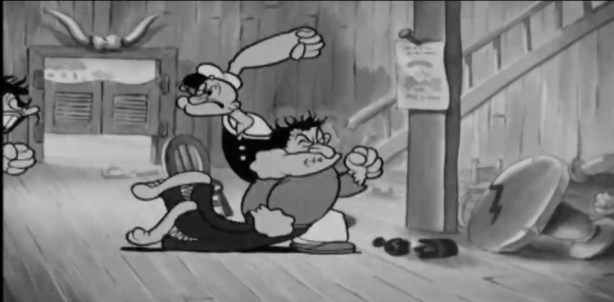
The influences always come back to two things: Adam West Batman and the average Popeye dust cloud fight with Bluto. Seems to me that stripping out the subjects and objects from what would otherwise be complete sentences like – Popeye switched open the other eye and thrust his knuckle sandwich right at Bluto’s kisser – creates confusion. A natural state in many fights.

When I do go against my base style seen in Paragraph Two in favor of the turgid Mike Hammer inspired prose, I guarantee you my next sentence is ALWAYS about flying canine teeth. I get to be that vicariously bloodthirsty in my work, the way Popeye animators facing studio Hays Code censors couldn’t. It isn’t lost on me that a probable emergency creative solution to an arbitrary restriction, I’ve elevated to high order art.

Anyway, my personal predilections for equal helpings of confusing fight prose juxtaposed with turgid aren’t really the point of this post. Except as a hook to talk about how sound effects can affect how we write across all the many media.

Where to start? Ben Burtt tapping steel tension cables that held up telephone poles getting a sound onomatopoeically transcribed as – PEEEEW? Puh-lease, forty-year-old Star Wars solutions, while brilliant, should be a jumping off point to other sounds, not the landing place. Besides, I’m partial to – ZZZT! – or ZAP! – for all things laser, taser and Joker’s hyped up joy buzzer. I’m guessing I associate a fairly classic visual here, that of the lightning revealing the victim’s skeleton. Okay, maybe lasers realistically work with a much different onomatopoeia, but in my books…nope, don’t actually like landing on the Writer as God theory, not out loud.

Yes, I have had Sound Effects as an academic subject in film class. We clapped when someone figured out a key sound to go over a breezy desert-scape on the Avid box: microphone, cover with paper, rub it on the wall. And when I still regularly watched DVD/BLU-RAY extras I learned about celery sticks as a key tool on the Foley stage…and wet T-shirts.

I’ve also held the mic on shows and have that Executive Producer moment with the earphones on, “now, if we could only get her to sound like that in real life.” That one earned two clicks on the mic from the boom guy, Audio/Radio for “Yep, but I can’t say it at the moment.”

I suppose all of this is the longwinded way of saying sound is such a HUGE part of the world I experience and therefore write about. I blame the Adam West Batman show…not really. But, with every – POW! KAPOW! SOCK-O! & OOOF! – I was done. Well, there was also Speed Racer with all those cool crash sound effects, but they weren’t printed on screen…they barely count for the purpose of this post. Though I find it odd that I had to fight harder to watch Speed than Batsie, but I digress.

And then I learned to read with comic books being a key way station between the books Mommy reads to you and George Smiley metaphorically suplexing Karla the Evil Russian. Sergeant Ernie Rock busted out quite a bit of – BUDDA-BUDDA! – for going full Rock N Roll on the Tommygun. Still trying to figure the .50-caliber machine gun belts that never came off his shoulders, except when captured. That and the whole thing about walking out of the Battalion Aid Station thirty-six hours after taking a sucking chest wound to lead Easy to victory dressed in mummy bandages. But, I digress…

You write like you read. With all of the above, of course, I’ll put a protagonist through the windshield of a yellow Lamborghini (one of many 18-scale toy…uh, inspiration aids in my living room). As I remember that moment, I went for it with – SCREEEEECH! CRUUUNCH! – and maybe described the falling glass with an actual sentence.

How did my protagonist walk away from that one? I went with It Was All a Dream, but honestly by letting the reader know in the first sentence. Further proof, Ducky, that I have perpetrated just about every cliché under the sun without remorse.

In addition to reading comics for other reasons like that even as a mostly educated fifty-cough gent, reading is easier with pictures. I have cool sound effects to greedily anticipate. My favorites – SNIKT! – for Wolverine’s claws. KTANG! – for banging metal together (haven’t used it, yet. Coming soon!). Maybe I’ll bust out a few – THROOOOOMS! – on a just because basis. And maybe I’ll make something up that gets copied by the next bloodthirsty honorary Teenaged Mutant Ninja Scribe to come after.

One caveat, just as you will only see printed sound effects in comics panels covering big moments, prose will always run home to Mama in favor of either complete sentences or fragments that mimic sentences (like stripping out the verb To Be for overuse). I think I bust out my sound effects because I’m bored with the previous three paragraphs. Insight…I think.

Anyway, I’ve just adroitly blasted off a lot of words perhaps about nothing, or even deceptively about lots of things writing related. Things like, “it’s okay to take two left turns away from The Way Things Must Be Done.” Or stop reading this blog long enough to invent your own style, methods and proclivities. I won’t tell.

© 2019 G.N. Jacobs

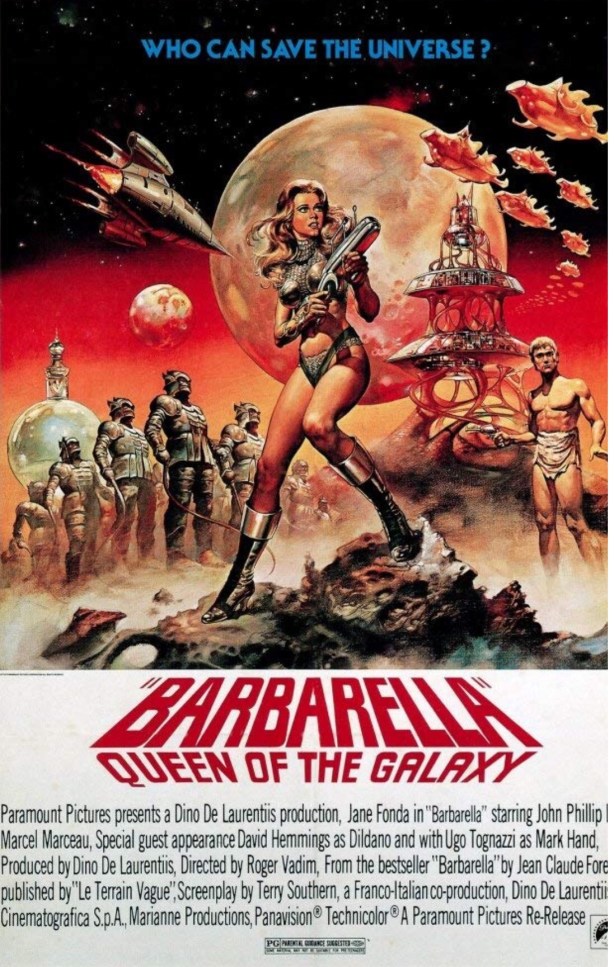
There’s a problem in the Tau Ceti sector. Who do you send? Apparently, send Barbarella. Yep, send a blonde in skintight clothes, also described as Class Five Astro-Navigatrix, and her ship, Alpha 7. Doctor Durand Durand and his Positronic Ray – gasp, a weapon! – stand no chance.

So did the filmmakers capture very much of the coolness of Jean-Claude Forest’s original comics in this adaptation? It’s hard to say, the book is on my reading list for this very reason. Even so, the film script is kind of blowfully underwritten, yet…let’s just say Barbarella succeeds the way I once heard Lou Reed and Velvet Underground described. Something that succeeds in spite of obvious and prominent flaws.

Of course, Barbarella serves as a vehicle for a young Jane Fonda to change skintight costumes right after the monster of the minute tears up the previous costume. There’s also a lot of implied sex. She shags a huntsman who still can’t fix her crashed ship. And then there’s the blind angel who needs the endorphin hit to get his flying mojo back. Oh, and the “wretched girl” breaks the Machine Excessive, a sort of organ device that kills by dishing out monster orgasms.

In an earlier draft of this review, face with suddenly looking at one of my guilty pleasure movies with an actual critical eye, I trashed it. I repeated – “I got caught looking at Jane Fonda” – with an air of many today just looking for things to hate. I don’t hate the movie that much, not even now that my blog beast wants Barbarella on the Half-Shell for dinner.

Getting caught looking at Jane Fonda is, by definition, a plus for any movie. Repeating this fact as if I’d somehow rewritten Friends, Romans, Countrymen – “But, Brutus is an honorable man” – is overkill for a movie that deep down, I still like. I needed to vomit that out. Happens.

What should’ve driven this movie into the nether depths of Cinema Hell, the writing. On the surface, the script seems appropriately dramatic in the sense of “and then we’ll put her in this bubble with these birds that eat the spandex parts of her costume!” Yes, the platoon of screenwriters, including Mr. Forest brought in towards the end, understood the idea of big moments where X attacks Barbarella and eats her costume as the basic building blocks of drama.

Nothing about what happens in between these moments (story beats long before Snyder named them so) helps the story. And that’s even with the need to consider that it is still a fifty-year-old tongue in cheek French skin movie, where possibly like out and out pornos too much good writing could get in the way.

Still, the narrative here skims over the many threads you could get out of a plot that trades on – “Barbarella! Please help! A wayward scientist built a weapon and disappeared into a galactic backwater! We have no military and I can’t spare the presidential band (only that last part appears as dialogue)!” It is my assertion that since this movie exists in the spaces between pornos and movies with more pretension towards good, that you need some good writing. It is still a story.

Barbarella is nekked getting her orders from the President of Earth and Rotating President of the Solar System. Even over the vid-link, we see the lech get caught looking. He says something about meeting her in the flesh as he closes the call.

But, Earth society is later described as moving beyond sex with pills for the blast off part and other methods for everything else. Only the very poor don’t use them…or so Barbarella assumes. Yet, El Presidente is only a panty sniff and triple vodka martini away from actually going with – “Barbarella, I have an extensive collection of etchings I would like to show you.”

Ooh! Do you see the narrative possibilities in highlighting the arrogance of a politician that feels generally immune from the mores of the society he represents and leads? I do. Perhaps this thread winds up too dark for the rest of the movie. It is after all movie that over the years has picked up the metaphorical meaning that sex is good when the woman chooses it. But, letting this corrupt president have a little narrative air to be taught something by the previously naïve Barbarella is an exploitable story thread nonetheless.

The Plot – Crash. Attacked by vicious spandex eating dolls. Sex with huntsman. Ship crashes again in Sogo’s Labyrinth. Sex with Pygar, the angel. Infiltrate city. Learn how horrible the city is. Meet the tyrant in disguise. Get attacked by the aforementioned birds. Meet the rebels. Sex with the rebel leader paying off what Earth Pill Sex Looks like (Ms. Fonda doesn’t need a hairdresser). Obtain a key to advance the plot. Meet the tyrant the second time. Dropped into the Machine Excessive. Jane Fonda gives the mother of all cinematic fake orgasms (paying attention, Ms. Ryan?). Barbarella convinces the man at the sex machine controls, revealed as Durand Durand, to change sides. Confrontation in the queen’s bedroom where All Could be Lost. Final defeat of Durand Durand and the evil city eats itself, but not Barbarella nor Pygar (both are too good).

On the surface, the above should result in a great script that acknowledges the sexy and fun intended campiness while still telling a story. What is actually on screen only covers the surface. I mentioned that you could do the thing about the Earth President possibly having real sex with specially initiated young ladies likely to keep their mouths shut as a good idea for a different movie named Barbarella. There are other dropped threads.

Barbarella meets the Black Queen several times, the first time she’s doing a Henry the Fifth Night Before Battle moment. We come to learn that Sogo the City of Night is fueled by the Matmos that induces evil thoughts and deeds among the citizens under its care in order to feed. But, nothing about how Barbarella interacts with either the Black Queen or the Matmos ever gives us pause that our plucky sex positive heroine could just say “screw it I’ll join the Dark Side (apologies for the mixed film metaphors)!”

Durand Durand, likely already nuts when he left Earth with his weapon, succumbed to the Matmos. As seen in the evil glee he has playing an organ sonata, while Barbarella blows up in all kinds of ways. But, shouldn’t we have a moment where the same forces tug at Barbarella’s admittedly micro skirts and spandex tights?

A moment likely to include the Black Queen making a pitch for Evil – “Join me, Luke. Together we can end this destructive conflict and rule the galaxy together as father and son (again I keep mixing my film metaphors)!” Especially, when there is no way this moment isn’t married to a lesbian seduction scene between the Black Queen and Barbarella. Oh, the hindsight of a man that once produced a stylistic copy of Barbarella, a story for another day.

Realistically, it’s an open question how tolerant Franco-Italian society of 1967 (the shooting year) was towards lesbian sex scenes that would shock, but also make the story less dependent on the obvious assets. However, the movie needed something to make Barbarella more vulnerable with greater obstacles. Story 101 that, even before the creation of the helpful screenwriting manuals, the best writers understood.

And Durand Durand just needed a better Villain Self-Justification Speech.

So what is so good about this movie that I still like it despite the above?

One, intention counts. Letting Barbarella be a voice for “sex is good when it’s the woman’s idea” is refreshing. It allows the rest of us to enjoy things that are goofy, silly and rooted in the bad old days. Of course, I’m possibly imputing things that didn’t even cross the filmmakers’s minds at the time. Still, it’s just fun to see people just making movies, music, paintings and books just because it’s the story they had to tell instead of submitting things to the grand censorship committee that only wants to say No.

Two, hiring Jane Fonda as the eye candy has all kinds of unexpected benefits. She has always been a phenomenal actress. Which means that when handed a script requiring lots of spandex ripped just so, she’s going to bust out quite a few facial expressions meant to trick the audience that there is in fact a well thought out story arc, when there isn’t.

She expressed fear, wonder, the naïveté and the enjoyment of sex as she discovers old ways are sometimes good. All in places that make narrative sense despite I don’t think they were in the script. The irony here is if we don’t get caught looking because the filmmakers chickened out and put Barbarella in a boring Earth Space Force flight suit, maybe we don’t see what Ms. Fonda brought. And I wish I could take some time to praise the rest of the cast, all having fun.

Three, even fifty years later, the Machine Excessive (aka the Orgasmatron) scene is just the kind of clever set piece that will recommend the movie forever. The villain sticks the heroine in the device and plays a sonata. She breaks the machine because a good woman getting her freak on can’t be killed with sex. And it packs the most plot service of any scene in this underwritten movie.

One quibble, the music starts with a few bars of Bach’s Toccata and Fugue, the organ arrangement, before launching into music that fits the rest of the soundtrack, orchestra and modern instruments. I would’ve just used the Bach for this moment. Ironically, I listened to the orchestral version just before typing this draft; yep, I’m getting better at figuring out music (a post for another day). And, yes, let a public domain classic carry the weight for a scene that lets us see a great fake Big-O and is supposed to kill her.

Four, I can’t speak highly enough about the production design of this movie. Other movies of the era have wild sets, but this one should’ve won the Oscar. Even with most of the spaceship viewer screen shots being close ups of lava lamps and ink dropped into water, the interiors of the City of Sogo are the kind encourage getting caught looking (unless Barbarella needs to change costumes).

A city of glass walls. Glass medallions and pendulums. An interesting color palette for which I might not even have the full vocabulary. A candy apple red starship that looks like a hand-vac mated with a condom rack…never mind. Lots of semi-opaque plastic for certain silhouettes to tease and somehow still get a PG out of the MPAA (huh?). Plants placed just so. The way cooler evil liquid oil slick than the one that later killed Tasha Yar. An all around work of art.

Let’s do the Egyptian afterlife thing, weigh the feather (the good stuff) against the heavier bad stuff. Barbarella is still an out and out fun movie with lots to recommend it played out against a script that while it should never even aspire to be The Scottish Play, is still vastly underwritten for the genre. Well, I guess I’m the guy that just likes fun movies.
© 2019 G.N. Jacobs

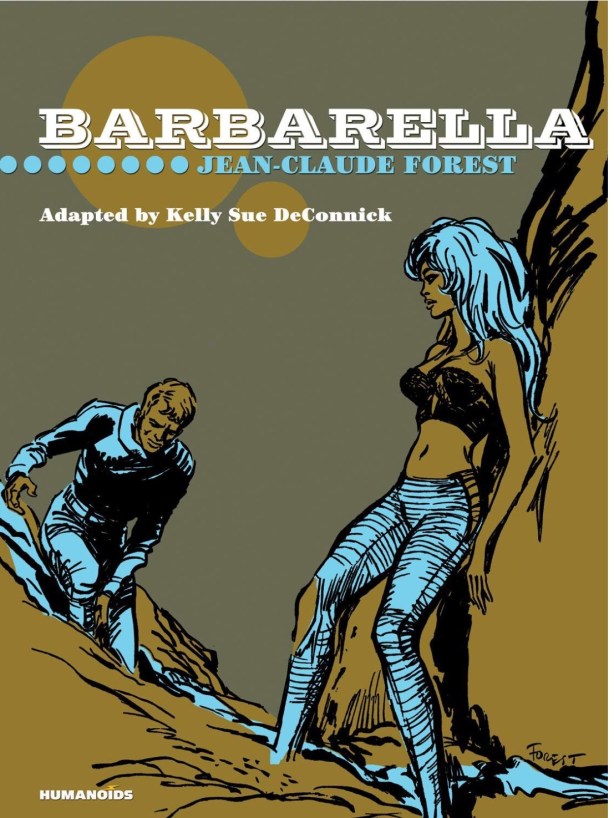
Sometimes diving into original source material for the movie doesn’t work as planned. While I might think the Roger Vadim film somewhat underwritten (see post), turns out Jean-Claude Forest’s original Barbarella comics have many of the same problems and several more. Clearly, the character has somehow managed to be more valuable than the books in which she appears.

The volume reviewed here under the collected title Barbarella started life as French newspaper strips. Think Mary Worth just with fewer “later that day” caption boxes, which help make this story vastly more confusing.

Barbarella crashes on Lythion, a strange planet that seems the product of haphazard kitchen sink world building. First, she bonks her boat into a greenhouse causing winds/decompression that kills off the highly sought after flowers. The dramatic problem: the gardeners in the domed city have dispossessed their neighbors out of key water rights, so crucial for survival in hot-spring settlements described as surrounded by desert.

Barbarella makes out with the leader of a liberal faction seeking a negotiated settlement to the problem. After agreeing to take a message to the opposite number among the dispossessed, Barbarella then has sex with this man. Diplomacy with Benefits. She takes a side for a fair deal where everyone shares in the wealth of the city’s flowers and arms a key uprising from the gun locker on her crashed ship. All is now right and then she leaves town on the next cargo ship to arrive for flowers.

Soon after, Captain Dildano crashes this boat with Barbarella aboard on what appears to be a watery planet inhabited by giant Portuguese Man O’War jellyfish. Said creatures are large enough to be used by their mostly humanoid inhabitants as cities and pirate vessels. The queen of the jellyfish pirates is a Medusa, condemned to immortality fueled by adopting the face of the next woman to roll into town and then killing her, making a case that Earth mythology later landed on the “don’t look, you’ll turn to stone” rule of the Classical creature.

After a highly charged and completely unrequited lesbian moment, Barbarella is finally told to look at the queen and *gasp* she sees her own face. This Medusa is soul sick at the cost of her life and agrees to die. Maybe she feels real love.

Then we have a completely forgettable segment, except for Barbarella and Dildano walking and just barely surviving the ubiquitous deserts of Lythion. Dildano sacrifices his life becoming part of a rapidly acting petrified forest. There’s also a space prince with princess sisters with carnivorous dolls somewhere in here as well.

And then Barbarella uses a borrowed digger boat to visit the completely isolated evil city of Sogo. This section that inspired the movie plays out as a truncated version of the same where Barbarella has sex with the right men and robots setting in motion yet another rebellion against cities dominated by a monster that feeds on evil.

Four main segments. All of which seem too short as seen on the page. I really would like to have seen Mr. Forest take each block and expand them into four graphic novels of the same size as the book kept in print by Humanoids Press (a successor company to the original publisher).

Milk the greenhouse city and the destruction of the crystal structure that fends off the dispossessed and their telekinesis. Milk the Medusa Queen of the Jellyfish Pirates for something, anything. Same with the space prince and his crabby little sisters and their biting dolls. And even though we saw a better version of the Sogo/Black Queen story in the movie, even here there’s not really enough on the page.

To be clear, my major criticism of the movie that the Matmos exuding Pure Evil into the city should affect Barbarella in such a way that a scene of the heroine fighting her way back to being good counts as a Big Scene (an All is Lost Moment perhaps?), also applies on the original page. Why? The segment is too short as written.

In addition to thinking that this narrative structure of shoehorning four adventures into the space typically reserved for one good story just makes things go too fast, this book left me scratching my head about Lythion itself as a imagined world. The planet is described as desert, except when Plot intrudes. In the third section, Barbarella does the Lawerence of Arabia trek in the sand, but this is juxtaposed with the jellyfish sea, or the greenhouse city and, of course Sogo.

Once I figured out that Captain Dildano never left Lythion and that creatures from earlier sections reappeared at the needs of Plot, I started asking the kind of questions that pretty much indicate I’m totally not buying the story on the page. Mostly of the kind an exo-geographer armed with Wikipedia wisdom on the subject might ask.

So the planet is described as being mostly desert but there are seas for jellyfish pirates? Where does the greenhouse city lie with regards to Sogo? And how did all the other settlements of Lythion pull off the isolation of Sogo without the inevitable consequence of the Black Queen opting to invade everyone else on the planet? How does the climate from one section affect the rest of the planet? And many more of similar ilk.

By comparison, Earth has a greater variety of regional climates and cultures than Lythion, but there’s a logic to the distribution rooted in latitude, longitude and ocean and air currents. And since the airplane, we’ve lived on a tiny blue marble that only seems large in the context of going out for a walk. So more than sharing climates where heat in the tropics becomes hurricanes in Charleston, there’s a sense of crowded that affects our politics and cultures.

We worry about ozone holes. We worry about plastic straws in the Pacific Trash Gyre. How about that carbon dioxide, huh? And don’t get us started on those people three countries over who understand us about as well we understand them (not at all) and are suddenly acting out. Earth obviously ain’t Lythion, where the cheek by jowl settings seem highly contrived.

Reading this book wasn’t a complete nightmare of contrived nonsense. Buried somewhere in each truncated narrative segment was a potentially great story if allowed time to breathe. I really wanted to see sixty pages for each, including Sogo. And I’m okay with moving segments off Lythion (Pluton Omicron Six?, Vulcan? New Vatican City in orbit around Ophiuchius Four?), but expanding each story to its proper length also allows you to keep the stories set on Lythion while avoiding the contrived feel.

The best story in the book, Sogo, stands out. While this story still proved too short to do it real justice, I could see immediately why the movie picked this segment and dropped in elements from the earlier stories as nods and callbacks. A monster spewing negative energy until incorruptible Barbarella convinces the queen to immolate the city in a bubbling venomous apocalypse? Works in almost all forms even the truncated version (sort of) seen on the page.

The book is a comic book. A few words need to pass about the art, drawn by Jean-Claude Forest in addition to his writing duties. Frankly, I liked looking at the pictures even less than reading the odd narrative. The panels on the page were tiny with even tinier lettering that already had me annoyed because of buying a magnifying lens to help my fifty-COUGH! year-old eyes get through the book. And the lettering is frankly painfully small. Bears repeating.

As for the pictures going inside these tiny panels, I find the art style loose, slashy and too impressionistic for my taste. True, I’m still learning my art vocabulary to say more, but I found myself wishing for some sort of open-loop time machine that makes alternate realities so I could live in the universe where somebody from the classic Marvel House Style could get his teeth into the Class Five Astronavigatrix. I’d initially thought Jack Kirby, but on greater reflection and discussion at the comic book store, John Romita Sr.

So far, I’ve really ripped into this book. Very little makes sense to my narrative sensibilities. But, there are also the seeds of greatness. I will reiterate that each story segment given more elbow room to breathe might just live up to the hype of the franchise. Sogo would still be the favored child, but the dolls, jellyfish could all steal more limelight.

And I’m absolutely convinced that Mr. Forest’s lasting contribution happened early in the process when designing the character. Barbarella has been asserted as a reflection of his views that the world of comics in the early 1960s needed to lighten up about heterosexual intercourse. The blonde crashes on Lythion and changes the world by strategically having sex with the right well-placed men and getting what she wants.

Barbarella thus ends up being the heroine that everyone can adopt. Men can get onboard in the sense of getting caught looking at Jane Fonda merely changing sexy outfits every ten minutes, while enjoying the story as well. The fact that Barbarella’s primary job is to release the guns from her ship into the hands of deserving rebels counts as a strong woman. And at least a portion of those same women fans might see that she has total control of her sexuality using everything to get her desired results. And the rest…well, let’s not go there.

To recap, I can’t really get behind how Mr. Forest writes or draws faced with a tiny, crowded and claustrophobic mess with few signposts to keep my mind in the game. I asked too many extraneous questions about Lythion’s ecology and politics. But, the pieces could’ve been great expanded into their own stories with greater effect. Sogo shows great imagination that bears comment all by itself. And quite frankly, the character is simply far more valuable than this book in which she first appears. A middling read. Now onto Wrath of the Minute Eaters.