Harley returns for a candy cane and watches a crow eat a butterfly…

Harley returns for a candy cane and watches a crow eat a butterfly…
Somebody get the man a drink!

© 2016 G.N. Jacobs
Grendar the Magnificent kneels in the rat-infested alley behind the 70-story glass and steel spire occupied by ACME Comsumer Products. Eyes rolled back into his head, his heaving body twitches signal preparation for the Herculean task ahead: burglary for evidence of nefarious corporate citizenship. The intersection of chi and magic locks in a list of ready at hand burglary spells behind his gray eyes: Open Locks, Climb and Silence. Standing upon feeling himself ready, Grendar scratched Mr. Wiggles’ chin. The calico cat vocalized a soft me-row perhaps expressing the basic truth that free climbing a skyscraper, even with spells, still lit up as part of the Seattle skyline might just define stupid…
Mind you, my world building comments about the intersection of magic and modern society don’t apply as much to the residual, hidden or found magic common to horror, supernatural thrillers or anything featuring a certain fedora wearing archeologist. In those stories, the magic went away except for the tiny and deadly remainder the protagonist will trip over like a serious minefield for any number of perfectly acceptable narrative reasons. Maybe the Catholic Church and other allies killed off all the old practitioners and their knowledge guiding humanity to a DIY technology driven society? Maybe magic is a metaphor for petroleum and other resources that Homo sapiens foolishly used up during the Ice Age or the presumably mythical Alantean or Hyperborean Ages?
Pretty much, in these tales the magic is a secret thing husbanded by practitioners described as the Last of the Line. The protagonist trips the trap and bad things result driving the narrative. However, there is another type of modern magic story that really needs careful thought on the part of the author, for lack of a better label we’ll call the sub-genre Spells and Skyscrapers.
This class of fiction relies on the visual tropes of combining the classic fantasy themes encapsulated in the Dungeons & Dragons adventuring party with the glass canyons, guns, hard edged politics and overall emotional grit and grime of Noir, Espionage or, more to the point, Cyberpunk. The tabletop RPG Shadowrun has spent nearly thirty years defining the standard for the sub-genre; probably the result of developers looking at trends like the popularity of fantasy RPGs and William Gibson’s body of work leading to do both coming from on high in the latest memo.
Buried in the coolness of running around near-future Seattle with a mixed species party intent on trashing the plots of mega-corporations as they wring Earth’s global economy like a turnip for the last pennies before we all bug out for Kepler 18b is a huge contradiction. In fact, how Shadowrun handled the contradiction is part of why the game system has become the standard reference for authors intent on writing similar stories. Full disclosure here, I did say reference, not game you might actually play. I found playing the game to be about fulfilling as trying to play Monopoly while hanging from a gravity boot rig. If you survive the aneurism, you’re definitely ahead of the game and you might start talking to your spirit animal. Enough of that, I’m not actually writing for my currently dormant Dungeoneer’s Diary column.
What is this huge contradiction between spells and skyscrapers? The modernity we see around us is the result of incremental decisions made in response to sociological, economic and political needs that when the author/world builder injects magic into the system deprives the literary creation of the very reason the City of Seattle would build skyscrapers. Under most circumstances a society with an ongoing element of openly acknowledged magic likely wouldn’t build cities that look like Seattle or New York, but would build places that look like Minas Tirith or medieval Paris with walls and narrow pedestrian and horse cart sized streets.
Let’s look at what Wikipedia or even actual books like Jared Diamond’s Guns, Germs and Steel might tell us about New York’s lifecycle from founding to now. In 1624, a bunch of Dutch explorers wanting their tiny piece of the New World to keep up with Britain, Spain and Portugal paid the local First Nations tribe a pittance in beads, blankets and trinkets for the right to build a fort/settlement near the mouth of the later named Hudson River. By 1665, Britain owned the place. In 1776, George Washington and the Continental Army got repeatedly run out of the many rural communities that would later merge into New York City. Suddenly, with the turn into the early 19th Century massive waves of immigrants mostly cleared from farms in Great Britain washed up on New York’s docks.
Building on the infrastructure created by earlier waves of slaves and immigrants, these new Americans took largely industrial jobs crowding areas of the city the elites didn’t want to live in. Demand for housing eventually drives the supply of housing. In time, the people with investment capital built tenements that first encroached the farmland moving laterally. Later, as the immigrants continued showing up with a suitcase and five dollars, the need for more housing, office space, hospitals and water projects created the need to knock down structures and go vertical.
Going vertical creates conditions that greatly advances materials science. By 1850 or so, the average civil engineer could do the math and tell the prospective property developer how high the structure could go using the stone of gothic cathedrals, locally sourced wood or the recently popularized reinvention of Roman concrete. But, the population of potential Shirtwaist Fire victims kept coming. Someone had to sell them shirts, steak knives and provide housing that is either close to the factory or pony up for the subway system.
Wood, stone and regular concrete quickly maxed out as materials for safe structures. The elites didn’t want the bad PR of too many Triangle Shirtwaist fires, or may even felt some sympathy for other humans (opinions vary). Safer meant experimenting with putting wrought iron or steel reinforcement into the concrete. Probably derived from ancient Biblical stories of bricks being made from clay and straw as a stiffener, concrete rebar served as an awesome first solution. And then, American society extracted all kinds of iron and coal to make steel in quantities to skip the concrete in favor of the average denizen of a modern cityscape, the skyscraper.
I maintain that magic would act as an impediment against this process of humans clustering into large cities driving vertical construction and concurrent population increases. If a spellcaster can take some money to perform a variation of the Sorceror’s Apprentice spell to run the looms for a weaving business said operation doesn’t need 500 immigrants and their children running the machines. These now nonexistent employees don’t cluster together in various tenements. They don’t cry over their children losing fingers in the machines, thus never developing the social outcry against child labor.
If there aren’t very many jobs in the city, people will tend to remain on the farm treating the nearby city for its original purpose, a marketplace and defensive rally point to be visited sporadically. This version of New York would maintain the Dutch walls around what is now Wall Street, not expand into an economic behemoth that sprawls across five boroughs that share borders with five separate counties of New York State, one of the few instances in America where city government is superior to county government.
Now, the trick Shadowrun pulled off in creating the modern Spells and Skyscrapers sub-genre was to say that the magic went away for many thousands of years allowing society as we know it to develop and then magic came back creating a new normal that incorporated both. The game, originally developed in the mid-80’s, hit on exploiting the long simmering social tizzy over the end of the Mayan Long Count Calendar in 2012 (it’s a pity the actual event was such a boring non-thing). The various demihuman species re-emerged from their long slumber buried in the Homo sapiens gene pool. And every writer seeking to invent verisimilitude has gone with a variation of this process ever since.
What is mine, you ask knowing I generally don’t write essays about concepts I have no intention of using? Nerth (New Earth) results when an asteroid filled with high potency magic rocks wipes out St. Louis and the Government thoughtfully sprays around nano-machines to modify the magic for safe consumption that has the unintended side effect of making electricity a troublesome service with random (dramatically convenient) blackouts. Pitched as Shadowrun meets Revolution with healthy doses of Road Warrior. It would be interesting to read the details of how other writers get to the same place.
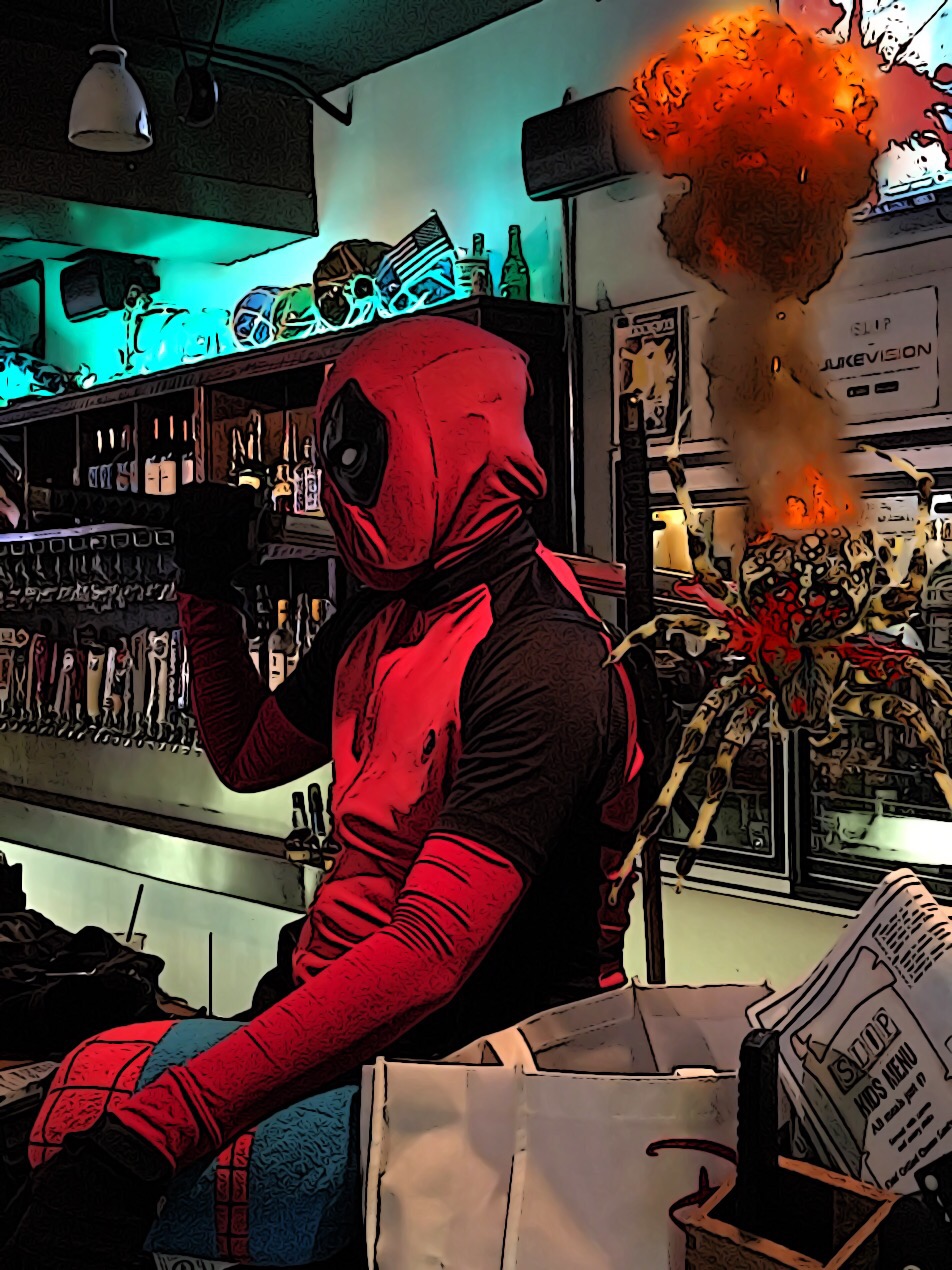
Deadpool, ever one to impress the ladies, dispatched a big spider for Harley Quinn. The barbecue is just overkill…Man!
© 2016 G.N. Jacobs
How many times have we writers heard the platitude write what you know from other well-meaning successful writers? Worse, how often have non-writing suits told this screenwriters desperate to get their work past gatekeepers? To horribly paraphrase from Shakespeare’s Marc Anthony speech, I come not in opposition to Write What You Know, but for which to assert how much weight to give this consideration.
The best answer I can give another writer asking me how to get started is to waggle my hand and say – “Meh!” or “Sometimes, but not always.” – when Write What You Know comes up. In it’s classic form, WWYK deals with research and personal knowledge being the basis for awesome and highly individualized fiction writing. So far so good, a writer plumbs his or her life for subject matter adding tiny little twists to the truth (It is still fiction).
Some of WWYK is really an unconscious process and therefore doesn’t need to be blabbered on about as endlessly as other commenters seem to apply to the concept. It’s like the weather here in California; it’s always a flavor of sunny out here making conversations about the weather mostly redundant. Say it once, hope it sticks and agree in principle without making a promise to read their finished work.
Let’s use my own work as examples. If I don’t undergo refresher journalism training and listen to my instructors justifiably whine about media consolidation, I don’t write Blood & Ink making a leap of metaphor linking media consolidation to bloodsucking. If I don’t suit up for 20 games of JV football in high school, I don’t write Option Right (Part of my collection The Beast that Almost Ate LA), a story described in one Amazon review as a “love letter to football.”
Okay, WWYK has some validity. Now, let’s expand our thinking to include writing where the author absolutely can’t know from first hand life experience about a subject. Genre/pulp writing, which I favor as personal preference, comes to mind.
I have zero chance of ever shooting it out with neo-Nazis in Cairo over the latest appearance of the Ark of the Covenant (snarky aside, neo-Nazis are so much less fascinating than the real thing who are mostly aged out off the planet). Assuming lightsabers don’t completely violate physics now and forever, my chances of lighting up a blue blade and standing shoulder to shoulder with a fellow Jedi to dice up droves of battle-droids or stormtroopers seems awfully remote. Of course, I might be the Jedi to show up to the party with a red blade – “Look, Fellas, my uncle was Darth Anus and it’s a hand-me-down. Less talking, more slashing!”
So how does anyone write stories like these with some believability? Well first off, I don’t really know, because ultimately believable is in the eye of the beholder (aka the Reader/Viewer). I just write trying for believable characters (see other essays and the bottom paragraphs for my thoughts on interesting characters) and I occasionally publish. At some point in the process, we just need to stop second guessing and trust that more positive comments on Amazon, Goodreads and Facebook means more readers found the work believable than those that joined the trolls giving out horse-whippings.
I suppose one method would be to apply sort of similar knowledge to the generally unreal of a pulp story. This would suggest talking to a real archeologist, if only to understand that Indiana Jones would get mugged at every professional conference he might ever attend. To whit –“Doctor Jones, brilliant use of surveying equipment at the Tanis Dig, but I find your subsequent methods highly questionable.”
And the lightsaber stuff might be understandable in terms of the real world equivalent: fencing. I have friends that fence saber. They’ll tell me if I get something completely wrong. In middle school, we had a class assignment where we dug a hole, put crap in it and then tried to decipher the cultural clues from the other team’s hole. We can call this a basic familiarity with real archeology. To be fair, if my story were about a real world archeologist caught up between various rebel factions who unfairly assume that he or she is really a CIA plant, well, this research requires looking into archeology, espionage and just simply reading as many news articles from the proposed setting location as possible.
Especially when the setting goes really far afield like into hyperspace, a theoretical concept hotly debated in real astrophysics circles, the writer will just make things up and go for the all-important internal consistency. Star Trek posits a warp bubble into sub-space at faster-than-light speeds equivalent to the speed of light times the cube of the Warp Factor Number with an upper limit of Warp 10 (a retcon in later shows to better explain the wormhole based Transwarp Drive). Trek captains can fight in warp and generally move in a straight line with modest turns to avoid stars and other astronomical phenomena.
Star Wars posits a separate nearby dimension where the ship enters and doesn’t interact with other ships and requires impressive computing to avoid the same large astronomical objects. Ships don’t seem to fight in hyperspace possibly because except for using the Force to feel Alderaan getting blasted and the use of tracking devices the ship is alone in hyperspace. This holds true with a fleet in formation jumping to the new location remaining in formation, but on the trip in-between each ship seems alone.
Some science fiction properties make use of an instantaneous fold/jump. There is no transit time because it is more dramatically important to move the ships to the star system for the action. Battlestar Galactica 2.0 famously used the fold/jump.
Additionally, my favorite form of hyperspace involves a separate dimension that shortens travel time between known and charted locations, but acts in other respects as a regular dimension in which ships can do many things. The shorter than instantaneous travel time in these scenarios allows for the radar warning of “Sir, the enemy fleet will be here in three days” and ships can fight (usually at their peril) in hyperspace. I describe the hyperspace physics of Babylon 5.
My version of this type of hyperspace adds the fact that outside the ship’s hull gravity is reversed, a black hole pushes objects away from it in hyperspace. I just like the image of surfing downhill in hyperspace to create dramatic tension. It also makes for null spots where the competing downhill spaces create valleys where fleets can hide. This is for dramatic purposes only; I have zero idea how real FTL works, assuming this too doesn’t completely violate physics as we know it.
But, this essay is about WWYK and any discussion of hyperspace and other form of high-energy astrophysics would suggest asking real scientists and those SF writers who started out as scientists their thoughts. If I wanted a little more hard-SF in my storytelling, I might seek out Larry Niven, Jerry Pournelle or Greg Bear and ask them about the high-energy physics that drives their storytelling.
But, here’s the rub, there are other ways to get that knowledge. Wikipedia summarizes most of the important developments in various fields as soon as they happen and does it for the benefit of a Political Science major that barely understands one word in three when conversing with his rocket scientist friend. Perhaps this particular thread shows a little bit of arrogance, but since the pitch on much of my SF writing goes like this – “Julius Caesar meets Prince and the Pauper filtered through the lens of Star Wars” – how much real do I need? Besides, I read books like The Physics of Star Trek by Laurence Krause.
I would probably spend more time on any hypothetical lunches with Mr. Niven, Mr. Pournelle or Mr. Bear thanking them for their various bodies of work, which in addition to being interesting books have also acted as research cheats, perfectly acceptable methodology in a world where we simply can’t know everything. Incidentally, thanking the giants that went before was something I didn’t get to do for Ray Bradbury or Leonard Nimoy, despite two specific opportunities.
When the subject becomes magic over high-energy physics because we intend to bust out a good Fantasy novel, the make it up as we go along factor becomes very pronounced. We live in a world with a very low quotient of observable magic/Divine Intervention. What our our sources? The Bible. A few texts on pagan witchcraft/Druidic practice. The Egyptian Book of the Dead. The similar Sumerian book The Necronomicon. A few stories from the Greeks featuring Hecate, Circe and Athena. A similar amount of Norse stories. And people with the time and interest in other cultures can find the rituals and spells in Native American or African tradition.
Everything else in Fantasy is total fiction/make it up as we go along on the part of writers needing to get through the next page. Tolkien spent more time inventing the two main threads of the Elvish language than figuring out how Gandalf lit up pine cones in The Hobbit. Was it a spell? We certainly didn’t hear what the words were. Or did Gandalf keep a hidden cigar going with which to lit ‘em up? Does it matter to the reader? In my own work, I posited that magic represents either the currently unknown Fifth Basic Interaction (since writing the first draft I saw articles about a possible Fifth Interaction, so is my interpretation of magic the Sixth Interaction?) after Electromagnetism, Gravity, Strong Nuclear Force and the Weak Nuclear Force and that has functions in common with radioactive decay and I moved on.
Fantasy writers also tend to make up their magic rather than go too deeply into the extant “sources,” due to a regrettable trend among a certain small percentage of Christian readers that attack anything with magic based on Scripture. Basing the magic system too closely on what exists in original source books adds the extra animus of you’re evil because you promote things that separate us from God’s Word. Moderate Christian readers gauge the intent of a character’s use of magic to determine Good or Bad. For the purposes of an essay on WWYK, I bring this up solely to mention that magic is a special case where no one really knows anything, except what has passed before in other writers’ fiction.
Buried deep in the above paragraphs, we find my assertion that book learning can and must, in some circumstances, equal our life experience. The books we read are part of our life experience. The point of books and movies is to have things to talk about at dinner parties. However, each project has its own needs for research.
In more prosaic/relatable writing like Crime/Detective/Espionage/Thriller the writer won’t be able to avoid calling up the Police Department and talking to cops (I do recommend learning a poker face in order to keep our current horror about cops and police shootings that transpire under strange and seemingly illegal circumstances out of the interview). Same goes for the Fire Department, you’ll at least learn how to dress for a fire and how to swing a Halligan bar.
Yes, books on these subjects exist, but reading should always be tempered with an in person interview because the meeting will help with character. I consider my longtime enjoyment of the original Adam-12 show with apparently whitewashed portrayals of Officers Reed and Malloy to be a starting point about the LAPD on patrol. My first question in the interview would be – “How have things changed since the show?”
For these “real world” writing subjects, we absolutely need to do some kind of research, both interviews and books. We live in a world two thousand years removed from Sparta where every able-bodied man was a member of the Army and “everybody rows, fuck you very much!” Barely one percent of our population (perhaps 3-percent if you factor in Reserves and National Guardsmen) have ever or will ever fight Terrorism, Nazis, Communists or certain dictators toppled because of oil. Yes, there are books, but the books represent the history of war. The interview will help with the emotions of war, which will, again, help with character.
In contrast, the great majority of us with the modest or even world-beating educational attainment to even consider writing as a career work in places that society considers boring: the office cubicle farm. Yes, there are ways to find the drama in fights over our precisely labeled Tupperware boxes in the office refrigerator and I suspect most writers working with these subjects have Been There and Done That. But, we also like books and movies about the things we will never truly experience ourselves. In one of my favorite small movies about filmmaking Bowfinger, Bobby Bowfinger (Steve Martin) had to tell his accountant/screenwriter to leave the accounting details out of his alien invasion script because the audience simply wouldn’t care, an apparent violation of WWYK (FYI, from the Director’s Cut version on the DVD).
One last note about direct personal experience forming the basis of our books and movies, we can take this too far. Every now and again we get to read gems of Participatory Journalism like Hunter S. Thompson’s Hells Angels or the, for the purposes of this essay, highly relevant George Plimpton’s Paper Lion. I’m indebted to Dr. Gonzo for telling me how to act around One Percenter Bikers (buy beer, be cool, don’t get too friendly with mamas or worse, old ladies, don’t come out accusing them of running the entire crystal meth trade…). Don’t particularly feel the need to replicate the beating Mr. Thompson took at the end of the book.
As for Mr. Plimpton’s book, yes, lining up with the Detroit Lions when they were in fact actual lions is a great thing for the average reader/viewer who never got to play. Perhaps this is my personal arrogance about football (I did suit up for 20 games, see above), but it seems like going to training camp and playing three downs in a game with real pros goes above and beyond what any sane writer should be expected to do for his or her art. Thank you, Mr. Plimpton, but I think we’ll cheat off your notes should we need to tell a football story.
Despite enjoying the books, we as reader/viewers have a tendency to view such stunts in a vein similar to common misconceptions about Stanislavski’s Acting Method. Hearing the silly extremes makes us laugh.
In the interest in full disclosure, I must admit that my “Meh!” reaction to the traditional usage of Write What You Know might come from my absolute luck in the Great Birth Lottery of Life. I come from a large family that represents such a huge cross-section of life that I basically get to cheat on a lot of research subjects. This family over the three generations of whom I got/get to speak with on a regular basis includes: military aviators that flew in WW2, people engaged in a variety of businesses, pharmacists, doctors, various scientists, lawyers and retired gentlemen of property.
Additionally, I have friends, most of whom I consider the family I chose. This list includes more doctors, scientists, actors, musicians and other writers. Everybody has a story to tell that relates to what you know and your circle of friends and family is unique to you. Use the Rolodex or lose it.
Which basically segues us to the one piece of advice that I consider more important than Write What You Know – WRITE WHO YOU KNOW!
At a few points in the above paragraphs, I mentioned that the interviews with cops, firefighters and soldiers while helpful for the purposes of knowledge also will help you figure out the details of your characters who engage in being cops, smoke eaters and soldiers. Meeting them means you sit across from them taking mental notes about the personality behind the knowledge you seek. You now know, however slightly, your interview subject and can try to replicate them (fictionally, we hope) for your great book.
Essentially, my character creation method includes mixing traditional methods like doing the outline: traits, flaws, needs, look, physicality, etc., with using my cheating methods because I have such a large potential Rolodex. I sometimes take elements from people I know and mix them with other traits from other people I know.
Yes, I do have to report the danger of this method of character creation. I really like a family member who happens to be a lawyer and used her as a partial inspiration for a Fantasy character that needed to be a lawyer. I will never be completely sure if her annoyance with the final result surfaced because I captured her too well and put her in a situation where the real woman felt demeaned or if I helped kill the book because I made sure she knew she inspired the character ahead of time.
I believe that writers always filter their associates through the lens of themselves because writing is an act of ego, so get me drunk and talking big and I’d likely assert that it was more that I said she inspired the character that killed the book. The end result, I had my one Truman Capote moment where I faced pissing off someone I like or standing my ground as an artist. I chose to kill the book and move on.
The above example reiterates that capturing your friends too closely might be problematic. This is why I completely favor doing the mix and match approach. That way you as the writer can truthfully say – “Look, this character isn’t really either one of you. It’s a blend and a complete work of fiction.”
But, once an experienced writer figures out the nuances of navigating this method, which mirrors the ups and downs of life, the results speak for themselves, at least for me. I also believe that even if you only use the traditional character outline method that the writer will unconsciously shade the results slightly towards people he or she knows. We have all met at least one version of all types of people and behaviors.
Let’s play a game. Do you know people who share traits in common with Batman? Do you know someone who with a few twists of fate might have ended up as Lex Luthor? What happens when you tweak your father’s personality enough to not get caught plugging him into the Millennium Falcon in the Han Solo archetype? This is what I really mean by Writing Who You Know. Yes, I know people who I would draw on to create, well, the Punisher, if not exactly Batman. Yes, I know people who would inform my portrayal of Lex Luthor. And my Dad as Han Solo makes me laugh, but after my first Truman Capote moment, I’ll probably wimp out or really bury that bit of awesome in traits from other people. I can’t get caught twice.
But, hiccups with trying to be a writer with friends aside, we need characters that are only partially based on ourselves because therein lies stale writing. We keep hearing that there are only six basic story types (or is it fifty?) in all of storytelling. Yet, instead of quitting storytelling altogether because Homer, Shakespeare or Dashiell Hammett got there first, we keep telling stories with the same basic story forms. The difference is new characters placed in these old forms. However the writer gets to his or her new and interesting characters is the right method.
So, I close this long ass essay saying Write What You Know is somewhat important, but Write Who You Know is far more important. But, I’m just a guy going from how I write which is certainly intrinsic to me and may not reflect how you write. At this point, please stop reading me and start writing your own manuscript.
 Smoking Lizard Media