© 2017 G.N. Jacobs

I tell people who care that I’m slowly chewing my way through the X-Files on Netflix to make up for missing most of the show when it was on the air. At last pause to watch other things, Special Agent Muldur just met Deep Throat #3, the woman from the UN. It took me a while to realize that while the show is generally interesting that the writers built in a little bit of narrative illogic so subtle most viewers didn’t and don’t care (I make these observations more than ten years after the show went off the air). In a word (or two): supernatural episodes. 

The show has always been divided into two types of episodes: Core Mythology and Monster of the Week. The Core Mythology is any episode that deals with the fact that a secretive cabal of U.S. Government men discovered aliens in the wake of the Roswell crash and have subsequently made a treasonous deal with those hostile aliens to make a hybrid race in an effort to preserve their families and a small cluster of humanity as slaves. A Monster of the Week episode features anything else the writers could think up to put Scully and Muldur in jeopardy.

Having seen three full seasons plus a representative sample from later seasons, I actually like many Monster of the Week episodes better than the Core Mythology. Part of it may be as a friend put it – “the conspiracy only remains interesting as long as the writers don’t talk about it.” But, the Monster of the Week could’ve been many things: a flock of insects lying dormant in an old-growth tree that should’ve been protected from logging, or a deep-ice parasite brought up from centuries old arctic ice, an intelligent first-person shooter, or a demon hiding in a gypsy boy.

I decided I hated most of the episodes dealing with supernatural themes, not because they weren’t entertaining, but because to my mind they directly conflict with the Core Mythology episodes. In the first season, Fox Muldur participates in a Romani (Gypsy) – style exorcism. He breaks protocol and speaks to the demon when he shouldn’t. The good guys win, but the head exorcist warns Muldur – “be very careful, Young Man, Evil knows your name now.”

But, every time the writers went back to spooks they weakened the Core Mythology because I can’t see how spooks and other things that go bump in the night could share the planet with the aliens coming to enslave us all. For instance, the Romani demon booted out of the boy presumably went back to Hell plotting to return with more guys, so to speak. At what point, do the forces of Hell become aware of the aliens and the plans to steal the demons’ food source (human souls)?

The writers to my understanding never answered the Malthusian questions of the hypothetical competition between demons, vampires and ghouls on the one side and the green-blooded Roswell Grays on the other. They never wrote any episodes depicting a demon having a Mob-style sit-down summit with the aliens. Would they make a deal about spheres of influence and resource sharing? Aliens get the bodies and demons get the souls?

Would the demons go along with the genocide knowing their food source dwindles each day? Would the demons sign an accord with the aliens while plotting to crawfish at just the right moment? Would the demons suck up their ancient hatred of God and all things good and ask for help driving the aliens out to any other galaxy or nearby parallel dimension? How long would that grand coalition where Lucifer and Michael side up together last? Would the demons betray the angels to get a temporary advantage, only to come back when they needed to make nice?

We don’t know the answers to these questions because seemingly the X-Files writers never bothered to think out the consequences of their haphazard writing. They depicted Dana Scully as the scientist with the paradoxical final spiritual fallback point rooted in Protestant Theology. Her Navy officer father dies of natural causes in the second season and appears when Scully lies between life and death to tell her she can’t follow him because she’s not done with the duties of her life. Presumably, Daddy knows by virtue of being of good man sent to Heaven that the aliens are attacking and that key people like Agents Muldur and Scully will rise up like Post-Exodus Israelite Judges to save the world.

There are plenty of narratives that make use of the related concepts of hidden angels and the chosen champion: Highway to Heaven, Almost an Angel, Touched by an Angel, Sleepy Hollow, Supernatural and even Constantine. So, it does make sense that God as depicted in the X-Files would treat the attacking aliens as just one more set of barbarians or Phoenicians at the gates to keep the ancient Israelites honest – “keep my covenant and I shall send prophets and judges to save you in the nick of time. Abandon me at your peril.” However, none of these shows also depicted aliens.

On Highway to Heaven, the angel Jonathan Smith interrupts the President while he watches the 1953 version of War of the Worlds to deliver an environmental message. The angel specifically scoffs at threats from outer space, but asked why the President couldn’t muster up the international anti-alien coalition depicted in the movie to fight the real threat of pollution (the episode aired long before Global Warming became a thing).

So angels might only send forth Scully, Muldur, the Winchesters, Ichabod Crane and John Constantine to do the dirty work of standing up to demons, aliens or what have you, but demons seem to like the sure thing when it comes to a major food source. It is an open question whether the barely sentient human/alien hybrids depicted in the X-Files even have souls. When you medically or genetically suppress the higher brain functions of a clone does a soul develop?

If the answer in the narrative is no, then why would the demons, vampires and other supernatural creatures fail to fight the aliens? If they don’t they lose their food and energy source. But, the X-Files writers never tried to integrate the supernatural episodes with the Core Mythology. They treated the small handful of supernatural Monsters of the Week episodes as placeholders for the Wow Factor.

In a later season after Dana Scully’s mysterious cancer, she meets a bunch of nomadic vampires who are mostly nice people now willing to kill one of their own who isn’t nice. Yet, no one thinks to try recruiting the vampires to help fight the ever-lurking alien threat. Wouldn’t having bloodsuckers at your back help in a fight?

By contrast, Supernatural has been adamant that there “are no freakin’ aliens.” In ten seasons, aliens have only showed up twice. The Norse god Loki (revealed to have started out as the disillusioned Archangel Gabriel) does up a nice alien abduction gag as part of a joke on the Winchesters. The Roswell Gray slow dances with the abductee. More recently, my favorite Greek Muse, Calliope, shows up to eat the brains and narrative of a middle school girl putting on a musical fan fiction show based on the Winchesters’ life. Calliope says “I’m not really here for her play, I mean it has aliens and robots in the second act…puh-lease! But, anything to get at the story of the Winchesters, it has everything…” So even the author and narrative eating Calliope seems to think that aliens and supernatural creatures shouldn’t necessarily coexist in the same narrative space at the same time. Good to know.

Now is there a way to have it both ways for the discerning writer who wants a literary universe fit for all stories? Maybe. I’ll tell you for sure after I write and feed my work to the maybe fifty people who read me right now. If my readers hate it, then it didn’t work. In short, one of my wizard characters will cast a spell that completes the depletion of Earth’s magic in order to save the world from zombies. Suddenly, no ghosts, no demons, no zombies, no wizards and someone will discover the equation that takes Faster-Than-Light travel from a purely theoretical frustration where no one can marshal enough energy to jump more than once to a real economically viable repeatable service. There that’s simply my best thinking on the subject.
© 2017 G.N. Jacobs

“Greg, where do you get your ideas?” 

I sometimes wish I had a dollar for every time someone asked me this question. Yes, my answer is usually no better than a shrug because I know I’m speaking to someone that might not understand that being open to ideas is merely a mindset and muscle. If you use it being the weirdest dude in the room for the majority of your life, watch what happens. It isn’t rocket science.

Leaving aside the “stand back, I’m a professional” aspect of getting ideas, perhaps I can put some observations about ideas on paper to help other writers. Allegedly, the point of the Scribbler’s Saga column. So here goes.

I’m sure that many of you out there must’ve seen Dangerous Method or some other movie about psychoanalysis and just assumed that we as writers go to bed get a fun dream and go “aha!” I’m not knocking the let your dreams do the heavy lifting solution. I’ve used it a few times myself, emphasis on a few.

I had read once the Robert Louis Stevenson came up with The Strange Case of Dr. Jekyll and Mr. Hyde out of a screaming nightmare and promptly got snippy at his family members that woke him up…in the middle of the story. According to the narrative I read, he found his way back to that dark place in order to finish the story a few days later.

Personally, I took that story with a grain of salt because, if true, it unbalances what writing actually is in favor of a cool story that wouldn’t last the minute we face the blank page or blinking cursor. Writing is as much about consciously studying and surgically crafting as much of everything as we can. How much of Mr. Stevenson’s seminal scary dream actually survived to the second draft?

For a modern writer, how much of that dream gets shafted by the need to apply the lessons of the many books that teach us to tell a story, or at least a certain kind of story? Did your dream place moments that the late Blake Snyder would recognize as Act Turns, Fun and Games, the Midpoint or The All is Lost Moment in places that were slightly out of their traditional slots? If so, the writer then either edits out the extra stuff or he or she decides that a page or two of imperfect lumpiness actually makes the script or manuscript interesting and further edits will be someone else’s problem.

I’m not always sure how much actual story lives in our dreams. I tried to milk a sweating nightmare where I fought demons and woke up just before getting strangled by Beelzebub, I think, for a college writing assignment. I still got my ass handed to me on the readability of that pretentious story. Why? I was eighteen and didn’t know what I know now.

I’ve found the narrative usefulness of my dreams to be about cool images and juxtapositions of those images. The most vivid recent dream that cut through the fact that I stopped writing this stuff down a long time ago involved guys in orange flight suits that I instantly associated with X-Wing pilots, though I think their helmets were rounder like football helmets with the face masks removed. That and I saw a field of what I assume to be magic mushrooms at my feet. Nothing about that I spent the rest of the dream yelling at somebody about a missing story element, a thread since lost to the ether the minute I woke up.

I do better when I’m conscious and ready to rock and roll. There is still a element of subconscious psychology at work, but less pronounced than the cheaty-head method Robert Louis Stevenson alleged where the dream wrote the whole work for him. I have several personal case studies from different works with similarities and differences.

TALL FIRES AND LADYBUGS – this upcoming work involves a young lady much like Paris Hilton who has been pushed by her mother into riding a flesh droid as a firefighter in order to gain life experience different from being a billionaire trust fund baby. Essentially, I binge watched Rescue Me and simply had an epiphany. Now to be fair, the flesh droid part of the story is a total borrow of Joss Whedon’s Dollhouse, but with a little bit of the “more of the same, but with a twist” storytelling sensibilities we’ve come to expect from the average Hollywood gatekeeper.

There is more to this story in that you’ll notice the bit about the mother. That’s relates to my personal life and my previous suggestion to you that you should Write Who You Know. Tiger-moms, to steal a buzzy phrase, show up in my work in all their glory, whether nice of massively difficult, quite a bit. That personal hint is all you get out of me without buying beer, then I’ll temporarily mistake you for a good friend who wants to hear my shit.

But, getting back to the firefighters and flesh droid story. What might this example teach you? Watch TV for sure, just like you should also read books for different reasons perhaps. But, watch with an eye towards using the blender approach, aka the Player Pitch. Listen to what this pitch actually is…Chicago Fire meets Dollhouse. Right to the point about flesh droids and more than enough fire for the average literary arsonist. Buy me beer and I’ll tell you why the pitch isn’t Rescue Me meets Dollhouse or why I don’t want to go with the original title – Ride Along.

SMOKING LIZARD-VERSE SPANDEX-HEROES – My spandex characters exist in their current unformed state in a version of Los Angeles due to several instances of figuratively and/or literally yelling – “you got it wrong!” – at the page or screen. I watched Wanted and hated the movie for the same reasons I might hate any comics to screen adaptation, indifferent care taken with the source material resulting in stupid. I hated the graphic novel upon trying to read it because it put me in a foul black place.

So I started writing a set of spandex characters based on my belief that, at least in stories, Good and Evil seek equilibrium with each other. That the absence of spandex-heroes can only be a temporary state of affairs eventually rectified by an accident of the same Chaos Theory that set loose all the dinosaurs in Jurassic Park. And that an absence of spandex-villains means Batman needs to retire and settle down with the latest trophy girlfriend. Yeah, once I get these characters into better shape I need to thank Mark Millar, even though I might not want to. And then I just didn’t like how old-timey comics books handled Los Angeles when originally written from New York.

This example teaches us that the things you don’t like can spark a good idea.

MONSTER REALITY SHOW – Where did I get the idea to put monsters on a highly competitive reality show for the right to scare people, possibly including a certain Orange President? I cracked wise on Facebook and wrote the good bits down in my note taking app, One Note. A well-regarded TV actor that might make the jump to out and out film star depending on how his talks to join the Marvel Cinematic Universe go commented to several entertainment news sites about his love for Dungeons & Dragons, even to the point of writing a script. At some point in my supportive but snark filled comments I ask how a Beholder, a very iconic D&D monster, got that way including “did he beat out the Mind Flayer on Monster Got Talent?”

The offhand comment leading to a lightbulb happens all the time for me. This is why note taking apps exist.

While I’m here on Monster Reality Show, it also represents an example of idea creep. The minute that the object of winning the contest becomes about sticking it to Dried Orange Peel Man the next question about monsters doing their patriotic part to discomfit that man should be wouldn’t Abe Lincoln’s ghost corner that market? So now I’ve expanded the story into an automatic part two where the winner then plays knuckle poker with Honest Abe over who tortures Cheeto-lini the most.

Expanding the idea is not necessarily good because a journalism teacher once plaintively reminded me that articles “are about one thing!” The reality show is one movie. The three-way throw down between the monster, dead president and current president is one movie. Putting both together ruins both unless I’m somehow Stanley Kubrick doing Full Metal Jacket.

And so now we come full circle to the truth that just because I got a brilliant idea doesn’t mean the story will be any better than the product of a hackmeister who cynically starts from from a Blake Snyder beat sheet and hopes something good will come of it. I still have to figure out, for instance, how to incorporate X-Wing pilots with magic mushrooms without it being too much like this moment from Heavy Metal – “the trick to flying on Nyborg is you got to know your perspective is farked and you just got to let your hands drive like you’re sober.” It is what we do with our eyes open facing that cursor that defines our work, the funky dream is just a bonus.

Ideas come from all over the place and land on the people who did a little bit of the same thing yesterday (aka experience). We crack wise and feel aha! We wake up from. We force ourselves through that ugly date scene and get a completely different idea that goes onto the list so we can keep typing. And when all else fails I roll dice and consult writing flip books and apps, but that bit of cheating is the subject of another post…

© 2017 G.N. Jacobs

I wasn’t going to comment on the recent version of Ghost in the Shell, especially so soon after using this column to suggest a simple in hindsight script doctor fix for Passengers. The highfalutin point about allowing art, even that with which we don’t agree, be has been made. The second point that we should treat artists better to forestall the ugly day when after getting the shit beat out of us by our very customers we quit and cede the field letting a certain fat and evil Orange Peel Man win in the absence of all art…been there, done that as recently as last week. Basically, I didn’t think I had a fix to justify inclusion in this writers’ column. Give it a day… 

So the problem. A sci-fi movie given the live action treatment needs at least $100,000,000 to convince filmgoers to come out instead of stay home and dig out the original anime. Hollywood being what it is needs a white actress to lead the movie or the suits will stay home and dig out the anime…taking their checkbook with them. In the course of needing to explain how a white actress played what might be interpreted as an Asian role, the story on screen decided to come up with a convoluted deal where Major Kusanagi was a white looking asskicking fembot who didn’t know her human brain started out as a Japanese girl murdered as part of unethical cybernetic experiments. In 20/20 hindsight, expect to roll tape on the shrill racial outrage.

Now, there are other, so far unsuccessful, ways to argue that the butthurt among us should’ve just chilled out, treated this movie as a flawed artifact and given it a chance. I tried on Facebook to remind people that Japanese animators don’t actually draw verifiably Japanese women in anime. I tried the “it’s science fiction set in an era when people have become post-racial,” argument. And it didn’t work, because the butthurt don’t listen to rational argument, but also because the story chosen really is a convoluted mess that actually gives me a tiny bit more sympathy for the anti-whitewashing position, at least in this case.

Don’t get me wrong, I’m agreeing with the detractors more because the perceived racist story solution is also the clumsy and inarticulate solution. But, hey, we put up with the Soviets for three and a half years knowing Russian bodies backed up by American bullets would kill a lot of Nazis. I hate clumsy. We all hate the racism underpinning whitewashing (I just don’t let it get in the way of experiencing art). Allies…until they improperly go off on the next butt-rash inducing movie.

So how would your humble unemployed script doctor fix Ghost in the Shell? Eliminate the whole “started out as a Japanese girl firing off sharply worded manifesto blogs until kidnapped by the evil robot building corporation” origin. Yes, it’s just that simple. Major Kusanagi was always white, even as a human.

“But, Kusanagi is such a stereotypical Japanese surname,” you might comment, “we really should explain this oddity.” No, actually we don’t. The less elegant variation of this solution, say nothing and trust in the imagination of the audience, could work. This is the same trust that stage impresarios show when they decide that the ticket sale value of James Earl Jones playing Lear far outweighs the inevitable – “But, isn’t King Lear a white dude?”

How does that play out on stage? No one changes Shakespeare’s words. James Earl Jones shows up and plays the hell out of the role without resorting to a ridiculous white-face makeup job. They cast Cordelia and the other sisters according to whoever walks in the door with the best auditions. Maybe people discuss the oddity for a few minutes over dinner, but then they talk about how James Earl Jones made them feel. A workable but inelegant solution in the case of Ghost in the Shell.

My solution. Major Kusanagi starts out as an orphaned white girl washed up on the unnamed, but presumably Japanese shore. Madame Kusanagi falls for the little girl and takes her home adopting her. Later, the temporary argument leads to a runaway situation where a beloved daughter never actually comes home.

I really like this variation of the use black highlighter to the script solution because of several factors. First, it fits the theme of the movie better, where the movie defines the struggle of the individual to stake out a claim to our singular humanity in the face of technology that, when used improperly, debases us. In a movie where evil robotics corporations just grab their enemies off the street to harvest their brains to run lethal fembot shells, you don’t need to clusterfuck the story with excessive reliance on racial gymnastics intended to explain how a white woman is named Kusanagi.

Yes, in the real world the answer to that mess lies in the paradox of the white actress funds the movie, but you can’t change the character’s name because you can only go so far before your movie stops being recognizable as Ghost in the Shell. A “she was adopted” solution works even better than the “say nothing and tap dance” solution. Why, you ask?

One thing that it will take to evolve our society into anything resembling the post-racial tropes of most good science fiction is that we’re going to have to get over ourselves when it comes to cross-cultural adoption. In the hypothetical case of Madame Kusanagi seeing a lost little girl for the first time, she becomes a mother ignoring stupid white people arguing for cultural purity at the expense of the wisdom closest surrogate mother willing to take responsibility gets the child. The Major picks up the Kusanagi surname because parents name their children usually based on patrilineal descent.

The foundling makes good as a literary trope goes back a long way. I’ll have to reread the Bible again to see if Moses got his name from his Jewish mother or the Egyptian princess that found him by the river. In this case, adoption artfully cuts out much of what fell flat about the movie, even for me.

No Japanese actress hired to play the Major’s human incarnation in blurry-face. No nasty, if unintended (we hope), digs about whiteness being better. No excessively convoluted story messes leaving the viewer asking WTF?

This clumsiness in storytelling basically helped the story find the worst possible way to unfold. It insulted people who would’ve otherwise found another movie to wipe their asses on hoping to heal their permanent butt-rash. And it just confused the segment of the filmgoing population less likely to care by taking the long and dumb way to the end.

By contrast, how are post-racial elements supposed to work in science fiction? Very carefully, you can still screw things up. But, just do it and don’t telegraph it might be a plan.

My favorite modern show, Babylon 5, had two examples of interesting casting choices that bear relevance here. In the episode “War Prayer,” show creator J. Michael Straczynski needed a racist anti-alien man named Roberts. They cast Michael Paul Chan, an Asian-American actor. Similarly, in “Voice in the Wilderness Part 1,” the casting call went out for intrepid Interstellar Network News reporter Derek Mobotowabe played by a white man, Langdon Bensing. Yeah, this one still raises my eyebrows imagining that fictional man’s genealogy how he ended up with what sure sounds like a Swahili derived name.

Neither casting choice was predicated on stupidity like – “okay, we need to explain how the Major will look white but have a Japanese name, because unlike theater audiences that can still use imagination to work out whatever they like about her backstory we assume movies audiences are stupid. Therefore, we’ll do some Frankenstein style brain and body switching between a Japanese actress and ScarJo!”

I might diverge some from my temporary allies over how much weight to give the racial whitewashing aspect of this narrative lead balloon. I think it’s bad, but shouldn’t have detracted from the larger themes of humanity in the face of corporations willing to crush everything for profit or to simply ruminate on the nature of humanity itself. I would’ve preferred that Ghost in the Shell’s many enemies didn’t freak out and go for the pious boycott missing out on a valiant attempt at a theme.

But, when the racism is also clunky, convoluted and predicated on assuming your audience is so stupid that we needed a narrative element we really didn’t ask for, you just lost me. So I will close suggesting those suits left holding the bag on the debt to remember to smile at the bank.

© 2017 G.N. Jacobs

Now that Paramount’s Passengers has safely moved into home video, I think we can say the movie needed a doctor. Two of them, in fact, an extra autodoc machine and, more importantly, a script doctor. 

A quick look at Box Office Mojo says at approximately $300 million the movie eked its way just barely into the black. This assumes a reported budget of $110 million and a longstanding rule of thumb to double the reported production budget. And the IRS will be told the movie tanked due to studio accounting shifting general operational expenses onto the movie’s ledgers.

One possible answer to why a film about passengers on a sub-light colony starship who wake up early, have a relationship, break up and get back together in order to fix the broken ship got kicked in the teeth: politics. Another, to be discussed in later paragraphs, is that the story needed another go around with the many script doctors that help keep the Hollywood engine going. And it’s nearly impossible to separate the sign of the times political vitriol from the fact that really good script doctoring solves both the pseudo-politics and the story issues of a movie.

Before we go further, I’ll briefly repeat my pro-Free Speech, pro-Artistic Expression, anti-Vitriol approach to art. Yes, art can and sometimes should make the viewer angry. But, the worst people who light up social media seem to lack the awareness of context for why the art came out the way that it did.

Was the artist deliberately playing Devil’s Advocate to provoke a response and discussion in a way that uses a negative example to teach? Was the artist merely going with the inertia of 150,000 years of human storytelling that echoed the Men Rule tropes of society as a whole?

Are those storytelling tropes highlighted by nearly every How to Write a Story book in our literary marketplace truly as psychologically immutable as claimed? And if the storytelling tropes described in Blake Snyder, Syd Field, Robert McKee, Robert Bly and Joseph Campbell are deemed immutable, either because of genetics (in our DNA) or epigenetics (the related science of how biochemical triggers change how DNA expresses itself: on or off), does this mean that any well meaning attempts to change how we create art that don’t take into account the factors are doomed to fail because the consumers will simply reject things they don’t understand?

I don’t have these answers. No one does really. We live in a global society where the few name-value rock star scientists are almost all astrophysicists. A class of people who just aren’t going to take ten years away from measuring universe expansion, dark matter and string theory to really go everywhere in the world with the intent of telling us if Joseph Campbell, Robert Bly and the rest were, in strict point of fact, full of shit. There might not be enough math in this field where people basically read a lot of books and create PhD level compare and contrast essays between two ancient literary properties.

I try to forgive art of which I might not fully understand or approve. Yes, forgiveness, a nasty word largely associated with male-dominated Christianity, but of which clearly everybody needs more. And understanding. You get the idea. It is this perception that I should take the time to experience new art trying to understand as much underlying context as possible, while speaking to the artist as a human being, well, that’s enough to pick a fight these days.

So anyway, the politics of Passengers. Nearly every script leak and advanced showing allowed the angry among filmgoers to bore in on one key story element; that Chris Pratt’s character when faced with the kind of crushing loneliness only really cinematically experienced by Bruce Dern’s character in Silent Running and Dave Bowman in 2001 woke up Jennifer Lawrence without her consent. Social media blew up with shrill cries of Rape Culture and a rejection of the decision of the female lead to forgive the man that woke her up. There are refutations to most of that noise that I’ll leave aside in favor the movie needed more development that likely would’ve solved this problem and made the watching experience better.

No, the solution is not rewrite the script so that the woman wakes up the man in order to save herself from drowning and then fix the ship. Yes, I’ve heard from a few people, some women included, that the simple role reversal ploy would’ve meant far less online vitriol because the loud and angry segments of progressive viewers would be okay with a woman acting badly instead of a patriarchal man. Which frankly just exposes hypocrisy and a double standard that doesn’t represent improvement for women if her gains come at the expense of the men and is likely to just cause a violent retrenching back in favor of men at a later date (the pendulum theory of society).

Eventually if an evenhanded society is deemed important, someone has to reach into the pit at the risk of losing fingers on the wire to stop the pendulum. Or the observer could wait for the swinging to stop on its own because even as a sociopolitical metaphor there is simply no perpetual motion with pendulums or any other devices. A fancy way to say it should be as equally unacceptable for the woman on the ship to allegedly wake up a man without consent as the shrill cries about Chris Pratt’s character.

In both cases, the character that did the waking up should be judged the same way with potential mitigation coming from that these actions actually saved the ship and thousands of blissfully unaware passengers. The moral balancing act between the forcible wake up and saving the ship is a nuance to this story that I don’t feel those that chose anger give full credit. And the lazy methodology of a simple gender switch doesn’t solve this underlying problem.

So how does one go about fixing this movie so that it’s empirically better than an average relationship movie on one side and a politically charged nightmare on the other? Double down on the mind bending science fiction by enhancing story elements that already exist on screen but were curiously not explored…steal from 2001 and make the computer the agency driving the movie.

Chris Pratt wakes up because of an apparent glitch. But, was it a glitch? The character is described as a plumber/handyman traveling to the distant colony world on the economy ticket. He is exactly who an intelligent ship that knows it just took a cosmic bullet and may die killing thousands of helpless people in its care would wake up in a cry for help.

Jennifer Lawrence could then be woken up because the ship simply acts like a dating computer and matches the man to the best possible woman on the ship. The AI doesn’t want her chosen repairman to go crazy from loneliness. So she makes an executive decision to wake up the three people most likely to save the ship. The handyman, the helpmeet and Lawrence Fishburne as the engineering officer who provides two functions in the story, he checks the handyman’s homework and mediates the dispute. In my hypothetical rewrite Lawrence Fishburne’s character would also serve a third function, to point the other characters towards the computer as the entity behind their vastly changed lives driving the film to the end.

My solution to this problem created by loud pseudo-politics would on the surface actually make the story less dramatic. Movies are asserted by the late Blake Snyder in Save the Cat to work according to the same fifteen beat structure, so once the type of story is chosen by the writer the beats become clear. Basically, the woman learning the truth about waking up at the man’s discretion acts as the Third Act All is Lost Moment intended to create obstacles for the characters late in the movie. If she’s angry about waking up she might not help fix the ship.

My solution adds another wrinkle of the intelligent computer wakes up the woman, but contrives to make the man think he’s responsible. He was depicted as being nearly out of his mind with loneliness; it would be easy to get him to believe he pushed the Thaw Button. Lawrence Fishburne’s character could find curious clues to the ship’s sentience before he dies leaving breadcrumbs for Chris Pratt and Jennifer Lawrence to forgive each other, fix the ship and confront the ship for screwing them over.

Yes, these fixes solve the political outrage expressed at the movie, but they also give the audience a more impactful experience. The story would rise from an average romance to a cool twist ending where the ship is alive. A better reason to play script doctor.

Sadly, these story elements were never fully explored and so now I’m a crank with a pet methodology to fix things. But, I also bring it up to nudge some of us writers towards getting paid for fixing movies that other writers couldn’t because of a failure of imagination. If attacking films for political reasons is the new normal, there will be lots of jobs for script doctors.

© 2017 G.N. Jacobs

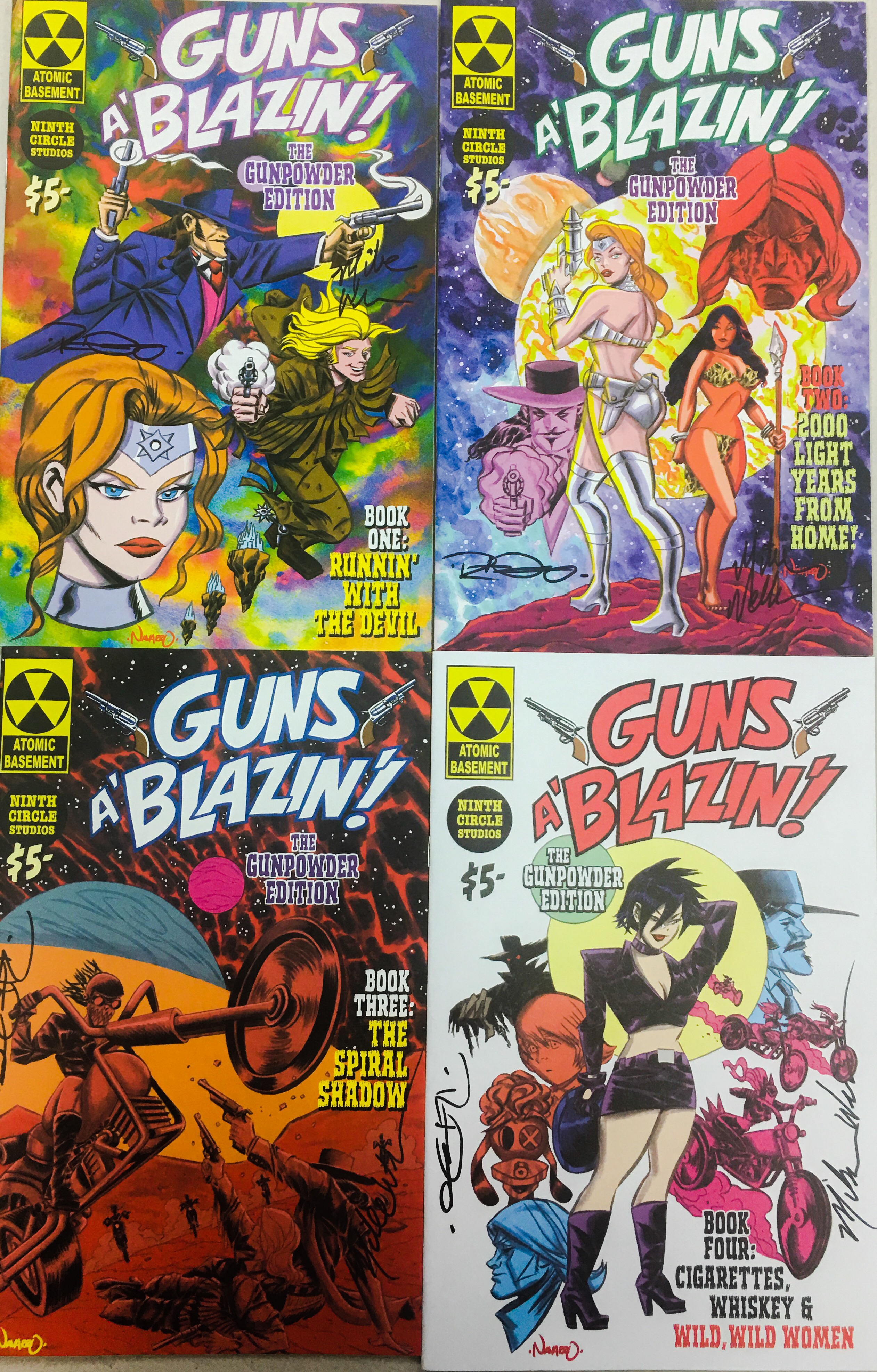
The pull quotes on independent comic series Guns a Blazin’ might go something like this…ah, never mind, why spoil the memory of a fun read with something as cheese-tastic as single word pull quote adjectives? Besides, even just thinking the words pull quote sparks an idea better hunted down and killed elsewhere, another observation for my as yet mythical Ideas post. 

So anyway, I buy, have signed and just now read the first four issues of Guns a Blazin’ following the haphazard time travel adventures of Eddie and Kody. I ended the reading session nearly busting a gut laughing. And I got caught looking at the various fictional ladies in this story for whom bikini defines daily attire. The point, I suppose and one I should expect from friends that grew up watching the same TV and movies as I did.

Indians attack a frontier fort. Blond haired Kody Willis, probably a cavalry scout from his civilian trail clothes including union-mandated duster, runs to wake up his buddy, Eddie. The dark haired man that looks so much like artist, Rafael Navarro, that I know I need to ask, just to save up for a bit of friendly teasing, wakes up. A quick scan of the horizon shows attacking Indians, no problem. Finishing the sweep puts several creatures of the large, hungry and really shouldn’t be in a Western tale variety firmly in the scope. If I had to guess, Rafael went for something like how Ralph Bakshi drew orcs for the first time around with The Lord of the Rings crossed with the Green Goblin. Even more worrisome than these troll-orcs, Eddie sees a familiar redhead in a metal bikini on a flying disk, Domina.

Eddie and Kody are forced to leave the fort to its fate especially after seeing the troll-orcs smash the old-timer manning the fort’s lone howitzer. Facial expressions tell the reader that Eddie and Domina have a bit of history of the ‘he went out for pizza taking her time machine with him’ sort. Thus begins four and soon to be five issues of a fun time travel story with a garnish of an unapologetic Y-chromosome knucklehead buddy picture.

The highlights: a visit to Dinosaur Time where Kody falls for a brunette in a leopard print bikini, later named Myra. Eddie gets Myra’s father drunk to facilitate the night of passion. Myra trades on Kody’s genuine affection to request aid attacking an otherworldly installation intended to rain asteroids upon Dinosaur Time. Eddie distracts Domina sexually while Kody and Myra escape the slave collars and together they reverse the asteroid magnet.

Eddie and Kody jump forward in time, heartbroken that something that the boys couldn’t or wouldn’t do for Myra kills her in the jump. And then with Domina chasing them angry that Eddie consistently seduces her and books it out of there before she can restore his damage to her grandfather’s grand plan for the timeline, the boys land in a wasteland. Said wasteland is revealed to be an inter-dimensional dumping ground for a former time traveler, now known as The Void, drawn as a male force of darkness. Eddie and Kody land in the laps of the ladies of the Hell’s Belles, a One Percenter Outlaw Motorcycle Club for women representing the last gasp of regular people. The Void approaches…

In a way, I’m kind of expecting Guns a Blazin’ to fall into the hands of someone who is not a fan of Y-chromosome Knucklehead Adventure Fiction. The hypothetical political screed disguised as a review would define savage in Webster’s Dictionary and possibly the OED for at least six decades. All because my friends wrote and drew a Two Knuckleheads with a Time Machine Loose About the Cosmos Among Bikini-clad Women Story. Luckily, I’m a fan able to see an innocent throwback and judge according to the small details, not overarching pseudo-political concerns that don’t let people have fun.

Pretty much the four issues, so far, do a really good job of channeling writer Mike Wellman and artist Rafael Navarro’s collective sense of boyish adventure. It’s a simple idea, to give two knucklehead types the local equivalent of a TARDIS and set them loose on the timeline. And throw beautiful bikini clad women at them as part of the dramatic obstacles.

Both guys are, in strict point of fact, knuckleheads. Kody the cowboy with a heart of gold is the knucklehead intended as the Everyman Foil, an obvious metaphor that in the face of the advanced mathematics and high-energy physics of time travel everybody is the lunkhead cowboy. And Eddie, or Eduardo if you please, is a different kind of knucklehead. The kind explained by this question – “why is a guy with the ability to run the, as yet unseen, time machine on the run from his ex-girlfriend, Domina, while apparently being unable to fix the already damaged timeline?”

To be fair, much of the answers about Eddie are yet to be revealed by the story, after all it’s not like there isn’t anyone left in comics who hasn’t read the choice of Blake Snyder, Syd Field, Robert McKee, Joseph Campbell (or his literary descendants) and Stan Lee. Knowing the books we read, I can make loosey-goosey guesses about the kind of events to come. But at the moment, the reader is too busy riding shotgun with the boys to worry about when Domina, her mysterious grandfather, or Eddie himself will use the events to come to illuminate the why of the story. Mr. Wellman asserts that he just recently locked the script for Issue Five teasing out more of Eddie’s backstory. Stay tuned to this Bat-Channel!

Speaking of Bat-Channels, I think Mr. Wellman’s real strength in his scripting for Guns a Blazin’ is his masterful pacing and use of the last page/panel as a cliffhanger leading into the next book. As we left it, because Misters Wellman and Navarro can’t write and draw the books fast enough for readers, the Void approaches after testing the Belles’ defenses. We could just as easily say Winter is Coming or next week we will see if Batman and the Boy Wonder will defeat the nefarious Joker and straighten out those crazy Dutch camera angles. A long winded way of saying, yeah, we’re dealing with a professional at teasing the cliffhanger for next time.

Another thing in the plus column is that Kody and his interaction with the still enigmatic and roguish Eddie really goes a long way towards creating empathy for these lovable knuckleheads. Kody expresses an uncharacteristic, for this kind of throwback fiction, genuine affection and respect for the cave girl, Myra. He wants to stay or bring her along over Eddie’s experienced objections. Pretty much, this sweet intent to avoid being a stereotypical bed-hopping cad on Kody’s part will have to serve to mollify the anger likely to spew from the hypothetical screed disguised as a review should the expected angry non-fans read this series. There is only so much that any book can do to chill out the hordes of party poopers and nothing that’s possible once the ink dries.

This affection for the boys allows readers (me at least) to simply not worry about the small things. When introduced to Kody running for the sleeping Eddie during the Indian attack, he speaks with words I associate with a later timeframe in our common spoken lexicon. Shouting incoming and man gives the initial impression that Kody might be the time traveler, not Eddie.

Now, am I an actual expert on what people of 1881 said or didn’t say that isn’t polluted by watching too many Westerns? No. But, these pages do feel like Kody might have originally come from any time after 1900 and the regrettable mechanization of war. Kody’s spoken dialect drifts back to a more accurate personal lexicon over the course of the four books, especially as he expresses his lingering anger towards Eddie for his Try It and See What Happens response to the question of bringing Myra through the time vortex.

Regrettably, this review is quite writer-centric because…hello, writer! While I’ve dabbled in photography and photo-manipulation art, my ability to comment on Mr. Navarro’s art is limited to “nothing strikes me as overtly wrong about the images” and get ready for a style somewhat like Oeming’s work on Powers. You’ll like the art or you won’t; I do given that Mr. Navarro has done some interesting caricatures of me and my character creations (I’m pretty sure the tone of this post has already given away I’m pals with both guys).

So basically, we have a fun (if your worldview allows this kind of fun) time travel romp that makes no apologies for being what it is with minor flaws likely only to tweak the professional ear of someone like me. I’m waiting with baited breath to see how the creeping male pseudo-zombie army gets soundly trashed by the ladies of the Hells Belles MC assisted by two knuckleheads who have the classic We Should Help decision to make. The Void is coming! Winter is Coming! And stay tuned to this Bat-Channel!

Oh, and if you really want single word pull quotes for the poster, there are a bunch littered throughout. I don’t have to make it easy, though.