© 2017 G.N. Jacobs

Themyscira. I had to look up how to spell Wonder Woman’s home because I sometimes transposed the Y and I. Mostly, my reverence for Diana Prince suggests I really need Themyscira programmed into my iPhone. As you will see from the accompanying picture I discovered that it usually takes four repetitions of a completely new word to tell your device to thoughtfully provide the word as one of your three options.

And it being a slow news day I got to thinking about the words we use over and over doing our thing as writers. Words that are for the most part are safely ensconced in HAL-phone’s autocorrect feature. And to speculate about how this feature works.

Another word that I bitch-slapped into both versions of my iOS autocorrect: Gröpen. Anyone reading my Facebook posts pretty much knows I didn’t vote for a certain orange president. Allegedly, due to the constant and tiresome repetition of the latest assclownery, I have retrenched from bashing Cheeto-lini (ask me in 2020 if I was successful in restraining my social media to the acceptable classes of post: here’s my link, funny video Man and teasing a friend). Somewhere along the line I fell into the verbal habit of replacing his proper name with Der Gröpen Führer.

Naturally, HAL-phone has Gröpen plugged into the autocorrect helpfully anticipating that I want to bash said Orange Peel Man one more time. Führer. However, for some reason autocorrect doesn’t seem to want to plug in führer, neither in the normal upper case proper noun usage or the lowercase noun loanword from German. Fuhrer. Fuhrer. Nope, autocorrect isn’t spitting up any version of this ugly word that used to just mean leader without watching people’s faces cringe with bad memories now seventy years removed from direct relevance, but still scares children.

Possibly, Apple is doing what they can to keep me, a hopefully valued customer, from getting fucked when the mostly leftist and centrist forces of The Anybody but Der Gröpen Führer Camp regains a congressional majority. I’ll take my chances on satirical and derisive context. However, Apple also probably wants to avoid a lawsuit.

Writing purists frequently piss into the wind about “don’t trust your spellcheck, autocorrect to do everything.” If you’re talking about the last draft before Print (Post actually, I did sort of move into the 21st Century while I wasn’t looking), this is my Agree Face. We call this Proofreading, Ducky. But, given that I write this with headphones in doing the delicate toe dance between focusing my words and justly going deaf as legitimate battle scars while finger tapping on a five-inch phone, nearly the slowest way to do this job, I figure some accommodation with HAL-phone’s autocorrect defines inevitable.

Many of the commonly used big words in this piece pop up on a Tap Four Letters and Choose basis. Autocorrect comes up after five letters because the Auto prefix gets used all over the A-section of our dictionary. But, repetition tends to teach the device to get better guessing which words I actually (three letters) use.

What I can’t fully grok (Gröpen just showed up) is how the autocorrect decides in which of the three cells, Left, Middle, Right, my desired word will appear. Sometimes it seems that the Left cell represents the word as exactly as I tapped it, but after that I don’t know the criteria for Middle or Right cell placement. Don’t really care once I put this post to bed.

Autocorrect also tries to be helpful guessing usage involving apostrophes and plurals. Something about the interplay of font, writing app and whatever tends to suggest that autocorrect will give straight up and down apostrophes and quote marks, when the same Word font on a regular computer automatically gives you the font specific curved marks automatically. When I use this same app (Mobile iOS Word) on my iPad with a Bluetooth keyboard, proper punctuation is automatic, so just a quirk of finger tapping. However, this is reversed on Final Draft Mobile where iPad typing gives straight marks, but tapping on this phone allows you to hold the button down and choose the font specific punctuation just like with Word.

Okay, so I’ve gone around in circles highlighting the quirks about how my autocorrect (three letters, repetition) works. At this point I just want to type rude and other odd words specific to my writing. An adventure…

Lightsaber (five letters). Yeah, I’ve already trained HAL-phone on this one. Skywalker (three letters). Same thing. Darth (two letters, right cell). Hydrolysis (six letters, right cell). Assclown (two letters, but it comes up for the more common asshole).

Batman (three letters, middle cell). Green Lantern (four letters on Lantern, helpfully capitalized). Now for the killer from DC, Mr. Mxyzptlk, Mr. Mxyzptlk, Mr. Mxyzptlk, Mr. Mxyzptlk, Mr. Mxyzptlk…okay, perhaps the intentionally unspeakable name for DC’s trickster imp is equally impossible for autocorrect. If I’d said his name out loud, I’d be really screwed, a race between Beetlejuice and him arriving first. Maybe, I could sic these comes when called characters on each other and slip out for beer?

Shit (didn’t want to come up). Fuck (finally got fuhrer in the middle cell). Dick (no). Piss (no). Okay, time to wrap this up; I don’t have Tourette’s (autocorrect overridden to edit out the straight apostrophe). I don’t get to spew out lots of dirty words beyond their sell by date and pretend to be professional.

So do you feel improved as a writer dorking around with my autocorrect? I told you it was a slow news day.

© 2017 G.N. Jacobs

I used to poke a little fun at Southern California café and coffeehouse culture where everyone has their tech out and furiously types what we hope is the next great movie. Then the first time I got ants in the pants stir crazy and went out to find a not home place to work, I became what I beheld and convinced myself I had done right. Neither Argentina nor Los Angeles should cry for me with the related First World problems of – Does coffee help me write? – If so when do I stop on any given day to balance out any gains to completion against pulling my shirt over my head and doing a Cornholio? – Lastly, where do I go to get caffeinated and get my words out? 

My enjoyment of coffee isn’t just a new thing because I now seriously give a damn about writing novels, comics and screenplays. A sister in law commented a while back giving me a set of glass coffee glasses for Christmas that no matter whose house I visited I might be first in line for morning coffee. Back then, it was because it was the holidays and someone else with more knowledge of The Machine made the stuff for me. Well that’s still a thing, but also these ladies probably don’t want me using their kitchen tools to begin with.

With each episode of put on some pants and treat a few hours of your writing day as a job the average writer can wind up in a library (post to follow, whenever), a coffeehouse, or a regular food place. I’ve never been able to steal more than a few sentences in a restaurant because the anticipation of a nice meal gets in the way of deciding whether Luke Skywalker should throw a hard elbow or kick somebody in the nuts. Scratch restaurants.

I suppose I didn’t get into library writing at first because the nice lady at the desk might get sniffy, even if the liquid in your container is water. And God forbid if your earbuds are up a little higher than Miss Tessbocker thinks is proper. On the plus side, libraries are like study hall, productivity central.

This leaves coffeehouses. Make no mistake, I would like to blame my coffee consumption on the coffeehouse that astutely knows they can withhold the WiFi password until you buy a cup. No, not really, coffee is a choice and conscious act. I like having the ability to reach for coffee with my left hand and absently swill as I type.

I can’t say that coffee helps me type in any meaningful way. Many things are all sympathetic magic and psychology, you convince yourself you need a cup and your earbuds on something cool to get rolling. Ergo, gimme my frakking cup right frakkin’ now! But, I do well when I’m elbow deep in it with my trusty mug.

There is a cost to coffeehouse coffee and nibble food, just like you pay extra for the privilege of having other people fix your food for you anywhere. It builds up and so very recently I stopped letting relatives and baristas make coffee for me buying my first coffeepot. So now that I’ve figured out grounds go in up here, water there and flip the switch to allow for at least a little coffeehouse writing at home on my couch, from where I originally had to escape.

There are, of course, the usual health concerns about caffeine. Some sources come out really opposed, bad for your heart. Other sources say what most people say about many things in our diet: moderation, know your personal limits and get support group/psychological help if you don’t. A small few sources are completely pro-coffee.

Personally, I suspect articles that are either massively Pro or aggressively Anti. At best, the recent against the grain Pro articles fighting for readership on Facebook are the product of an assistant editor choosing words for a post title designed as clickbait. At worst, I figure the scientists producing Anti articles took money from Green Tea Corp, while the other guys doing Pro articles took money from Big Coffee. Leaving only the moderation articles.

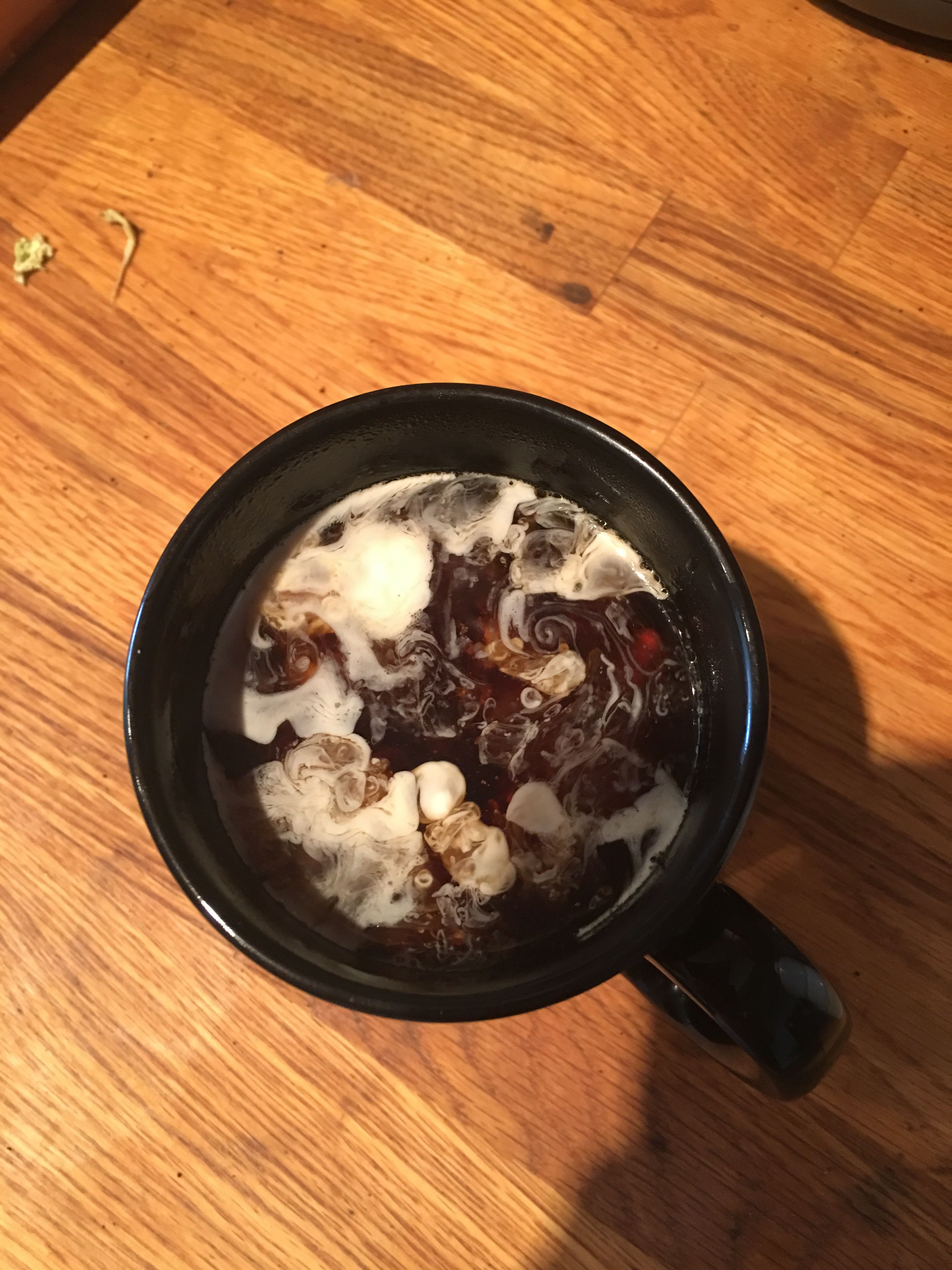
Regardless of bringing a proper amount of skepticism to the science of food and coffee, a writer shouldn’t just go completely nuts swilling the brown juice. My limits for coffeehouse cups is maybe two big travel mugs (cheap bastard that I am, I love getting the dime off for bringing my own) per day. Or this is four normal cups from my own pot (the cup pictured at the top). Too much coffee can, especially on a No Exercise day, spike me up unable to sleep until well after 4am. I exaggerate some saying that on really bad days I might do Beavis as Cornholio with my shirt over my head finding the funny in Lake Titicaca. I’ve come close.

I’ve found a recipe trick for my own pot that I’m sure in no way represents a new invention of the wheel. Decaf. I cut the blend in my pot half and half, which buys me a little time to not feel the cup later and lets me get to sleep whenever it is that I fall asleep after putting my head down on my pillow. I cut it with cream or half and half, which is usually all the coffeehouse has. That’s it, my blend.

I trust the small amount of lactose in cream to do the work that others feel needs tons of sugar to do, cut the bitter taste of coffee. Unless I want a Mocha for the occasional sweet chocolate hit. Now if I could just remember to ask for Half-Caf at the coffeehouse, things would get even better. I hate buzzy terms for many things.

And now we come full circle to the last issue of where do I get my coffee fueled writing done? Writers in my experience are almost as territorial as Bruce the Robotic Shark was claimed to be in Jaws. For me prowling West LA for literary seal, I bounce between a few places and the coffee is the last thing on the decision tree.

More often than not, I wind up at Coffee Connection at 3838 S. Centinela at the corner of Venice Boulevard and Centinela glad to have found parking in the private lot across the street. I get a cup, even though I could be a douche and sneak in a few times a month because the password hasn’t changed, and get to work.


I’ll let the pictures give a little bit of the flavor of the place without wasting too many words. It used to be an Italian restaurant and has cool stained glass and an open air courtyard for summer days. The coffee is alleged to be fair trade organic, but I barely know what those words mean outside the dictionary. But, you did hear me say coffee is the last thing on the list?

I’m reasonably sure I can’t taste much about coffee other than bitter, burned, too fucking sweet and needs cream. I’m just here for the WiFi that allows me to work with all my mobile writing apps and I’m paying what should maybe be a tax deductible office rental fee. But, I already bury a lot of other sketchy writer deductions on my 1040 forms.

Different writing apps approach the cloud slightly differently and these quirks need to be taken into account. Final Draft Mobile interacts with Dropbox going for instantaneous updates, so a coffeehouse that sets up their WiFi with that in mind allows me to work on a script on my iPad without pulling out my phone that I keep on LTE when I roam to prevent version conflict errors. Word Mobile updates to Dropbox and other cloud services manually using a Save A Copy button followed by a Replace prompt.

The difference between the two means spending a few minutes back home after my sessions renaming the newest version to the desired file name, deleting the older version from Dropbox and then telling Final Draft to link to this new version (Yes, a First World problem, but still…). After that my only worry is figuring out how much sunlight I want to take in the courtyard on sunny days (I came from the factory with the Lobster Gene).


By contrast, I sometimes wind up at various Panera Bread locations, but most frequently at the one on Jefferson Boulevard in Culver City. Slightly different flavor choices like hazelnut coffee served using the Bottomless Cup method are balanced by a couple weirdnesses. First off, they pull half of their coffee tanks after 2pm of which decaf is one.

Really? You’re going to pull decaf going into the evening where the concern is having that much Bolivian Speed will keep you up well past dawn? And that’s also not taking into account that some people feel too much caffeine in other ways. It would be nice to cut hazelnut or dark roast with decaf to even things out for the evening.

Secondly, Panera must think that booting you off WiFi every 30 minutes forcing a new authorization sells more coffee. Knowing this I don’t work on screenplays at Panera. However, even though you learn to work on the device’s local file version, the interruption if you aren’t paying attention is total forcing you to either shut off WiFi and lose the ability to quick hit some Internet research/distraction, or connect all over again. I’m reasonably certain at least once Batman almost kissed Wonder Woman and then I changed my mind after the interruption that she went all mean-harpy on him.

Yes, complaining about WiFi exists as the ultimate First World problem, but it’s an annoying problem with a tech solution where going for an iPad with LTE or an out and out MacAir requires spending far more money than I spend on coffee. Easier to just find a different purveyor of caffeine.

So here we are, the current state of my relationship with caffeine. In time, I may find another home break coffeehouse or make more days where coffee isn’t part of the equation. Or actually pull up my shirt around my head…

© 2017 G.N. Jacobs

Marvel Comics has recently figuratively and rudely speaking stepped on its…ahem! And Blue Facebook has blown up in response to the various flaps. Here. And here. Or here. And lastly here

As usual with my column, I try to find the writing solution to things that are otherwise too political for this space. I agree with the authors in the above linked articles that perhaps Marvel puts out too many books in each of their character groups. Or the similar and related criticism that events, crossovers and other forms of fan service publishing can dilute interest in each book affected, yes, I also agree. For my two cents, I would like to propose an end or at least dramatic reduction to the very concept of the monthly ongoing title.

Why? Because possibly comic book writing needs to have a better feeling of an ending than currently provided by an open ended format that goes until tastes change and sales tank right into the toilet. I noticed as I considered my own reading/media consumption habits that I don’t gravitate very often to the true ongoing storytelling of comics and daily soap operas. Yes, I do like certain shows slightly derived from the soap opera format. But, they’re all produced in what has come to be called the evening soap opera format where the writing staff only has to create 13-24 episodes a year and thus can edit out much of the overexposed minutiae of their characters’s lives going for as William Goldman put it in The Princess Bride – “the good parts edition.”

I think I always eschewed the classic soap opera form in favor of the classic cop shows broadcast at the same time on what used to be LA’s independent channels before the need to have six (later contracted to five) national networks ate up all the choices because of this issue. There might have been unconscious gender bias in that soap operas were a “female thing,” but I firmly believe that a seven-year-old boy liked that classic Hawaii 5-0 simply presented me with nearly 300 cases for my purview and didn’t bog down the narrative with extraneous details. McGarrett and company got the bad guy at the end of the episode, unless it was Wo Fat (saved for the end of the show in 1980). That and the high probability of car chases featuring those late 60s and mid-70’s land yachts that have zero business hitting those sharp hubcap popping corners and you might see why my sick at home days passed with McGarrett, Ironside, T.J. Hooker and the, I forgot his name, SFPD Inspector Karl Malden played in Streets of San Francisco.

Moving these thoughts over to comic books, I find that perhaps the Big Two (DC and Marvel) publishers, who between them cornered the market for and trademark to superheroes, might be fatally wounded for attracting new customers by the very weight of their publishing histories and the highly convoluted narrative storytelling methods used to liven up their respective character stables. So when I walk into my current home break comic book store (Comic Bug in Manhattan Beach, in case you care) to see the wall of new titles in monthly floppy format I shake my head at having too many choices and then step over to the graphic novel book case usually for an “indie” title.

On that wall, you’ll see maybe three or four Batman titles and similar amounts of books featuring all the many Big Two Legacy Characters or their Not So Legacy Replacement Versions. But, every single one of those stories has to fit into that ongoing narrative based on literary mythologies beginning around 1938 when Batsie, Supes and Wonder Woman because they have been continuously in print on the monthly and sometimes bi-monthly schedules. And once it became clear that the true fans kept all their back issues, continuity mattered. So basically, the Big Two became soap opera-like in their storytelling and might not have seen it coming.

Part of my beef against the daily soap opera form and the similar animal comics mutated into is that having too much content and history creates a tendency to meander. The classic monster-themed Dark Shadows soap that should have been right up my alley was famously reported to me by a slightly older friend (I was three when the show got cancelled) who could watch as having a staggering amount of alternate universe digressions. So how the fuck am I supposed to make sense of the show now that I’m old enough to pluck out what’s available on Hulu?

Similarly, Big Two continuity seems to do the same things that in order to keep readers interested in their titles where they try experiments to liven things up between regular stories that could be boring over the long haul. A precarious balance exists between Batman fights the Joker and how many times can Batsie get up in Joker’s grill before someone dies? So over the years, like Dark Shadows, General Hospital, Big Two comics have created all kinds sub-continuities and alternate Earths. They also temporarily remove characters and bring them back to great fanfare all while keeping the majority of this storytelling in the main continuity.

Once a decade since 1986 the Big Two clean house creating challenges to published reality that trims out stories (only to reintroduce them later in slightly altered form). These house cleanings become events that sold well encouraging more events. Other events rely on a massive crossover put everybody in the book methodology. Massive crossovers can lead to too many Bat-titles, or Spider-titles to tell the full story, which is one way to get to the observation that the Big Two are publishing themselves out of their marketplace by producing more of their products than readers actually want.

The Diversity-Don’t-Sell-Gate part of Marvel’s recent problems can be seen in light of the ongoing trend towards temporary experimentation, emphasis on temporary. The overall makeup of comics readership has changed where the Big Two have to balance new readers against old readers trained by the ongoing monthly book to expect things will always be so. Old readers will tell you who Batman has always been and confidently assert that Bruce Wayne will get miracle spine surgery to come back after Knightfall.

So, for instance, when faced with a brilliant young lady POC taking over as Iron Man, some of these older readers freak out asserting – “we understand but don’t do this at the expense of my comic books! Make new characters that handle diversity and promote them!” I’m not sure the Big Two even know how to market new characters that are less then five years old, but I feel certain that putting Replacement POC Iron Girl (Iron Man) up against perhaps fifteen Avengers and related single-character standalone books did her no favors.

Back to my proposal for less monthly ongoing titles, what do I mean? I mean a shift to more standalone books, where a publisher can compartmentalize Earth-1095 versions of characters and other experiments into a six to twelve issue run that has zero connectivity with the rest of the stable, unless somebody in the future wants to reference the work. Ideally, in an ask for it but the Powers that Be don’t have to listen to just me kind of way, this means a little more go straight to the trade paperback publishing.

Of course, this is me as a novel reader commenting that even when I wade into a series of novels each story begins, middles and ends and I’m left to imagine the spaces between books. But, many novel series are also designed to have a predetermined ending. Harry Potter ends at seven novels and one play because representative of British schooling and the need for one postscript story, Sweetie! Or Song of Fire and Ice will end at seven books because “Dude, the ice zombies from beyond the Wall are, like, dead and someone from among the many focus characters used their contribution to making a Westeros free of ice zombies to win the Monarch Derby.”

In comic books stories do end, but when they are part of main continuity they are called story arcs and later packaged in trade paperbacks only modestly different from a graphic novel. A graphic novel (to the extent that the concept is not a made up marketing term to make it okay for adults to read comic books) is a story designed to end in the same way as a regular novel and is published all at once. A story arc collects a set number of issues that make up one story. To my thinking many of these story arcs, especially the experimental ones should just go straight to trade and isolate them from main continuity that requires frequent usage of Wikipedia to understand.

Marvel might have created less grief for themselves if the recent Captain-America-Nazi-Gate were more clearly isolated into a What if or Elsewords kind of limited series that used to be part of the Big Two publishing model. Putting the story in context with every other Captain America story requires more narrative legerdemain that needs to experiment to heighten reader interest than many readers are willing to tolerate.

It doesn’t matter that savvy literary analysis can use Three Act Structure to get to Dev Patel’s line in Best Exotic Marigold Hotel – “things always work out in the end, if things aren’t okay, then it isn’t the end.” Cap as a Nazi first seemed like one of many experimental stunts designed to shock more sales out of a legacy Nazi-fighting character, but then Marvel doubled down and tripled down by apparently making it a permanent change relying on the Cosmic Cube Infinity Stone and then sending out the T-shirts. So Cap as a Nazi will be another of many “reversals to reverse things which had already been reversed” found in such dense and impenetrable comics continuities. But, it doesn’t feel that way right now.

Would Marvel using a model of a small few ongoing titles and publishing everything else as trades solve the blowback? I don’t know. I’m one guy with a preference for complete stories who gets whiny contemplating the soft floppy books because I’ll forget to tune in next month for the next issue. Buying the trade a few months later works better for me because I just can’t use up any more of my thousand square feet on monthly books. My suggestion is at least one way to experiment with trimming down on the intimidation factor of seeing that wall in the comic book store where some characters need their own section and your head explodes trying to keep up.

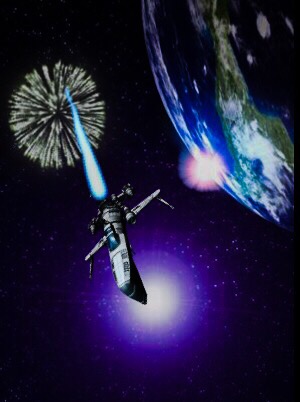
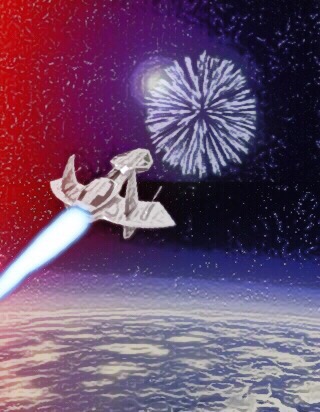
Is it a ship entering hyperspace, or one watching a fireworks display? You decide…

© 2017 G.N. Jacobs

“Punch it, Chewie!”  

Except for a certain sequel where the writers really seemed to want Han Solo to throw up his hands and – “go see Cal, go see Cal!” – for a new starship, punch it Chewie always results in a white shift of blurry stars as the Milennium Falcon jumps into hyperspace. If the heroes and other passengers chance to see out of the cockpit window, they will then see a blue-white vortex as the ship bends spacetime to shorten the distance between Tatooine and the unfortunate Alderaan. Or for the Trekkies amongst us (I straddle both camps), the order can be “Set Warp Factor Six…engage!”

Science fiction writers have basically wanted to dig up Albert Einstein, perform a zombie ritual only to kill him all over again for many decades. It sucks when actual science gets in the way of going somewhere likely to easily support life instead of almost rocks like Mars. General Relativity and the many following works basically tell us we aren’t going anywhere given the currently astronomical and expanding distances between stars because if the Speed of Light is the absolute speed limit in normal space, everywhere is too far way with a rocket.

So we basically threw some hard elbows and made up Hyperspace (Subspace or Warp Space in Trekland…six of one half a dozen…). Hyperspace is a extra substrate dimension permeating reality over, under or three left turns from the four dimensions that allow us to touch things and live through our lives. If there is an absolute speed limit, then how about we figure out how to shorten the distance between Earth and Procyon (in the Star Trek universe, I keep hearing about this awesome Italian-Klingon fusion joint just off the main marketplace on Procyon Four)? Sounds logical.

For this next part, I invite you to back channel this discussion to Neil DeGrasse Tyson or any other rock star astrophysicist for their opinions. I’m only a layman reading the summaries of their work on Wikipedia, but it seems the general thread of the hard science says extra dimensions exist but are tucked out of the way of the four we actually need (five if we fall into a black hole, according to a recent theory popularized by Christopher Nolan’s Interstellar). However, untucking dimensions so we can use them seems to require energy…LOTS of energy.

In fact according to some abstracts, if we as a species could marshal that much energy and the related concept of manpower even once the Emperor, King, Pharaoh, Queen, El Jefe, Big Brother, Big Nanny or Grand Ayatollah leading that effort will justly get to take a bow along the lines of how Shelley described Ramesses the Second – “My name is Ozymandias, king of kings: look on my works, Ye Mighty, and despair!” In some threads, that much energy breaking into the hyperspace dimension breaks normal spacetime based on the question – “So, guys, you folded, spindled and mutilated space near your departure point and did the same at the arrival point, what makes spacetime want to unbend itself to allow normal operation in the future?”

Enough science for the moment. I’m a writer speaking to other writers in a fascinating literary environment where we still get to make shit up to tell our story. And for the most part, those rock star astrophysicists won’t mind too much. They are almost all Star Trek fans, at the very least. I suspect the possibility that our current mathematical understanding of extra dimensions has some small relationship to these scientists wanting something cool to be true, so they expended research resources into finding out just what the science might allow. Luckily peer review, when it works, tends to wipe out confirmation bias.

But, how does hyperspace work for the writer burning to tell that story about a kid frustrated in his love for the girl next door and who joins the military to hone his skills in the very dangerous occupation of rescue pilot? However said writer wants things to work, after all it is his or her act of imagination and the rest of us either accept the fictional multiverse presented to us or we don’t pay our ticket for admission. But, perhaps the new writer needs a little help with the common methods of hyperspacing (ugly gerund there)?

STAR WARS – The galaxy far, far away and a long, long time ago makes use of a full dimension that shortens the distance everywhere in the galaxy. You jump away from home and jump towards space Tahiti or Coruscant and arrive at the destination in what in most cases seems like a few hours. I think George Lucas basically ignored anything coming out of a science journal in favor of a narratively fluid means of getting people from the sandbox planet on the outer rim to the formerly lush planet of Alderaan.

As best as I can figure hyperspace travel in Star Wars Land allows a ship to travel in its own dimensional bubble even as part of a fleet going in the same direction. We haven’t yet seen anybody try to shoot it out with an enemy ship while in hyperspace. The ship guided by a computer or (according to one of my more recent comic book store discussions) a Jedi or other Force-sensitive just ends up the destination, unless somebody screwed up and didn’t account for the supernova in between.

Star Wars hyperspace defines elastic literary concept. In Star Wars: A New Hope, Luke, Obi-Wan and the droids hitch a ride with Han and Chewie heading to Alderaan. Pay close attention; after blasting out of Mos Eisley, Han trusts the computer and autopilot to handle things while everyone congregates in the lounge. Chewie cheat-wins against C3PO. Han dismisses the Force while Obi-Wan uses a saber-drone to teach Luke the basics of the Force, like a five-year-old youngling. Implication, a few hours elapsed.

Most of the other episodes reinforce the nebulous concept of travel time to varying degrees. Send in the Clones…sorry, Episode Two: Attack of the Clones has this exchange between Padme and Anakin upon discovering the need to investigate the doings on Geonosis – “look, the Jedi Council has much further to go, but Tatooine is about half the distance. I’m going to Geonosis and you’ll just have to protect me there.” Juxtaposed against Han jumping from the Resistance base directly into Starkiller Base’s atmosphere in Star Wars: The Force Awakens. A journey that takes ten seconds. Believe me for a franchise evolved out of a pitch of Battle of Britain meets an Akira Kurosawa samurai flick, even I would rather cut straight to the pistol fight, dogfight or, more to the point, the lightsaber fight at the destination.

STAR TREK – The competing franchise runs subspace travel somewhat differently. Warp travel happens when a warp engine that focuses a matter-antimatter explosion through an interesting unobtanium substance, dilithium crystals. The energy of hydrogen anihilating with anti-hydrogen (still calculated as insufficient by the average rock star astrophysicist who loves watching the show) is filtered through the crystals asserted to be an extra-dimensional energy multiplier for the juice to go places fast.

Navigation with this system typically relies on straight line travel with pre-programmed sharp turns handled by that sultry computer voiced by Majel Barrett. Speed between Warp One and Warp Nine represents a cubing of the Warp Factor times the Speed of Light. The travel is reactionless in the sense that the energy expended warps local spacetime to create a bubble of subspace in which to freely violate General Relativity and to bunch up spacetime behind the starship creating the localized effect of surfing downhill.

Faster speeds than Warp 9.99, retconned out of normal Trek physics by the modern spinoff shows, require a different kind of antimatter reactor that taps into a deeper realm of subspace where the ship either creates an out and out wormhole (transwarp conduit) or taps into conduits that already permeate the fabric of spacetime. The literature suggests both. Usually only bad guys like the Borg have transwarp, until the plucky Federation crew pulls off an operation akin to Prometheus stealing fire to make it home in the nick of time.

Regular warp travel does quite a few things for the intrepid storyteller wishing to borrow the Trek lawnmower. While hydrogen is so widely distributed across the universe and anti-hydrogen is clearly an industrial byproduct of having a high level of reactor/particle accelerator technology that fuel should be essentially free, dilithium crystals are not. Star nations roll up to planets with scans of dilithium deposits and let the political metaphors pertaining to resource (petroleum) acquisition diplomacy and last resort special forces missions commence.

Because of the cubing of the Warp Factor times the Speed of Light, time and distance in Trek become standardized. When the Science Officer looks up from the scope and reports that the Big Bad is on a trajectory towards Earth, Vulcan, Tellar or…God forbid the pleasure planet Raisa at Warp Five due for arrival in five days, the nitpick holding the remote can hit Pause and do the math to get a rough distance from the target planet, which will match published star charts for the Trek universe.

If there is one silliness to this model, ships traveling through the shallows of subspace in regular warp still interact with four dimensional spacetime. Phaser and disruptor fights at warp speed take place all the time, leading to this question – “beam weapons seemingly move at the Speed of Light, shouldn’t the Faster than Light starship arrive before the beam?”

A common just go with it answer relies on a solution from modern jet dogfights, that when a fighter spooled up to Mach Two fires a missile rated at Mach Three will have an initial launch speed of Mach Five until air resistance and the first series of sharp turns slow the missile down to the speed rating of the rocket motor. So the phaser adds the Warp Factor of the firing vessel to the Speed of Light still allowing normal operation.

A late addition to Star Trek FTL travel, includes several areas of subspace instability where flying through an area too fast will erode the fabric of spacetime. When threatened with whole areas of the Federation cut off from civilization, artificial speed limits are enacted. I want to see those traffic cops making stops.

Or hyperspace could be a full realm above, below or three left turns from normal where distance is merely shorter but physics remains the same. The only energy required is that needed to bust through the dimensional barrier and fuel consumption once inside hyperspace is otherwise normal. This kind of hyperspace allows for fleets to lurk until needed to close the trap. Some variations include jump gates helpfully left behind by the ancient race that found hyperspace first.

Another major thread of faster than light travel is the fold drive. Backed up by some curious possibilities in the paltry available science, a fold drive assumes that a ship can harness enough energy to connect two disparate points in spacetime allowing instaneous travel to anywhere in the universe. This method assumes that the fabric of the universe will snap back to normal with the release of the applied energy that seems cosmic in scale. Certainly, a species fighting over the balance between the efficiency of hydrocarbon fuel versus needing to breathe on dry land can’t even conceive of the vast energies to use a fold engine even once.

Writers basically fill in their currently pretend FTL physics however they want to because heading out on a whim to your favorite pizza joint on Arcturus just isn’t a thing. Slipstreams, wormholes, subspace, hyperspace, black holes and anything else we haven’t thought of will work for you as the writer as you need it to. So what are my contributions to our imaginary usage of faster than light travel?

Check it, my starships enter a realm where external gravity is reversed. Black holes and blue giant stars repel objects causing a downhill surfing type navigation except for null spots where the gravitational influence of several stars work against each other. Downhill equals free energy much like just declaring that all distances are just shorter. Of course, the fields of the hyperspace engine allow normal physics inside the ship. Can’t have objects floating away from the deck stuck in the center of everything.

Just make up your physics as you go along. If our rock star astrophysicists bust your chops, you’re ahead of the game because they don’t really know how any of this stuff works either.