© 2018 G.N. Jacobs

Wow! There’s a pull quote for you contemplating seeing Guillermo del Toro’s new movie, The Shape of Water. Just wow. The director is back in his weird but playful element weaving a Cold War era tale of a secret base, the young mute lady pushing a mop therein and…her amphibian lover. And there is a Busby Berkley style dance number to boot.

Elisa Esposito (Sally Hawkins) is mute. She pushes a mop in a secret base in Baltimore, 1962. She lives alone above a mostly empty movie theater next door to Giles (Michael Shannon), a man in the closet living with cats. One day a new “asset” rolls into the lab with the strongest steel door contained in a secure fish tank. Elisa is curious to the consternation of her good friend and sign language interpreter, Zelda (Octavia Spencer). Romance and a daring escape from the facility ensue…

Mister del Toro brilliantly captures the nostalgia for the America that might not have actually existed except in the movies that distracted us. In the movies we danced with our lovers for whom we had undergone an emotional journey just to get to the black and white waltz in clothes for which the shoes were likely too small for the occasion. And then we popped off the screen in vivid Technicolor that requires a restoration print and celluloid surgery about every twenty years to preserve that feel.

And then because the director has read enough books about the real America of the time, he brilliantly reminds us that two 800-pound gorilla superpowers rattled sabers at each other. That a black couple in the South had about as much chance of sitting at the counter as I do being invited into Al Qaeda to lead the struggle. All of this happens in the background while we’re caught looking at Ms. Hawkins eat up her scenery and then chase it with the production scripts slathered in mustard.

I can’t speak highly enough about Ms. Hawkins as she gives Elisa an enigmatic smile, especially baiting Amphibian Man with hard-boiled eggs. And the lady in question doesn’t need words to express the eternal conflict between the Frankenstein Monster and his creator…how far do we go with a new mostly sentient creature that might teach us about our place in the universe, but will also eat our cats when we fall asleep at the switch?

Because of the all around deft handling of the seeming incompatibility between America as we wanted to see it versus the America as it really was, we see Ms. Hawkins be fierce signing a hearty “Fuck you!” in all-caps to the union mandated evil or perhaps just scared Security Chief. Of course, said torturer doesn’t understand American Sign Language and Zelda does a bit of creative “interpreting” to keep the guy about to lose fingers to gangrene from blowing his stack. The solidarity of ladies who push mops and clean up piss from places where urine should fear to tread.

Pretty much the rescue aided by a scientist spying for Russia takes place and Elisa and Amphibian Man get to know each other in her bathtub as they wait out the coming rains that will fill the canal to the sea. We hope Giles’ cat served raw tastes like chicken. Amphibian Man becomes progressively sick because the bath water isn’t exactly to taste for his survival. And for the second go around, Elisa floods her bathroom for the full aquatic experience. Then all the threads meet at the canal and bullets fly.

Anything, I might say bad about this film is so far into the realm of needing to invent things just so I don’t write a completely warm and gushing review. I got caught up into this world where principled people can see the Other as more than a lab rat. The music, photography and the probably disgusting key lime pie that informs Giles’ subplot popped off the screen as intended (the pie filling looked a lot like green Jell-O instead of actual Key Lime…ick!). So, I have to work to find things for Mr. del Toro to think about next time.

If I had my way, I might suggest making more of the downstairs movie theater as a story element. Amphibian Man escapes the apartment after eating Giles’ cat and he is found in a middle row staring at the screen. Could someone use a really good old movie to deepen Elisa and Amphibian Man’s relationship beyond the Nurse-Patient tropes we see on screen? Yes, and I hope Mr. del Toro lets us know on the Blu-Ray that he cut those scenes for time.

But, the problem for this thread is that you can hear gears of the studio footage-licensing machine working behind the scenes. The film in question is The Story of Ruth, to my mind a Sword and Sandals “classic” to which I’ve generally reacted indifferently in the past. I bet the studio producing The Shape of Water owns The Story of Ruth. Thought experiment time, what does Amphibian Man learn about Elisa and people if he sees Ben-Hur? Lawrence of Arabia? Casablanca? Or pick another classic movie from 1962 or before?

Of course, this suggestion only works if there is time to depict at least two back and forth exchanges of the conversation in American Sign Language between Girl and Amphibian Lover. It could be seen as an interesting parallel to the many conversations Elisa has with Giles at his TV set where the lonely gay artist next door needs company, but will do anything to skip over the disturbing TV footage of riots in favor of the Betty Grable movies that taught Elisa how to dance.

Now, if at some point Mr. del Toro says “Yes, I’m not stupid and could see the character possibilities sixty miles away, but we were five minutes long…” then okay, it’s called the Red Pen of Editorial Doom for a reason. Otherwise, pay for the meaningful footage and milk the thread for more. Just saying.

Quibbles aside, The Shape of Water is one of those movies we can’t be sure the Hollywood System even makes these days. Then they sneak it out while we’re still recovering from Star Wars: The Last Jedi. This one goes on the disk shelf. High praise indeed. See you at movies.
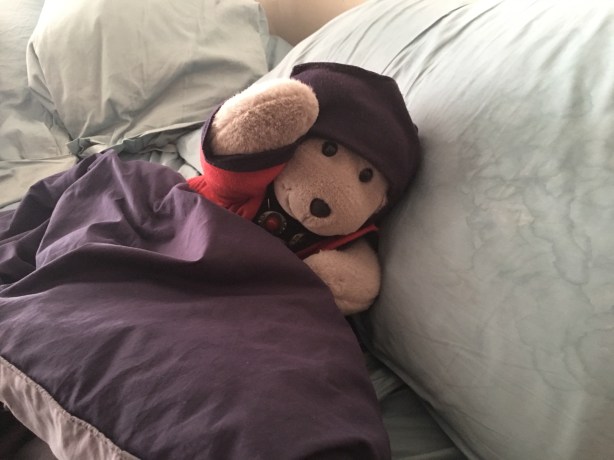
Shhh! Q-bear is sleeping dreaming of mayhem to inflict upon his nemesis, Jean-Bear-Luc Picard…

© 2017 G.N. Jacobs

Somewhere along the line I read an interesting tidbit about Robert Louis Stevenson during the writing of The Strange Case of Dr. Jekyll and Mr. Hyde that he’d had a nightmare with a lot of apparent entertainment value that told him the story that he then copied verbatim onto the page. Supposedly, his wife woke him up at the most screaming-est, bed-wrecking part (hopefully at the first reveal of Hyde’s face, always a killer in the movie versions). The author yelled at this otherwise helpful woman. She might have retorted something along the lines of “can’t please everyone.” Three or four days later, he lucked out when the nightmare came back and told him the end of the story. And this is me calling shenanigans. Dreams haven’t worked that way for me since ever.

Can dreams inform the stories we try to tell? Yes. The ideas that result are sometimes extremely valuable. Do they tell you stories from beginning to end that then land on the page with minimal editing as Stevenson tried to say? No. Certainly, I’ve never gotten more than a couple scenes out of the jumbled and disjointed narratives playing in my private movie theater. And I’ve always had to beat the shit out of everything I write afterwards to get it even readable. No shortcuts…ever.

What little I know about dreams comes from Wikipedia and waking up remembering the last narrative gift most mornings of my life. You dream for a few seconds. You don’t dream for longer periods. Rinse. Repeat as necessary all night long. You only remember the last dream before you wake because the messages aren’t stored in long-term memory.

Having moved away from relying too much on Dream Interpretation as a facet of Psychology, I figure a nightmare or other dream that wakes you up in the middle of the night serves the additional purpose of telling you to get up and drain your bladder before going back to bed. As you might guess, calling shenanigans on Robert Louis Stevenson possibly exaggerating an experience to help build up what it is we writers do doesn’t mean I didn’t try it to see if it was a real thing. Screw what a dream cigar really means; I’m at the stage of my life where – “can I use this?” – is all that matters. Narrative uber-alles.

John D. Fitzgerald, author of The Great Brain Series, asserted in his YA/Teen “memoirs,” that dreams or rather the subconscious mind hiding behind those dreams was the smartest computer on the planet. He would think really hard on a problem before going to bed and wake up with the answer. The coolest example was when worried that the cattle rustler Cal Roberts took his little brother, Frankie, hostage in the barn a dream of the swinging pull chain to the light in his room gave him an idea…

According to the books, John sneaked into the barn and tossed a rope over the rafters tying one end to the carthorse and the other to the sleeping Cal Roberts’ ankle hanging over the loft. He described the breathless terror that we expect when sneaking around places with life and death stakes. A quick swat to the horse’s flank yanks the villain off the loft to hang upside down from the rafter disarmed because his pistol wasn’t strapped into the holster. The adults find John waving a pitchfork in Cal Roberts’ face. And let’s not question a good YA/Teen story by asking if it actually happened.

My experiences with my private films somewhat echo these assertions about dreams. If the point is the next interesting idea, dreams can help. As I have previously written, I dreamed of giant spiders recently. On screen, I and other random members of the adventuring party/scientific expedition (the dream doesn’t explain these details, no shortcuts…ever) examine dark spaces with a lot of webbing all over. Discussion ensues that adventure parties tend to commit arson with nearly every encounter with spider webs.

We examine and/or experiment with these beads that act as a firebreak as a way for the spider to still feel everything about her house through vibrations without having asshole arsonist adventurers (alliteration! Wow!) burning everything in sight. I wake up because it’s the morning and I have an idea about a spider character in one of my books currently lying dormant. Sobekneferu the Tarkesian Spider doesn’t need her human goddaughter to dye the silk for the dresses; she can just eat otherwise indigestible food coloring or other pigments and dye the raw silk just before it extrudes from her spinneret. So I get a bank shot idea about giant spiders that wasn’t even featured in the dream.

As I’m mostly past caring what the images mean for my mental or spiritual health (already nuts and I don’t really need to ask Joseph or an angel what they mean), I pay attention to the narrative possibilities and usually come up short in terms of directly feeding me the tale. I get a lot of chase narratives. Run around after or away from random people. Fly like Superman. Every now and again I get to be invisible. Surf impossibly large waves on faraway planets. Through it all, the scenery whether familiar or exotic is the main reason I don’t mind the E-ticket ride playing out behind my eyes.

If there’s a monster, I’m the beast more often than not (the one remaining positive nod to Dream Interpretation in Psychology, I went to bed angry those nights). I even died at least once (woke up just before preserving the wives’ tale about in-dream deaths) picking a fight with a demon as Armageddon began and the story that resulted for a college English class still kind of sucked. No shortcuts…ever.

And you were thinking about the glued triggers in the title? I suppose this is my subconscious mind’s one nod to sanity and decency. I almost never actually pull the trigger in my dreams. We run around with guns on a suburban street covered overhead by elms that shade the whole street. I leap and somersault over ten foot high fences. But, I rarely actually shoot anyone; I pull and nothing happens, or sometimes it becomes a game of Army – “Bang! You’re dead!”

Real shooters talk about the trigger break in terms of pounds per square inch, a measure of how hard you have to squeeze down to release the hammer and fire a bullet. In my dreams, the trigger break is so high that you’d think I’d learn and just smoke pot and make friends with everyone in my private movies. An easy way to describe it is as if some prankster glued down the hammer, but the feel is actually more like somebody changing the local gravitational field so that the pull tightens up the further back I go. Obviously, someone or something doesn’t want me shooting people for real in my dreams saving that for people with PTSD remembering real events. I’m good at my job so like a lounge pianist – “hum a few bars and I’ll fake it.”

Regardless of how informative our dream may be, a writer still has to get up in the morning and make words. The dream may have given you a good concept or streamlined something you were already thinking about. Then that writer takes the Red Pen of Editorial Doom and does it all over again. The subconscious doesn’t wait for you to sleep to feed you the next idea for the next paragraph. I’ve had all kinds of minor eureka moments swilling coffee pen poised for a bloodletting. This is how I know after many years of being open to the possibility that Robert Louis Stevenson basically sweetened a story to make writing sound a little more like Rocket Science. No shortcuts…ever.

© 2017 G.N. Jacobs

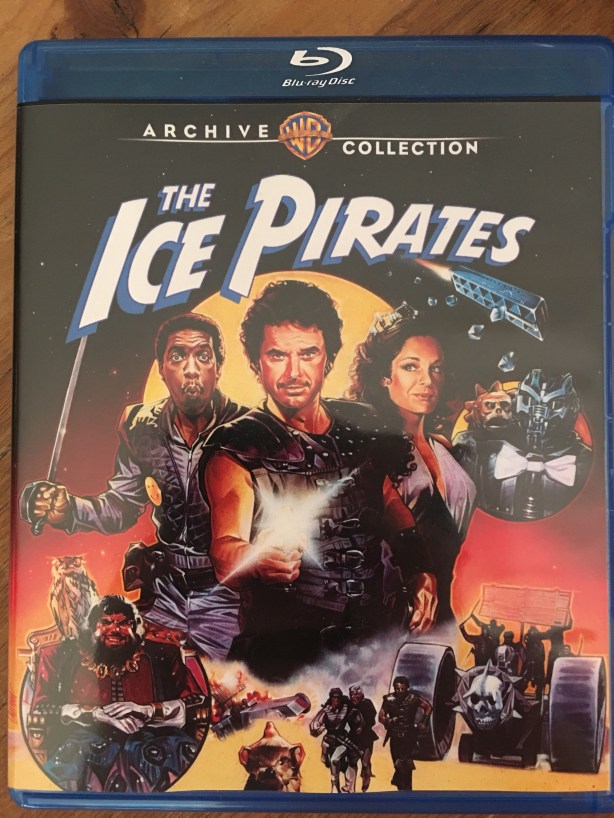
Now that we’ve paid homage and tithed in the collection plate at the Star Wars temple (shake hands, sing an Ahhhh chorus hitting C7 and add bluish light to our faces), we can get back to one of the real purposes of the Filmgoer’s Flamethrower, cheesy movies. But, not just any cheesy movies…good cheesy movies, like The Ice Pirates.

Made in the same 1980s rush of Me Too Science Fiction Movies that gave us Battle Beyond the Stars, Spaceballs, Krull and, like, six different things named Starhunter, Ice Pirates tells the tale of a far future where humanity nearly committed suicide across the galaxy with large scale wars that destroyed or poisoned most of the freestanding water everywhere in the galaxy. An evil force called Templars has arisen to control and dole out water and by extension rule the galaxy. Small bands of ice pirates form to resist and survive stealing blocks of ice from Templar ships. Legends of a Seventh Planet that survived the wars blasted out of orbit into the Time Warp at the center of the galaxy are repeated as wives’ tales to sing children to sleep.

Jason (Robert Urich) leads his fearless band of pirates from the most successful (longest uncaught) ice pirate ship in the galaxy on a raid of a Templar ice fleet. They board, a music theme intentionally evocative of an Errol Flynn swashbuckler film (lots of rope swings into the icy cargo hold here) wells up. Jason, his crew and the many robots in this story defeat the Templars and their robots. Along the way, he spots the Princess Karina (Mary Crosby) asleep in her freezer bed and falls in love.

The Templars, dressed in chain mail, counterattack forcing Jason and his crew to split up and try to rendezvous back at the pirate moon. Jason and his good friend Roscoe (Michael D. Roberts) are captured and taken to Mithra, headquarters planet of the Templars. Princess Karina pulls our intrepid heroes off the slave-eunuch castration line needing stalwart spacers and rogues to help find her father, who went in search of the Seventh Planet many years ago.

Realistically, anyone seeing this movie after a bad breakfast burrito will hate it. At a technical level, the movie starts slow and with possibly the bad kind of weird and builds to a pace worthy of a pirate movie even a funny space pirate movie, leaving better and the good kind of weird. Pretty much all departments follow this arc.

Acting. You won’t believe some of the names in this movie all of whom had a lark with spaceships, swords (the steel kind) and some groaner jokes that can’t be resisted here in this review (even if I should). Anjelica Huston, Ron Perlman, Robert Urich, Mary Crosby and John Carradine are all in this production mugging through this tale and not giving a damn about whether you’ll like the movie (casts this one squarely into the realm of so bad, it comes around like Magellan on the other side of good). The characters and their actors somehow buy a lot of trust by the end of the movie.

Music. Except for the aforementioned Errol Flynn style horn calls, the score falls flat for me in the beginning mostly in the form of silence that didn’t make sense to me. Somewhere about the middle of the story, we start hearing completely serviceable music that fills in the emotional spaces the way film music should.

Writing. Again this department would most likely be the most susceptible to criticism should various hypothetical bad breakfast burritos choke down our throats. There are a lot of robots on the good guy side that were pretty much interchangeable once Roscoe (the robot expert) got his hands on them. Except for Percy, the Butler-Bot with the bow tie you can’t tell them apart. The human characters spend the early parts of the movie going through the motions, but somewhere along the way finding the Seventh Planet becomes deadly serious business. That and fighting off the vicious space herpe (Yes, you heard me, the ship has herpes) that infests the ship.

Assuming a bad burrito state, the story presented onscreen is too short. At 90 minutes, Ice Pirates feels like a raft of missed opportunities. The filmmakers might have added more scenes between Princess Karina and the Templar attack dog, Zorn (Jeremy West) in the same way that Dark Helmet in Spaceballs was caught playing with action figures including Princess Vespa revealing an attraction to the heroine that could’ve added more conflict to the story. As it is the story was cut down to the bare bones with very little time for character development

All of the above criticism requires a bad breakfast burrito before watching. Now what is it about this movie that says I didn’t actually eat said contaminated foodstuff and enjoyed this movie when I first saw it on cable a million years ago and just now buying the Blue-ray? For starters, it’s fun. Fun to see filmmakers just having fun, especially with the intentional onscreen sight gags to poke fun at and play with many social tropes of the 1980s: a defensive system that operates exactly like the Space Invaders video game, the aforementioned space herpe twisting the knife in the whole Alien chest-burster scene at dinner and the tongue-in-cheek ballsiness pushing several NSFW moments past the censors.

Pushed to the wall, my real reason for liking this movie falls into the realm of a concept that wins at the level of innovative ideas over onscreen execution. A water dry galaxy with overlords that throw fairly hedonistic parties similar to the real world soirees of the time? A castration machine on what looks like a repurposed bottling line that is a pair of vicious metal teeth ready to chomp down?

The really cool part of this story is the time warp leading to the Seventh Planet. Princess Karina finds course information left by her father that says to never deviate from Course 283 or be lost in time forever. Zorn follows directly in the ship’s wake and attacks right after Jason and Karina kiss it up to a music video that highlights how important water is.

The ensuing boarding party action with swords takes place as all characters progressively age filmed on fast-forward. Robert Urich saves the day taking over the fight as the sped up Jason Jr. swinging on a block of ice crushing the remaining Templars – “Mom and Dad, we won!” And then, because the good guys won they fly through the time warp reverting back to their ages they were at the beginning of the fight. The blue Seventh Planet fills the window and the pirates are – “out of business.”

For a fun time that doesn’t actually require worrying about whether the movie is an according to Hoyle good movie, I recommend The Ice Pirates, but only if no one remakes this movie, largely because what’s good here won’t survive $150,000,000 budgets.

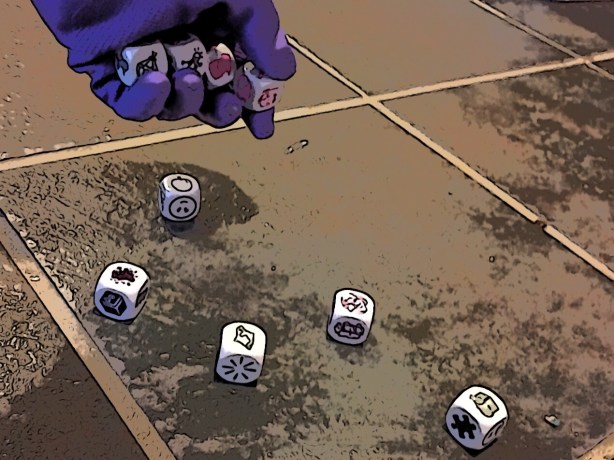
A Pollex Fati throwing the tools of their trade. No word why this particular example needs to wear scary killer purple rubber gloves…

© 2017 G.N. Jacobs

Another slow news day trying to avoid the real work of this blog…reviewing another writing manual. Luckily, I can avoid work by doing other work, one of which I was going to warm up my story dice, make a few throws and call it a two thousand word day. I have to clean up my table or dig out a box top to do that. I’ll be chasing dice under cabinets otherwise.

Still, the thought that I should be shooting my dice and writing down the prompts that result wouldn’t go away. In an effort to work diagonally, I get to wondering if there is a way to incorporate said dice into a monster sure to ruin the average adventure team’s day…my currently preferred method for avoiding the next writing manual.

A monster that throws story dice and with failed Wisdom or Intelligence checks, a blown Remove Curse spell and/or the player failing to white-knuckle the ancient artifact The Ruby Heart of Sartre (an obscure library card reference) forces the poor devil to enact whatever actions and thoughts come face up on those dice. Yeah, we’re cookin’ with charcoal, I think rubbing my hands with the kind of glee usually reserved for tax plans pushed forward without doing the math. And just to acknowledge the giants on whose shoulders I stand, there is no way a monster thumbs the Scales of Fate like this without seeing the Tweedledum Dance Nimoy and Shatner did in the OG Star Trek episode “Plato’s Stepchildren.” Still only cookin’ with charcoal…

I need a name. Luckily, the name is usually carried forward by understanding function…auto-translated into Church Latin. If the monster puts his/her/its thumb on the Scales of Fate, then thumb gets you pollex and fate becomes fati. And use the noun forms…easier that way. Pollex Fati, I don’t do rocket science folks!

Name, check. Now we have to define the beast further for the benefit of the average DM/GM out to pummel his players just enough to keep the game interesting. On the surface the Pollex Fati has a simple to explain ability, point at the player most likely to be entertaining as a fate-puppet and roll dice (first to determine resistance to the curse and then to see what the character actually has to do). Resisting the Pollex Fati’s curse usually results from making either a Wisdom or Intelligence check on the theory that smart and/or wise people can puzzle out that we choose key parts of our fate making decisions every day, but only if the dice are with us. A nod to Free Will based metaphysics.

Personally, I see this monster as a magically corrupted gambling addict that made the dumbass mistake of asking an annoyed in-game deity for a positive shift of fortune and fate once too often. As an added modifier, the strength of the individual Pollex Fati’s ability to affect local Fate quotient depends on how pissed off the god or goddess was at the time of the ask. I envision that a deity that doesn’t do Fate, Fortune, Gambling or Luck as a divine niche will make the strongest Pollex Fati; members of pantheons seem to hate asking siblings for favors.

An easy Greco-Roman example, Athena does Justified War, Weaving, Knowledge, Olives and Owls. She also has a mean streak when it comes to direct affronts to her ego (Arachne anyone?). Imagine one of her favored warriors needing more of the minimal thumb on the Scales of Fate she gives as the War Goddess.

In order to make nice with her sisters, the Fates, especially the one holding the scissors, Athena has to ask a favor. If the mortal making the ask abuses that trust in any way, expect bad things to happen…and welcome the newly-minted arch-Pollex Fati to the world once the rubble lands six miles away.

Regardless of the backstory, I suggest a range of modifiers to the Wisdom/Intelligence check between -3 and -15. Most Pollex Fati will likely land on that normal distribution (bell curve) between -5 and -10. The player rolls, applies the modifiers and starts his/her version of the Tweedle Dance.

Because the DM/GM always holds final sway over his players, there’s nothing stopping he/she from just declaring what the afflicted character will do – “you, chow down on that Green Slime!” This allows the game a little extra flavor to have the same kind of fun with any random result generator: playing cards, matching coins, tarot cards, I Ching coins, or even Inka-binka Bottle of Ink You Stink. This is a logistical concession because in addition to the result dice common to most RPG systems, the GM has to bring 10-15 (RPGs, an evil corporate plot where dice manufacturers paid Gary Gygax to invent Dungeons & Dragons to move dice sets…discuss now) extra picture dice to the table. It’s your game and your mayhem.

I see the Pollex Fati as a monster and not an in-game deity. The difference is that the Pollex Fati can only pick out one victim per turn to force the relevant Wisdom or Intelligence saves (Gods/goddesses can do lots more all at once). And to seek balance, so that DM/GMs don’t use the Pollex Fati as an annoying character assassination machine (ask me about the Halls of the Falls dungeon from the Stone Age sometime), whatever modifier the beast brings to the table I suggest it is halved when the Truth or Dare request is directly lethal (eat Green Slime, fall on thy sword, O, Bereaved Roman Gentleman, etc.), but indirectly lethal (dance, Bitch, make a lot of noise to attract the sleeping orcs in the next room!) is, to my mind, perfectly okay.

Additionally, the Pollex loses a point off the negative saving throw modifier for every turn in battle past the third that they stick around to fight it out. Any player character that survives two saving throws becomes immune to the workings of that particular Pollex Fati’s curse for a whole year. Pretty much the point here, I see the Pollex Fati as a hit and run distraction and narrative plot point monster that should be tough to corner and kill not as a straight ahead bloodletting machine (most DM/GMs have armies of orcs, ogres, skeletons and my personal fave, Vorgons for that).

For instance, Polly appears from around a corner waggles fingers, starts up the Tweedle Dance or sets a character off on side quest and decides to be anywhere else for coffee. Cornering one should actually be the stuff of legend (better suited to D&D fan fiction posted on Wattpad instead of a feature of an average campaign or an adventure).

My best suggestion for fitting the Pollex Fati into a food chain of energy, magic and a fantastical ecology is that Polly eats the energy from a successfully affected Fate. The player character injured while cursed feels the life going out with each moment under the curse that eventually wears off and heals with physical healing. The beast gains strength using this Fate energy as food and/or in a similar fashion to how player characters use experience points to gain hit dice and the skills to match. Polly is driven by their need and they are immortal until killed.

Given my assertion that a Pollex Fati started out as a mortal that either asked a capricious deity for the wrong favor and/or abused the help of a kinder, gentler divine eminence, it seems that I’ve just walked into a wider than usual range of alignments than seen in most D&D monsters. Alignment has always been one of the weirdness of Dungeons & Dragons where all creatures smart enough to speak and form societies have a moral alignment that is supposed to inform the personality. Monsters that fall into this category are all evil and generally inappropriate to play as player characters. But, with the Pollex Fati the multiplicity of backstories of who asked for the wrong divine favor, you get all kinds of personalities…alignments.

I can see DM/GMs with a good Pollex Fati trying to use their power for good, but continuously fighting against the hunger induced by their power. Yes, this is basically the Good Vampire/Tragic Werewolf narrative that wore thin after Angel, but we really do tell the same stories over and over. The good Pollex Fati steals energy from bad people and may create change for good, but how long can they last against the hunger…This could result in good Pollex, however temporarily.

Now for the other boring statistics for the listing in next year’s Monster Manual (posting will do). As the Pollex Fati is a regular human/humanoid PC race that asked too much of the gods, they will bring the hit dice they had as people and retired player characters to the party. However, the curse magic will add hit dice roughly equivalent to the negative modifier on the saving throw that they gain from how spectacularly they pissed off the gods (a -15 Pollex Fati gets that many extra hit dice, but this is the campaign world’s probably singular arch-Pollex best saved for the very end of the video game). I see armor class being a function of whatever gear they brought with them.

Now, we turn to any tricks for players to get past this monster. It occurs to me that a classically reported limitation on many monsters might go a long way for game balance. Medusas don’t like mirrors. Sirens cry legendary songs of sorrow confronted by wax and cotton earplugs. I suggest that we steal from another Star Trek episode – “I, Mudd.”

If we get to part of the Pollex Fati mythos from “Plato’s Stepchildren” (Tweedle dance), then we should perhaps borrow the distraction campaign that resolved the second Harry Mudd episode…dance around illogically until the robots’ ears blow up. What this means is that if a player character party already does weird things around a Pollex Fati, the beast will get caught looking entranced by these weird players giving it what it wants without being forced. It will not point and use its curse magic while such a show is going on. The monster may stay too long and lose points off its modifier and become vulnerable just as if it tried to stick around more than two turns.

Of course, the give the monster what it wants plan can only be employed if the adventure party knows they face the Pollex Fati. Until said dramatic obstacle rolls dice, flips a coin, pulls a Suicide King or Queen of Spades from the deck, or even rolls regular dice in place of story dice and consults a table (how a DM/GM might get around the Wonder Woman Tie-in Story Dice Set not existing, yet), all the adventure party might see is a humanoid figure with the tightly yanked in skin of any number of immortal humanoids that have lived too long. Once the dice hit the floor, it might be too late…or not.

And so here we are, presenting my thought process and the newest new monster for the discerning DM/GM’s bloodletting pleasure. I’m pretty sure I don’t want to meet one used well by another DM trying to get one over on me as a player. See you at the gaming table…

© 2017 G.N. Jacobs

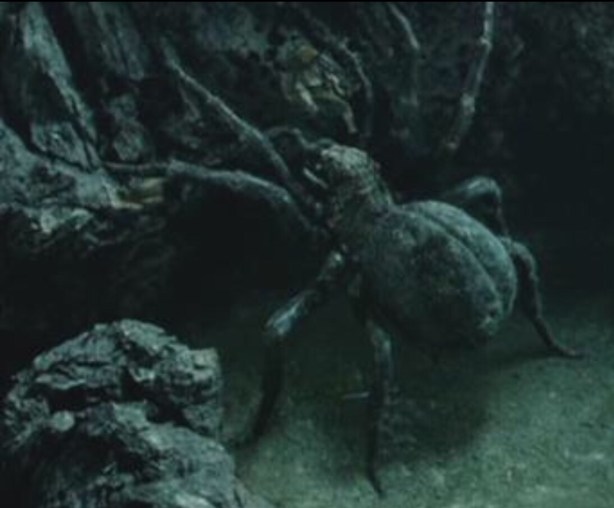
Spiders. Spiders good? Spiders bad? Ask an entomologist…spiders good. Something about how Charlotte culls all manner of insects to manageable levels. Ask J.R.R. Tolkien…yeah, we know how the master felt having Shelob and her kin overrun Mirkwood Forest like that. Either way, we walk in rich literary territory for wordsmiths like me.

I get my knowledge about many things from Wikipedia where I assume a 75-percent accuracy for people and history with maybe an 85-percent get it right about science things like insects, sorry arachnids, the extra pair of legs puts Charlotte into a whole other family of arthropods. Probably cuts down on any weird feelings among sentient spiders about cannibalism.

Whatever, don’t assume I know much more than spin webs, balloon to spread the species and that it’s kinda cool to watch video of Charlotte fuck up insect trespassers for lunch as the main course. And this is where I brag up the video buried deep in my Facebook profile of a spider hanging from its drop line running like hell from my cell phone light. It was shoulder height to me and the only anchor point was the cross arm of the streetlight 30 feet overhead. Free nature show.

But, as you can see from the many varied examples of E.B. White’s Charlotte, Shelob, Boris the Spider and even the eponymous Itsy Bitsy Spider we have complicated relationships with the eight-legged bi…ladies (some are gents like Boris the Spider). When they are small and posted up outside in the rose garden only the most psychotic of us will lift a finger against them. Especially if the morning dew catches the light the right way, or if said web is loaded to the gunnels with silk wrapped food pods that used to be insects.

I doubt that if Charlotte took magical spider growth hormone or the science fiction equivalent, radioactive waste, to grow to even half Shelob’s size that we’d be saying nice things about the apparently nice spider that stood up for her pig friend. We start to worry when things grow large enough to eat people, or even the medium sized ones cleaning fangs at the prospect of an unattended child or dog. They look weird and defend their webs with ferocity.

Speaking about Charlotte…was the eight-legged lady really a nice caring spider as depicted doing what she could for Wilber, or did she make a determination that the pig was too large to eat and thus helped for other reasons, like annoying the farmers? Oh right, it’s a kids’ book that needs a nice spider without being confused for Animal Farm with the smell of revolution in the air. An interesting question once the kids leave the room.

Our fascination with arachnids, especially the mostly mythical large ones that come after us when the natural order rolls over us, goes back a long time. Athena supposedly bonked an arrogant girl, Arachne, on the head after a weaving contest. The sources don’t exactly say if the grey-eyed goddess won or lost, but the moral of the story is don’t brag up skills that Athena sets great store by. The myth provided the scientific name arachnid.

Some spiders seemed designed by Evolution/Creation to maximize the dichotomy of interesting to look at and deadly when provoked, like the black widow. A widow’s black dress, a flash of red (not always an hourglass) for flair and style and a penchant for wiping out her husband (some of the time), pretty much makes the hyperbolic argument that Edith Head or an angel with her skill set consulted in the design process.

So far we’ve just considered the regular sized spider that is usually not threatening because they’re typically too small to do much damage. I’ve never seen any black widows grow to more than half an inch. Whatever the lethality rating of her venom, she isn’t large enough to inject enough in a bite to kill healthy adults. We ignore her and let her set up the web outside in the trees as a first layer of defense against insects. But, broom out her indoor web, it looks like a dirty house with webs in high corners.

But, I’m sure we’ve looked at those inscrutable compound eyes and imagined losing control of a previously inoffensive species and woken up screaming from a nightmare more than once. Enter the giant spider, one of many overlarge creatures of nightmare and literature come to upend the natural order. And writers like Tolkien were only too happy to oblige using giant spiders in The Hobbit as a way for Bilbo to prove his worth to the dwarves. He wakes up first and gets slashy slashy with the yet to be named Sting.

In Two Towers (shifted to Return of the King in the movies), Tolkien then used Shelob, the mother of the Mirkwood spiders, as a thematic callback to the reader that Sam Gamgee basically lopped off evil giant spiders at the source. The moment where Frodo eats spider venom and seemingly dies and his body is grabbed by nearby orcs will probably have everyone reading Save the Cat screaming “All is Lost!” at the page or screen.

Spiders good? Spiders bad? The answer depends on how large they are and whether or not you’re the author of the next cook fire story that needs sweetening in the Second Act and Bob sitting to the left already used up dragons for the evening in his story. Authors love giant spiders that we dream of them sometimes.

But, are spiders always monsters to fight? Is it possible to conceive of a giant spider with the traits of kindness, humor and perhaps even a maternal streak, the ultimate mother-in-law possibly taking the name Arachne Stewart? Okay, that’s a leading question; a writer has complete control at their keyboard. If you want a twelve foot black widow taking over the high corner in the kitchen using one pair of legs to stir the spaghetti sauce, another to rock her human foster child and egg sac while weaving silk fabric with the third pair and anchoring with the last, type it and it will be so.

I did just that. In the yet to be revealed Scorpio 7 space station, tucked away in the zócalo back near the Italian restaurants and pizza joints you’ll find the finest dress shop within a twenty light year circle. A human woman cuts the cloth and her Tarkesian Spider godmother spins and weaves the silk.

Sobekneferu the Spider has completely bonded to her daughter, Anne Bonney. Madame Spider will find her baby a good mate, currently the station’s Chief of Security, Henry Pantoliano. Despite being kind, funny and devoted to family, she stores various contraband items next to her zealously protected egg sac trusting that no honorable sentient will open up the silk outer layer without a warrant. Yes, we’ve seen this man/wife/mother-in-law sitcom before.

I do things like this after a lifetime of giant spiders bad mostly to give equal time that spiders just ain’t all that bad (not counting Shelob, can’t help that one). It just amused me to see the spider hanging in the rafters above the dress shop stall sending down silk strands for Anne to dye which then get sent back up for the spider to weave into yards of fabric. In my mind, I’ve gone back and forth between whether the spider only makes the raw silk for Anne to cut and sew into dresses of the appropriate size or if Sobekneferu theoretically could just weave/knit a dress around a customer’s body. An interesting problem to just make a ruling about…seams and zippers serve a purpose for wearing a dress twice, methinks.

Sobe in her unformed state seems like a friendly being to the extent that the two competing goals of hooking up Anne with Chief Pants while dodging his pointed questions about the 50 ray guns stashed next to her egg sac. She laughs frequently and loves refined sugar while discreetly ratting out the worst among her black market competitors. Somehow, I think referring to her as Arachne Stewart might just earn you a sting because she’s her own spider named after a Queen Pharaoh thank you very much.

I’ve mentioned spiders and spider webs being a feature of our dreams, the ones that disguise entertainment as fear-mongering. I write this after a dream that didn’t have a spider in it per se, but a large web to be dissected like at a crime scene. The visuals proved weird referencing that in my RPG experience adventure parties deal with giant spiders putting the highly flammable web network to the torch.

The characters examine these spheres attached to major anchor strands in a subterranean web. These amber colored balls are determined to serve the purpose of acting as a firebreak whenever asshole adventure parties get their inner genocidal arsonist on. The heat severs the web at the sphere allowing the spider to rudely flick her forelegs at those firebug humans. No, there wasn’t a burning web in this dream, just a pseudo-scientific talking heads ruling on the subject.

Does any of the above translate into something I might write? No. The firebreak things make no sense in the waking world where we still have to look up what we think we know on Wikipedia. But, what it does do is tell me that maybe Sobekneferu could also handle the silk dying. The spider loves her candy, fruit and other sources of indigestible food coloring and other pigments and could pass them out of her into the silk stream. The subconscious loves its misdirection.

Spiders good? Spiders bad? I suppose the answer simply depends on whether we ate a bad breakfast burrito the morning before. Hopefully, you’ll take my weirdness as a guide through your own process of imagination twisting the commonplace into the scary, meaningful, or just outright fun. I’ll put in a good word for you with your measurements at Sobe and Anne’s place, but you still have to bring the Red Vines if you want a scarlet frock.