© 2018 G.N. Jacobs

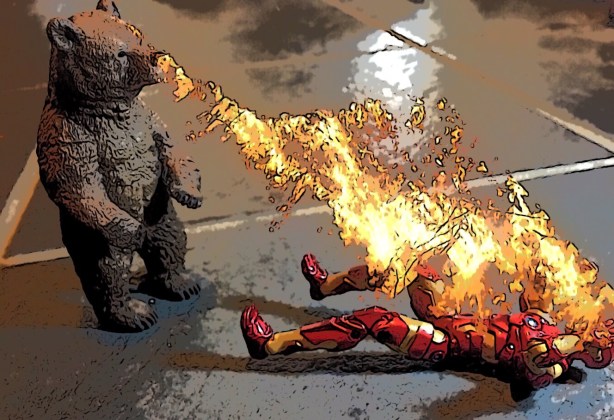
Fantasy novels and RPG campaigns need fantastic monsters. Start small with blended beasties. May I present the dreaded draco-bear, basically a grizzly (or the extinct super-large cave bear when you really need to go big or go home) that breathes fire? Boom! Instant monster. Did I really invent said growly snarly beast? It will take many thousands of man-hours of reading prose written by literally the whole planet to be sure. I assert that the fire breathing ursine is my invention; if I repeat that often enough and no one else produces copyright dates from 2016 or earlier with torch bears languidly burning the pants off every passing hero I will likely get credit.

At this early stage, I won’t bother you presenting Monster Manual stats for this beast. Probably, you’ll take the existing listing for grizzly or cave bear and add an extra handful of hit dice and strap on a fire damage blast with a damage rating of (X – 2)D6 where X is the total number of hit dice bolted onto the creature. What do I know? I’m so far from a consistent RPG game and might not know jack about current game mechanics that this is me telling you to work it out for yourselves…for now.

I mostly just care about how cool these things look between the pages of my books.

We first meet the torch bear occupying a patch of land alongside an ancient piece of two-lane blacktop at the bottom of a steep hill. Homer the Not-So-Barbaric (he’s a collector and transmitter of knowledge, too educated to fully stand in for Conan don’t you think?) leans into the fearsome downhill curve with a mysterious semi-naked lady (more on her in a future post) on his handlebars. Making full use of gravity in the context of giving a lady a thrill on a bicycle works as intended, she squeaks or even screams like the time you first went on Space Mountain with your SO.

The draco-bear lashes out appearing from behind a rock when Homer’s bike with all the Shimano gears a cyclist could ever kind of want is the fastest it will ever be. Homer uses the built up this fearsome downhill speed to launch off the nearest rock catching lots of air leading into a 540-degree spin whipping the frame around and certainly framed to be backlit by the noon sun (trust me, scenes like this in early chapters of books are pure adaptation bait). Homer displays either the impressive situational awareness of a literary hero to instantly grok out that he can push the woman off the bike so she’ll land in a nearby pond deep enough to brake her fall, or he’s been on this road before and remembers these things.

Homer draws the rapier attached to the bike frame (even I’m not so stupid as to give a bicycle riding hero a hip mounted sword, almost as stupid as capes and jet engines). He rolls under the left paw, at least the size of a dinner plate. I give it three passes between torch bear and wandering hero and then Homer skewers the beast.

Like many other writers, I recycle into other stories. The second time my subconscious mind insisted I meet a draco-bear, I started filling my prescription for the literary methadone needed for the end of the seventh season of Game of Thrones by starting up my own version. I have a recently resurrected mostly Roman hero tricked by various great powers into going far from home and – WHOOSH! – enter the torch bear burning and slashing everything before it.

Whether it’s Homer catching air leaping off his bike into the fray or Pelman Bealis facing the torch bear on his long but unsuccessful journey home to his wife, so far I think I shafted this proud beast in my writings so far. Why? When a writer goes for a monster slaying of anything like a draco-bear in an early chapter, he, she or they are clearly going for something that looks tough to show that your character is tough. Dispatching beasts quickly can ruin the value of said creature.

Everybody beat the crap out of LT. Worf first in the average Star Trek: The Next Generation episode to show the audience how much trouble the Enterprise crew would be in this week. But, I can always rationalize these early ass-whoopings on a – “Dude, it was just a baby, wait ‘til I unleash the Mama!” – basis. My whole career thrives on dramatically rationalizing almost everything.

What would the torch bear, the common name used by the peasants, be like, now that I actually have to say a few words about ecological niches, fantastic biology and its lifecycle?

Gordon R. Dickson brought forth an interesting explanation for fire breathing in his Dragon Knight series that started with The George and the Dragon. The dragon breathes fire because body processes create an excess of flammable gasses. Dragons muscle the local dwarves into giving over copious amounts of calcium carbonate (chalk) that interacts with stomach acid to create methane.

The gas changes the dragon’s density to get past the whole – can dragons actually fly with those bodies seen in the pictures? – question that people have asked since Tolkien first wrote Smaug. The dragon lands by expelling the gas through its mouth past a metal protrusion back in the throat near the human uvula that creates a spark. So when asked about a torch bear, don’t reinvent the wheel. Cut and paste.

Fire breathing would make pretty much any beast a little tougher than the average bear (can’t resist, eh Boob!). Likely, we’ll need to construct a gullet with the kind of thermal insulation similar to those tiles NASA used to bolt onto space shuttles before fuel tank foam knocked them off. Is that accomplished with a substance like asbestos infused throughout the soft flesh of the bear’s GI tract to prevent back flashes of what is essentially a flammable waste product? Or is there another similar way to keep the beast from frying its own innards?

Executive decision happening as I write, I’ll go with asbestos infused into bear flesh laid over the chalk and stomach acid explanation for creating the fire. The bear would grow somewhat because another way to resist fire is to make sure that the fireproofing material is laid on thick which spikes up flesh density, resulting in a massive creature compared to the average bear with muscles to match.

In game mechanics, I’m seeing maybe a spread between 50-80 HP and a good armor class that splits the difference between regular bears (about like leather) and a dragon (practically Chobbam tank armor). The hero party would have a moderately difficult time defeating this beast that would increase exponentially with each one on the field.

Are torch bears social, the way most real bears aren’t? Does that make them rougher because they attack like a wolf pack? Can you bribe/distract them throwing your string of fresh caught salmon that way while running this way? I’m keeping this part of the discussion loosey-goosey because right now it’s up to every GM out there to work the draco-bear’s specifics.

There is one thing I will suggest; the torch bear’s main defense is to blow methane through its mouth and light it up. Assuming the Gordon R. Dickson explanation for fire breathing is given credence, please understand the beast is slightly modified from regular bears so as to fart through its mouth instead of through its ass, like every other terrestrial land animal. Whatever changes happen inside the draco-bear’s body; that sounds painful. Expect the torch bear to be a mean bitch with regard to those puny insignificant hairless apes with the pointy objects.

If you read carefully, I use words that are generally suggestive of a post-apocalyptic world in which to drop the torch bear. Something about this wondrous monster just screams – “made in a lab during the Before Time, possibly as part of a complex lifecycle designed to clean up all of that leftover toxic asbestos, and then it escaped.” Or dropping it into a fantasy novel solves that problem because the writer doesn’t have to answer the why of a beast as long as it leaves scars on which the hero reflects.

So there it is, a few basic thoughts on a solid medium-range utility monster sure to burn the adventuring party’s pants off, a good result. I now send you out with the concept for you to tweak to get it just right. Your results will vary…fun.
© 2018 G.N. Jacobs

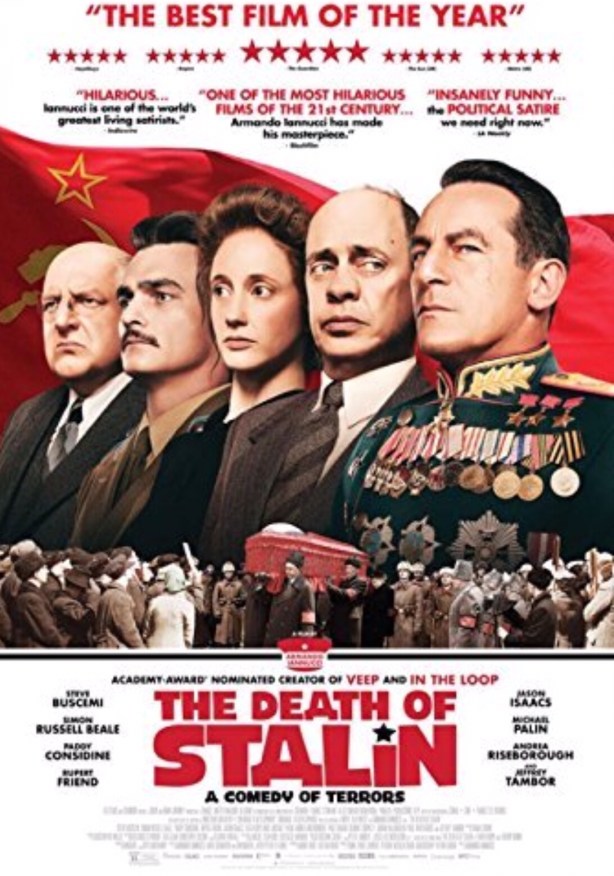
Get ready for Julius Caesar with Russian accents or rather since The Death of Stalin follows an ancient film tradition of spoken in English juxtaposed against Russian written on the signs and flower arrangements we’ll skip the Russian accents entirely.

Scene. An orchestra and pianist play Mozart live over Radio Moscow. Joseph Stalin (Adrian McLoughlin) enjoys the performance in his dacha and calls the station manager wanting a copy of the recording. Ooops! No one had thought to push start on the record cutter.

The station manager runs around frantically because no one denies the “great” man anything. The live audience has mostly left the building and must be replaced. The audiophiles say that the different people will change the acoustics however slightly. It will have to do. The conductor has gone home another must be found. Amid, yet another round of late night roundups of people disappearing into the totalitarian night, a conductor is seized and brought to the radio station in his bathrobe. And they bribe the pianist with 20,000 rubles to play again.

This possibly true to life scene said to have happened in 1944, well before the 1953 death of Stalin, serves as a brilliantly hilarious farcical set piece to open a hilarious movie about the death of one of the world’s great villains. Especially when you consider that the movie has the pianist, Maria Yudina (Olga Kurylenko), a real life musician famous for hating Joseph Stalin and barely tolerating his successors, add a nasty note into the record sleeve that in the movie promptly creates the stress that brings on the cerebral hemorrhage or stroke that history says killed Joseph Stalin.

The movie unfolds as a power struggle between Nikita Khrushchev (Steve Buscemi) and NKVD Chief Lavrenti Beria (Simon Russell Beale). Largely because history records that Beria had his hands on the wheel of the many purges throughout Stalin’s Reign of Terror and the filmmakers making no bones about a common belief of ‘absolute power corrupting absolutely’ we quickly start rooting for Nikita Khrushchev as the lesser of two evils. The secret police chief is depicted as using his power over political prisoners to get on with their desperate wives.

The pitch perfect farce and comedic acting of Buscemi and Beale drive a delicious romp through official Soviet Russia intended to make mincemeat of totalitarian government by casting it as necessarily absurd. The contestants must maintain the ear of Deputy Chairman Georgy Malenkov (Jeffery Tambor) depicted as an ineffectual and easily bullied man more interested in photo ops than running a coherent government.

Each man gets in his shots against the other. Beria sends his secret police to take over Moscow security from the Red Army. Khrushchev orders the trains to let mourners into the city forcing Beria’s unprepared men to open fire. Finally, the game turns on making the right deals, promises and outright lies to Field Marshall Georgy Zhukov (Jason Isaacs), the head of the Red Army and Conqueror of Berlin. With the army on Khrushchev’s side things go as downhill for the movie version of Beria as quickly as they did for the real life man once described by Stalin as “our Himmler.” Good riddance.

The filmmakers and the French graphic novel on which the movie is based clearly used black farce to grind several axes about the Soviet era and Stalin’s rule. And it shows on screen where the guards hear Stalin drop to the floor and no one enters to check because if you guess wrong about the big man’s health and disturb his sleep…BANG! It shows in Nikita Khrushchev flushing toilets to beat Beria’s bugs and complaining about “fucking apartments!” It shows in the sheer number of extras cinematically executed with pistol shots especially Stalin’s house staff. And in a nasty crack when the Politburo arrives and decides to summon a doctor – “We killed all the good doctors.”

In this absurdist farce played completely straight by everyone in the movie, there is one character that stands out as part of the anti-Soviet symbolism in the movie. Foreign Minister Vyacheslav Molotov (Michael Palin) infamous as origin of the nickname Molotov Cocktail (firebomb) is played as the only true believer in the room. His wife has been previously rounded up during a midnight purge and held alive by Beria as a bargaining tool and still the man assumes that his wife must be guilty. It takes Mister Buscemi’s Khrushchev to slap him around and admit the previous regime was capricious and did things at a whim, including that Molotov was on the last Enemies List put out before the death. Mister Palin deserves any and all accolades for this small but vital part.

It helps that this story about ambitious men killing each other to further their ambition and survival is set to really great music. Composer Chris Willis creates the tone of the times by creating music that sounds like Sergei Prokofiev and Dimitri Shostakovich could have written them (assuming the Soviet censors would let them be associated with an anti-Soviet movie). It grounds the movie in a time where brutality was great and the art that survived the insanity of the Socialist Realism Movement reaches higher.

With the exception of Mister Buscemi as Nikita Khrushchev few of the actors look very much like their real life counterparts as seen on Wikipedia. But, you spend so much time laughing at this perfectly directed and edited farce gifted to us by director Armando Iannucci that you just don’t care.

You’ll laugh hysterically at the movie antics of some of History’s worst people. Family entertainment at its finest.

© 2018 G.N. Jacobs

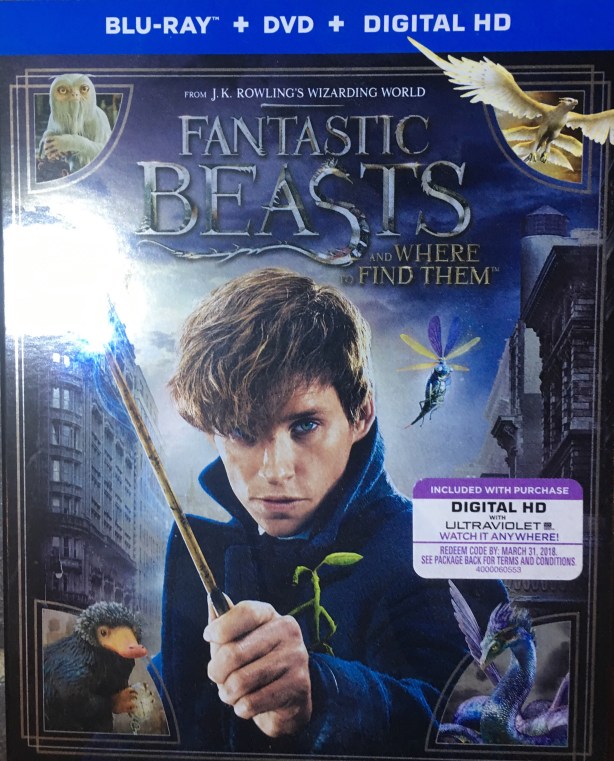
Some movies sneak up on you and Fantastic Beasts and Where to Find Them is exactly that kind of movie. I’ve seen it now a couple times since stripping off the shrink wrap on the disk that I’d let sit on my table for several months doing other things. This latest entry in J.K. Rowling’s Wizarding World franchise gets better with each viewing.

Scene. Gellert Grindelwald (Johnny Depp) blows up other wizards presumably in Europe. Events that are reported with the typical bloodthirsty scaremongering headlines of The New York Daily Ghost or perhaps the real life New York Post. The viewer must pay attention to the moving newspaper as it lays the foundations of the story. Grindelwald has the wizards everywhere in an uproar. American wizards don’t really like the magical beasts with whom they share the planet. Certain muggles or No-Maj Americans organize against the wizards despite few believing them. You might enjoy some giggle water…Oh, yeah, mustn’t forget the unknown force rampaging the city.

Into this turmoil lurking under the surface, Newt Scamander (Eddie Redmayne) walks down a steamship gangplank bringing his special suitcase that needs a Muggle button to hide the wondrous things inside. He intends to release a Thunderbird back into the wilds of Arizona. All of which goes awry walking past a bank in Lower Manhattan.

Despite being the sort of odd duck that has trouble looking people in the eye, Newt catches the attention of Mary Lou Barebone (Samantha Morton), an anti-witchcraft activist. The distraction allows a niffler to peel its way out of Newt’s TARDIS-like suitcase. Newt follows the kleptomaniac platypus into the bank where he chances to meet Jacob Kowalski (Dan Fogler), baker in need of a loan to open his bakery. Newt and Jacob each bring similar suitcases into the bank.

Meanwhile, Tina Goldstein (Kate Waterston), a former Auror (magic cop) with MACUSA follows Newt into the bank suspicious of the odd duck in New York. Between the niffler picking up all manner of shiny objects for the pouch and the inevitable switcheroo of the similar suitcases, Ms. Goldstein has her hands full helping Newt and Jacob retrieve the magical creatures that have escaped. Launching us on a path that leads to the inevitable discovery of the creature terrorizing New York such that even No-Maj people feel the threat.

In many ways, Jacob Kowalski steals large sections of the movie as the No-Maj sidekick. Mister Fogler’s performance as an everyman attempting to bootstrap himself in the bakery of his dreams helps ground the movie. His eyes bug out seeing what magic does for the wizarding community and then he shrugs digging in to experience the next assault on regular reality. And of the two male leads paired off with the Goldstein sisters, he gets the better scenes with Tina’s baby sister, Queenie Goldstein (Alison Sudol). He also takes getting steamrolled by a magical rhinoceros very well.

Given that the movie is set in 1926, I still found it odd that Tina comes off as the type of no-nonsense woman typically played by Kate Hepburn and Queenie comes off as the sort of high-pitched flapper later consolidated into the cartoon character Betty Boop. I kept wondering how these two completely different women actually resulted from the same orphan upbringing. But, then the filmmakers made sure that Jacob entered scene soon enough to keep us from asking this question more than once.

As for the developing relationship between Newt and Tina, both characters start with great reserve. Newt’s general inability to look people in the eye would seem to get in the way of engendering trust, but Tina finds whatever there is to find in this odd British duck. Frankly, Mr. Redmayne’s choices for the character are primarily why it has taken me several viewings to decide I liked the movie instead of merely tolerating the story. Even when they mean well, real world people that don’t make eye contact are sometimes hard to take.

But, then you dive deeper and realize that the odd duck is the plan. He admits to Tina early on that he “tends to annoy people.” And as you’d hope for the wizarding equivalent of Dr. Doolittle, the character lights up with wonder every time one of his fantastic beasts shares the screen.

I will highlight Colin Farrell as the chief American Auror, Percival Graves, providing a harsh look at wizard justice, especially violations of the International Secrecy Act. He holds his cards to his chest presenting what seems to be the care and concern for wizards and witches. He keeps an eye on Mary Lou Barebone’s New Salem Protective Society turning the woman’s adoptive son Credence (Ezra Miller) into an asset trying to find the Obscurus (a parasite that grows from repressed magic) that stalks New York despite official protestations to the contrary. Creepy personified.

Rounding out the experience of this fun movie, we get to look at CGI artists going all out for the creatures in Newt’s suitcase. Most of them closely reference real world animals or legendary creatures and provide most of the color in the neutral hues used for a New York imagined diagonally from the photographs of the era. Good times had by all.

In short for a fun movie that grows on you each time your kids make you see it, see this movie.

© 2018 G.N. Jacobs

Is it truly a slow news day? Depends on what kind of news for which you go looking. But, for the kind that matters here in Black Lung-ed Reptile Land, amusing shit that may or may not help a fellow writer get off their ass and make words appear…Yeah, slow news day. Especially in the absence of the next writing manual or oversold crap gear to eviscerate, I need things to distract me from the film review that currently seems to have tripped down the basement stairs (I do try to mix up my worn out metaphors… occasionally). So I sit down on my tile floor and roll my story dice.

And here we go with yet another trip to Grandma’s house…if Granny could stand living two left turns from normal. Six sets of prompts from which I will hopefully choose one over the next few days and post the results in the dormant Author’s Assortment column to kick things off. Or sit back and watch as the small handful of you that read me (thanks by the way) start goofing on the prompts. Eventually, I do want to read your stuff. And why only six sets today? Tile floor, Ducky! Obviously, sit normally like a Big Boy next time.

A few assumptions and ground rules. No overt erotica…please. Play nice, while I do have a lot of tolerance for challenging I have precisely zero for intentionally being a douchebag to hurt other people. I believe I have enough reading comprehension to know the difference. If you do play along, post links to wherever you post your writing and don’t fill up comment boxes whether here, on Facebook or Twitter with text. The according to Hoyle rules that come with the dice I use says roll 9 dice and start writing. They also say I can make up rules as I go along. Therefore, I roll 12 dice and drop the lamest three results (or not). Oh, and just because I rolled lots of dice doesn’t mean that this is a completely random thing. After all my eyes are open picking the dice for each roll and my proclivities are probably apparent to those of you paying attention, so perhaps I pick dice because of whatever.

The first prompt card #43:

1) Wolf baying at the Moon

2) Cyclops

3) Satellite dish

4) Spider web

5) Acorn

6) Tree

7) Hypnosis

8) Notebook

9) Scientist

10) Geode

11) Super-speed

12) Searching

Prompt card #44:

1) Shooting star

2) Break a test tube (or an eraser)

3) Syringe

4) Jet fighter

5) Bloodstain

6) Bricklayer

7) Goose/swan

8) Barbarian helmet

9) Acting

10) Crescent Moon

11) Evil cephalopod (C’thulu?)

12) Mirrored person (Star Trek Mirror Universe?)

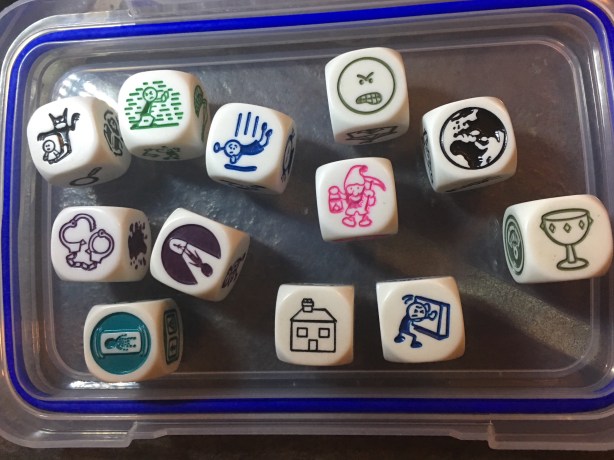
Prompt card #45 (see picture):

1) Anger

2) Drunken dwarf

3) Fall down

4) Chalice

5) House

6) Handcuffs (see rules above)

7) Scary shadowy entrance

8) Freezer pod (could also be a transporter)

9) Globe/Earth

10) Open/close a window

11) Open a secret door (this one really blew up my eyes)

12) Imaginary friend

Prompt card #46:

1) Soccer jersey

2) Marvin T. Martian

3) Tasmanian Devil

4) Stranded at sea

5) Bricklayer

6) Big splash

7) Bumblebee

8) Magic mushroom

9) Stethoscope

10) Team sports

11) Zombie rising

12) Police siren

Prompt card #47:

1) Stroll

2) Cyclops

3) Jet airliner

4) Eyeball

5) Cell phone

6) Bumblebee

7) Galaxy

8) Ambulance

9) Angry ghost

10) Sloth

11) Count money

12) Kaiju steps on people

Prompt card #48:

1) Drunken dwarf (again?)

2) Gremlin/goblin

3) Volcano

4) Light bulb/idea

5) Film reel

6) American football

7) Soccer net

8) Painful hit

9) Knock on door

10) Aging superhero

11) Dodge falling objects

12) Draw/animate

As a bit of commentary, many of the images are subject to interpretation and that I use reading glasses. For instance, Geode? Kind of, maybe. Same with Painful Hit. You are free to interpret any of this in the most useful way possible. Some of these are already sparking ideas that I’ll get to eventually, but I won’t go there until a little later. My words aren’t your words and shouldn’t pollute the stream until we agree to pee at the same time. Good writing to you!

There I feel a little better…

© 2018 G.N. Jacobs

I’m such a sucker at times. After enough eyeball impressions (usually in my Facebook feed), I might just buy anything that looks like it could help a writer toiling away somewhere. The ReMarkable Tablet that you might have seen advertised in your feed was just one of those new shiny objects that I just had to have. And because of the average lead time for a product review post versus just going out and seeing a movie to get my two cents in with my Flamethrower column, I fucked myself because I’m past the return date about two weeks after purchase.

To recap this not ready for prime time [expletive deleted] device promises that it will replace all the many variations of paper married to a trusty ballpoint pen, pencil or watercolor brush (for those so inclined). The ReMarkable is a white rectangle with dimensions (in Portrait) that suggest European A4 width and American Letter length that maximizes the piezoelectric tech of your choice of finger tap keyboard, or the write on screen ability of the recent Apple Pen that comes with later iPads. I declare the promises of buying fewer spiral notebooks overblown.

When I first got the thing about four weeks ago, I toyed with it. I play with every new toy at least once as soon as I cut open the shrink-wrap. I set up the device connecting to my home WiFi so I can email files to myself for storage. I charge it up and get ready stylus poised and write.

In this early session, I tapped the button for Portrait Mode like how we’ve been taught to approach any old pad of tear off Letter sized paper (short across the top and longer vertically towards your body). And I got busy with the provided stylus making letters and words appear in a variation of a College Ruled template (blank pages induce my text to alternately go up to the right or down to the right). Everything seemingly worked more or less as advertised in that choosing Pencil made words appear that I could later retype into something else.

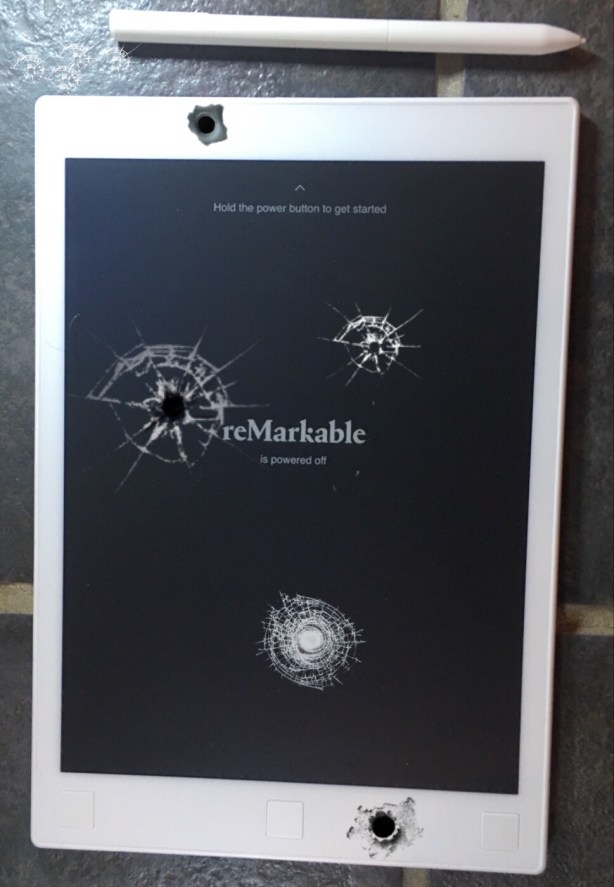
As you might see in the photo, this writing tablet has three buttons across the bottom when you orient it in Portrait Mode. The left button is Page Back sending you to the previous page (if it exists). The center button is the Home Button sending you back to the home screen where your note files are saved and you can choose any of your existing files or start something new in which to work. The right button is the Next Page button that will either send the user to the next page in sequence or if you’re at the end of the file it will automatically add a new page to the end of the file.

During this early session, my natural right-handed wrist on the page pen stroke style induced over decades of dealing with book reports and essays for school did me dirty. My wrist would hit this Next Page button suddenly putting me on a blank page orphaned from the rest of my notes/writing. I would have to hit the right button to find where I’d left off. I begrudge literally every second I spend fixing something that I don’t have to worry about using older technology (paper).

The second thing I noticed about writing with the tablet is that the plastic stylus is thinner than I like. If you were to mug me for the pens in my pocket you would see that while I have choices within the same brand between wide barrels and narrow barrels. The only thin barrel design I have has an iPad rubber stylus tip on it. I believe reinforced by how my pen strokes make my elbow feel that wide barrels sit easier in my fingers. Or I could’ve just convinced myself of this allowing my mind to think they fit better.

My solution, if I liked the tablet more, would be to dig out some of the leftover colored gaff tape from my film production days and wrap up the stylus for a thicker grip. It didn’t get this far, so we’ll never know. My words filled up the screen despite the screaming tendons in my elbow.

In the second session conducted more recently, I solve the Portrait problem by turning the tablet sideways to the right and picking the Landscape variation of College Ruled lines. My hand now moves away from the Next Page Button. All seems right in my writing universe as I imagine trading off between my Elfinbook notebook (see post) and the ReMarkable both allowing me to feel more progressive and pro-tree than perhaps I really am. The smaller reusable notebook that uses photographed pages to create PDFs would be good for some uses and the larger ReMarkable, I could maybe use for larger drawings because I really like belly-flopping off the 30-meter platform at the Olympics when it comes to my pictures.

Both paperless technologies are predicated on being able to create PDF files of my notes to send or cut and paste into a folder on my computer, especially wallowing in the arrogance of believing in a historically relevant literary estate. I’ve commented on the reusable notebook saving things to PDF and how easy it is to combine pages into one document. I tried the same thing with this big first draft of my review for The Death of Stalin. Tried as in – “Do or do not, there is no try!” – or the similar, “I’ll try means I’ll fail!”

Sending this handwritten text to myself using my fairly standard WiFi connection failed miserably because the file size was too large in PDF. Really, three pages of handwritten text is too large when other mobile apps can handle huge PDF files by comparison? And you have to send files from the tablet itself because there isn’t a Share Files button on the companion mobile app.

Trying to save things, when I realized I had the option of sending the file using the Photoshop originated PNG format I did that. The file went through, but then I added too many extra steps reconverting to a PDF. And the full text didn’t go through so I would have to rewrite the review or type from the tablet.

Gee, Guys! I feel so happy knowing that I paid $678 for a writing tablet that fails miserably in all of the small ways like file management that I ended buying an unusable paperweight. Maybe I bought something I could put onto a starship bridge set? Or some other flavor of movie prop? Certainly, what passes for my ethics says can’t give this [expletive deleted] away and have the gift accepted in the spirit intended. I wuzzz ROBBED!