© 2019 G.N. Jacobs

Writer’s block, a hotly contested topic. 1) Does it exist? 2) Is it just an excuse for laziness? 3) What causes it? 4) What do I do about it? Those are usually the questions on the subject.

In my experience…1) Yes, some of the time. 2) Yes, the rest of the time. 3a) If you answered Yes to question One then the answer will usually be some sort of unhealed mental trauma. 3b) If you answered Yes to Question Two, bad habits, sloth and/or an apparent lack of ideas. 4) Your choice of therapy or “just write something and see where it takes you.” This post largely covers a small part of the second answer to Question 4 and an even smaller part of 3B.

Writers hear and say the Write Anything suggestion all the time. Ray Bradbury reinforced it telling people how when he could afford it he had six typewriters in his house in order to always work on something. Paul Savage, the head writer of Gunsmoke after the post-1963 shakeup told me at my dad’s seventieth birthday party to – “write every day.” Since I do write nearly every day both before my huge writer’s block episode ten years ago and after, I can attest the advice largely works.

Next, we have the single most heard excuse for not getting started – “I don’t have any ideas.” A writer with reason to feel empathy towards writer’s block when it’s real will still roll their eyes hearing this one. We assert Write Anything as the cure all precisely because of a phenomenon that describes a writer with the opposite problem, too many ideas shouting between the ears fighting for the next slot on paper.

A writer trying to get the vampire western onto the page doesn’t actually want to hear from the protagonist of the vampire pirate story (unless they’re really the same story, a topic for the advanced class). But, while scribbling out the big scene of the vampire standing under the full China Moon ten feet away away from the in-story equivalent of Jonathan Harker hands twitching near those classic wheel guns – *record scratch* – and…

Suddenly, a pirate Dream Team, Blackbeard, Bartholomew Roberts, Jean Lafitte, Anne Bonney, Mary Read, okay, let’s throw in Captain Hook and Jack Sparrow for good measure, are now swinging on halyards across to the bloodsucker’s bloody grimy quarterdeck. The writer hearing the Ennio Morricone Good, Bad and Ugly theme in his/her head suddenly shifted to the Korngold last heard on Captain Blood. And now most writers are either pounding head to the desk, pouring a whiskey or quitting to watch TV.

All three of these responses are wrong because what is not happening is a furtherance of the vampire western and this indecision could be how we become J.D. Salinger, a one hit wonder. Experienced writers hearing this complaint typically tell their students and mentees to take a minute to groove on the new idea, write it down in their notebook and get immediately back to the project that originally did the spawning. Other experienced writers (yo, I’m your Huckleberry) will modify that to say pick a small handful of projects with one as primary and the rest are secondaries; switch around as needed on these small few projects and write down all other ideas and brain farts as suggested above. A blocked primary project can cause full writer’s block if there aren’t a few other outlets.

So back to the scared writer afraid of getting started and probably annoyed that the Been Theres just rolled their eyes for the fiftieth time. Also claiming to have no ideas. This person is likely to ask – “is this phenomenon of getting all these good ideas while trying to write other things real?”

Yes, Ducky. Before leaving Facebook, the I Have Too Many Ideas While Writing Other Things thread surfaced about every two weeks. A lot of writers I know and I can all show you our list of ideas on our Notes and Lists apps at the drop of a hat, or will open up our paper notebooks. Lined part of the page for the current work; unlined top margin for new ideas and brain farts.

As one example, the morning of this writing I’m doing a pen draft for a post about exploring the Word of the Day where suddenly I comment that the phrase in English sounds like a horror movie title. BING! Write down the idea before it’s gone and keep going. I simply attest this happens to me literally all the time.

It then occurs to me that if the solution to too many ideas is take a minute to groove, write it down and move on, then some genius should figure out how to use the same advice flipped on its head to solve the too few ideas problem. Specifically, the new writer afraid of not having the right idea could, in theory, start writing from some goofy prompt (see bottom of post). Hopefully, something you’d never want under your name.

The idea is to trick yourself into creating ideas you like. First, write the thing from the prompt. You hate it. It’s not good enough. And…and… – *record scratch* – an idea.

Write this next idea down in your brand spankin’ new notebook or notes app. Go back to the prompt driven project. Yes, I know the title of this post is First Interruption, but hear me out, you need more than one homegrown idea to begin your list like sourdough starter. So repeat the suggestions from one paragraph above until you have four record scratches, just to be safe.

Now you have four ideas likely to be brilliant…after a draft, four edits, one shithead editor, two more edits and…(see the advanced class). You also have an unfinished craptacular prompt driven project that you hate because ultimately Not Invented Here is a thing everywhere, Ducky. So now you have a decision…

Maybe you come to love the prompt driven thing. If so keep going. Keep expanding your project list with each record scratch. Rejoice in the primary’s eventual completion.

But, likely you still hate it. So now you pull out the first interrupting idea and get started. Eventually, you rejoice in this completion, too.

Will this suggestion work? Don’t actually know. It feels like it should because once you’re in the consistently writing part of the club, you will get all kinds of good ideas. And make a list you’ll never complete barring a Faustian deal.

The prompt – “Suffering from incessant hallucinations, a fallen angel, accidentally runs over Lucifer’s favorite Hellhound (slightly edited, natch).”

The secondary dice prompt – Angry Ghost, Cow, Evil Puppet/Ventriloquist Doll, Science Experiment, First Aid Kit, Cough, Music, Gilded Cage, Pirates, Gemstone Necklace, Child with Glasses, Superhero Shooting Fireballs.

Extra points and the accolade “you’re a better writer than I, Gunga Din” for the writer that figures out if the two prompts might be the same prompt. Shall we begin?
© 2019 G.N. Jacobs

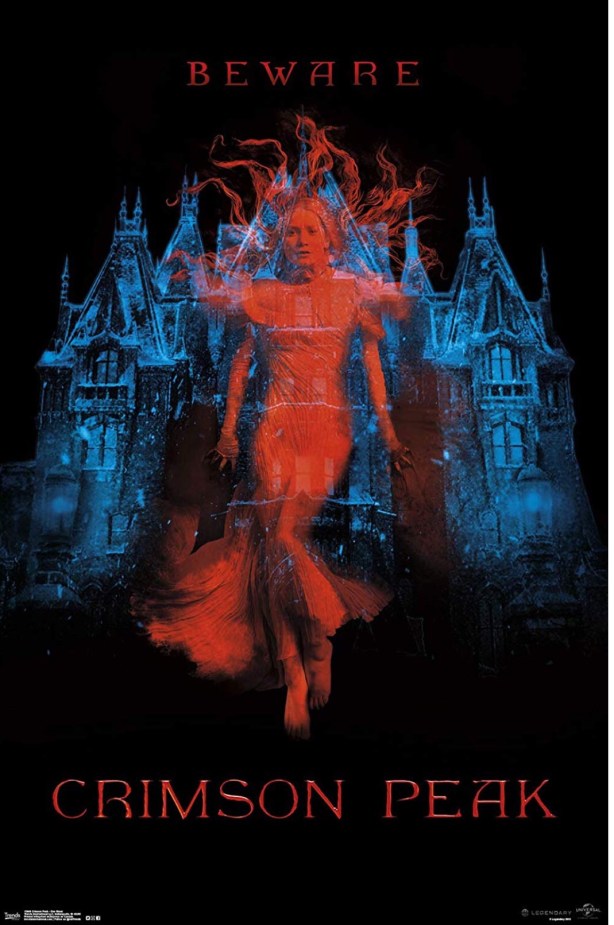
Romantic ghost story, so the DVD label said. Guillermo del Toro’s recent entry into the Gothic Romance genre, Crimson Peak, was on the face of things romantic and had ghosts in it…so no need to call the FTC. But, still only a movie to define the middle of the pack instead of me either really hating it or really loving it.

Edith Cushing (Mia Wasikowska) gets set to present her latest ghost story novel to an editor. The editor, perhaps expressing a mix of the sexism of the late Victorian Age and that Edith is still young and hasn’t been beaten around as an author yet, sends her packing. Undeterred, Edith arranges to borrow one of the newfangled typewriters in her father’s construction office to create an even better manuscript.

Father, Carter Cushing (Jim Beaver), leads a new business acquaintance, Sir Thomas Sharpe (Tom Hiddleston), into the office for a discussion about an investment opportunity. The English Baronet takes a moment to look over Edith’s shoulder and recognizes her work for what it is immediately. And then Meet Cute style is only clued into her being the boss’ daughter afterwards.

Carter and his partners hear Sir Thomas out concerning his need for funding new machinery to harvest the red clay on his moldering estate back in England in order to make bricks. The American businessmen in the room, including Mr. Carter, all got there Horatio Alger style and don’t trust softie-pants English gentlemen with privilege. But, there’s something else about Sir Thomas and his sister, Lucille (Jessica Chastain), that doesn’t sit well with Mr. Carter. Something likely to show up in the kind of Trans-Atlantic background checks possible in 1901, if you hire a detective.

Meanwhile, Sir Thomas goes around Mr. Carter in seeking Edith’s companionship waiting until everyone else attends a party that Edith didn’t care for. Edith and Sir Thomas show up fashionably late and dance a waltz. The detective brings back the fruits of the background check at the party causing Mr. Cushing to bribe Sir Thomas away from his only daughter. Schemes that only backfire leading to murder, marriage, more murder and you guessed it many ghosts in Sir Thomas’s crumbling estate on which only red clay is likely to grow.

The movie trades on the fantastic production design inherent in director Guillermo del Toro’s vision applied to literally everything he does. Need a house with a hole in the roof to let in both the fall leaves and later white snow? Need a physical darkness to go with the darkness in the characters? Need certain chromatic juxtapositions like white snow and the red clay into which the house will one day sink? Then the right director was at the helm.

But, Mr. del Toro’s usual instincts for storytelling that go beyond what things look like on screen didn’t fully show up. We are treated to a movie that works a little more like Rebecca than Dracula. In the former, the female protagonist gets into a battle with another woman associated with her new husband and his creepy estate and ends on good terms with her husband. In the latter, the new husband/lover is straight up the problem and doesn’t survive the story killed by the protagonist.

The checklist aspects of a plot putting Edith, Lucille and Sir Thomas in the same house with competing agendas unfolds more or less as expected. Sir Thomas despite a lifetime of being creepy with his even creepier older sister grows in affection for his new wife. The sister won’t have any of that and soon out pop the axes, knives and other tools of blunt and stabby force trauma. And we spend more time waiting for skeletons to float up out of vats of red clay.

But, the moment we need to see where Sir Thomas changes sides in the ongoing program to wed available rich heiresses with no other family, poison their tea and take the inheritances, really seems almost nonexistent on screen. Yes, structurally the movie contrives to get Edith and Sir Thomas snowed in alone in the village pub which results in sex that he’d promised Lucille would never happen.

But, what’s on screen is the “we need this scene because Blake Snyder says we need it, but we’re putting our money elsewhere” version of this admittedly union-mandated moment. This is me in the wilderness pleading for a little more than “you’re different than all the others.”

Which brings to mind that perhaps there were more things to use in getting Edith out through the story alive. She is a writer currently specializing in ghost stories largely due to her mother’s ghost earlier appearance right after dying of TB warning her – “beware of Crimson Peak” – the nickname of the house due to the white snow and red clay. Edith sees Dead People…I buried the lead in the setup. Deal. However, we don’t see a single action by Edith attributable to her writing.

No moments where the things going bump in the house are analyzed by Edith doing a cross between Velma and Stephen King (but only at certain snowbound hotels). Any newly rich woman being slowly poisoned by her new sister in law would do the same things Edith does.

I just had a thought. Tom Hiddleston gave Sir Thomas an air of being truly concerned that his new machine would save the family by resuming the brickworks enterprise. He spends much time outside firing up the steam engine, not oblivious to the women chasing each other inside with stabby things and poisoned teacups, but certain this is less important than getting the machine working. Could this be a motive for Sir Thomas to change sides, believing Edith to be better for his long term goals than his sister? We won’t know, no one wrote this script.

So far I haven’t said much about the ghosts. The spirits of the three previous ex-wives killed in this old house; they serve more as warnings and clues for Edith to solve than actual parts of the story. They lead her to wax cylinders made by the last dead wife and advance the plot until Lucille’s treachery is revealed. It means you could dump the ghosts and find other ways for Edith to discover the plot against her and still have almost the same movie.

That said the swirling blacks and reds of the various ghosts in this movie are almost worth the price of admission by themselves. I just wish these dead ladies did more to intrude into the plot instead of existing slightly outside. Well, there’s always the next ghost story.

The production also did very well in casting. I might not have liked very much about the writing between the three characters that matter: Sir Thomas, Lucille and Edith. But, for the imaginary well-written version of this movie I still want Mia Wasikowska, Tom Hiddleston and Jessica Chastain. Each actor was so well chosen that I can’t really see anyone else playing these parts.

Tom Hiddleston may have needed a few better scenes to create a more believable setup for his character’s big moments, but he did get what he could out his face in the moments in between. And of course, he brings every bit of Loki to the part where he’s the overtly charming prom date soon to expose his dark side. It helps to hire Loki.

Jessica Chastain just went for it with the creepy, crazy Lucille that clearly emulates the housekeeper in Rebecca. Crazy. Violent. Incestuous (been dancing around this saying creepy a lot). And totally convincing. In a “please, Dear God, Ms. Chastain, don’t tell us about your research process” sort of way.

Mia Wasikowska tears it up as Edith. A warm and engaging presence similar to her performance as Alice. We care as she explores the house led by the ghosts only she sees. And…

All in all, Crimson Peak served as a decent video renter where we get to spend a pleasant few hours in a house that really should be allowed to sink into the mud. And now we get back to our regularly scheduled programming.

© 2019 G.N. Jacobs

Depending on where I last left things, I love the in-between on many projects. The perpetual toe dance between getting forty new ideas a year onto to my list for later thought, writing/typing preliminary chapters to make sure I actually understand my idea and work intended to just “flop the fish on the deck, or go home” is just Tuesday for me. I must love it a little, I do this so often.

When I get an idea, I mull it over in my head for hours. Sometimes I land on a title, but usually I’m thinking about the characters, setting and maybe the antagonist. Sometimes I have a title and somehow have to live up the promise of the title…truth in advertising. And don’t get me started on a certain movie title that over sold what was on screen, but I digress…

One example of having what should be enough to create a draft in three or four months, but for all the other puppies clawing and whining for attention somewhere in my dinosaur pea brain…The Gunfighter Oratorio. A simple thought process really…at some point you’re just going to have to write a rip-off/homage to the Hobbit and call it a day. Specifically, start with a party and all these focaccia dwarves just invited themselves to the shindig leading to a quest to rid the world of dangerous tools.

As of this moment, I’ve already thought up the character and where he lives. And I’ve also thought up the “things I do differently,” a.k.a. The Six Points of Dissimilarity (a legal standard that means the difference between sued and – “HA-HA, MF! SUCK IT HARD!”). Fairly early in the process, I’m thinking: Thorin is a woman, no hobbits nor dwarves, the band of fourteen is, in strict point of fact, a band bringing along their instruments, the quest McGuffin is related to music (stole it from a horror novel idea, no reason it can’t appear in both) and the minute I decided upon a fantasy world with six shooters, the piece was always going to have its title.

I’ve done a couple test chapters establishing a comfortable house in the wellbit land of Haven (people don’t usually reinvent the wheel when they name things). The landed gentry-man splitting the difference between Bilbo and Frodo lives in this house playing his viola contemplating that his impending run for Mayor may require an adventure.

His guests arrive in ones and twos creating a party where there had been none; finally, the object of the party shows up last, their sister and cousin escorted to meet her betrothed in a faraway land. Sparks fly and when the guests mention that they need both a viola and a fourteenth for the journey, the host leaves home.

And that’s about as far as I’ve gotten. Other stories, maintaining this blog, doing a few more pages of my great comic book and the occasional side trip into TV Land all mean I have to pick a small number of these ideas just to scratch something off the list. My uncle once said, “I’m continuously impressed how you keep working and eventually publish things.”

Currently, the in-betweens that really matter involved an repurposed assassin clone falling in love with a widower as they delve into the secrets of her existence and save the world from hidden enemies. Or there’s been a decent amount of work recently on the two sisters from Trademark Safe Tatooine who band together despite loving the same man to save their planet from excessively greedy and destructive commercial exploitation. Until the next idea makes another left turn…

And there is still another book, a complete rewrite of my (hopefully only) tragically destroyed Crimes Against Elves. Five years grieving for the old version despite pretending it didn’t matter is enough. People asked “can’t you just take the parts that offended her out?” No, I either rewrite the whole thing from jump so that what needs to change doesn’t stick out where everyone sees it and gives me shit for leaving such glaring plot holes. A process that takes five years.

Nothing about how I handle my many in-betweens necessarily should inform how you handle your in-betweens. Yes, I try to keep my distraction to just a few projects keeping them hot and doing my words on a daily basis; that’s as much writing tip as I know how to give in this case. Fight to keep your gnat attention span focused on just a couple things; the other gadflies will still be there.

In addition to the simple incapability to maintain linear thought on just one project for more than six weeks, here’s what I’m thinking is also going on. The places I go when I write are just too damned entertaining in the sense of both places and the people living there that the imagining is sometimes enough to keep me entertained. Screw the words!

Of course, I can’t screw the words forever. The writing does two things. Help me understand what the purely visual part of the imagination didn’t actually tell me about, say, the Obsidian City. And I have to write it if I’m going to share the adventure. So here we are stuck in many in-betweens where I’m having all the fun (sorry), but I do write at least four times a week. I’ll get there…eventually.

© 2019 G.N. Jacobs

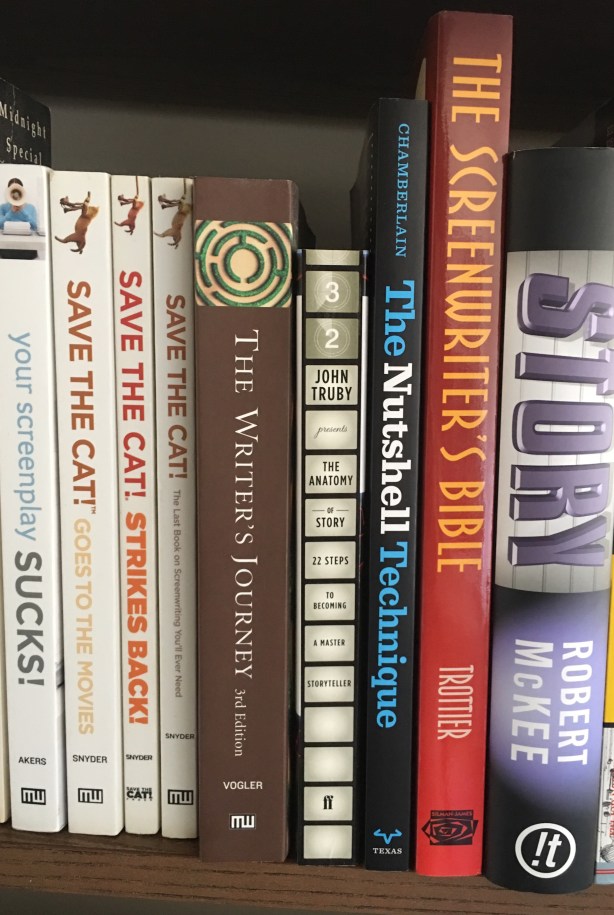
I have a complicated relationship with any sort of writing manual, but most especially the ones meant for screenwriters. You’ll hear me decry the cookie cutter feel of newer or lazy writers that use these books to the exclusion of all other considerations. Then I’ll launch into a discussion about a plot using the lingo – “In Star Wars what is the All is Lost Moment?” – “Obi-Wan raising his saber to give the others time to get away with the Death Star plans.” I don’t hate them completely, just misuse thereof.

So new rule: read all writing manuals, especially the ones primarily dealing with classic structure, after writing the first draft of your first work.

Now for the why. These books all harken back to the works of Joseph Campbell who in turn drew on Carl Jung, the pioneer psychoanalyst that taught us about narrative archetypes as a way to understand why we do things. Jung’s presumed thinking: people go crazy in ways that become eminently predictable once they start telling their stories that reveal personal needs.

Thus, when the doctor repeatedly hears the same general stories, humanity has a universality that shows up in our narrative. Identify the needs in the story, cure the patient. And the theory says that while the physical cause of being Napoleon versus the guy in the next bed being Alexander is the same, the reason for the divergent delusions will show up in the narrative heard in therapy concurrently with administering the drugs. At least, Jung moved the field past the nonstop sexual dysfunction of Freud, but I digress.

Joseph Campbell attacked the problem from the other end as a folklorist. He went out and tried to gather stories from as many sources as possible. Apparently, across many cultures he found a commonality of that leads to many of the aphorisms that still guides writers – “Two basic stories, a prince/outcast/farm boy leaves town or the stranger comes to town” – “Stories involve the metaphor of the dangerous quest creating the circumstances for the protagonist to grow into his true self” – “Characters fall into highly recognizable categories: farm boy, princess, orphan, rogue, absent father, monarch etc. etc., that Jung would call archetypes” – “We tell the same seven (fifty?) stories” – “You have zero conflict to drive your story.”

There are modern folklorists trying to shoot bullets at Campbell’s work. Because I’m just the guy writing the stories and not a professional folklorist, I have zero tools at the moment to decide whether it’s just popular to shoot bullets at work that might be too connected to the bad old ways. Or if Campbell missed key examples of stories that were dramatic, but didn’t follow the exact pattern of the Hero’s Journey identified in his work. Much actual scholarship to follow.

What I do know is this, I wrote a book with a vampire sitting pretty in a metaphorical castle trying to exert his will upon a young lady forced to make a choice between the un-life offered by the vampire and a full life in our world with lovers, husbands, jobs and the next adventure. As Mina Harker nearly cracks, but comes roaring back to stick Vlad between the ribs, so to did Anna Victor trick her vampire lover into a tandem embrace only to fuck his ass up with a Dixon-Ticonderoga Number Two pencil. It was only, like, three weeks ago that I even admitted – “Oh, wow! I just rewrote Dracula only changing little things like the journalism setting and made Anna the woman that drives like she should go pro! My bad!”

We really do tell the same stories over and over.

The best explanation for this presumed universality is this. People once shared the same campfires telling the same stories. When the truthful story about Hork and his rumble with a lion gets boring with repetition, then guided by the joker heckling the story from the far wall, the story evolves to take on the characteristics of Herakles killing the Nemean Lion, a true monster.

It is possible that the exact structure outlined in the books that I deride as Do X on Page Five, is even more completely ingrained than I want to admit. The good parts of the story which the bastardized theory says creates a biochemical response in the form of epinephrine, endorphins and other psychoactive hormones that are basically addictive. And because we all once shared the same caves, really good stories play well across the whole world because of the ancient memories of jonesing for the same stories.

Back to my suggestion for a new writer to read these books after completing the first draft of their first work. If it holds up that structure is an ancient species memory encoded in our genes by these chemicals, then the writer wouldn’t need the book to tell them Do X on Page Five. They will get there themselves simply by writing the words allowing the apparent semi-conscious thought process do the work for them.

If you add in that I wrote a book where it has taken me eleven years to admit that I mugged Bram Stoker for his literary lunch money, we can assume that the books you read up to the point you start writing will influence your work guiding your structure. Let your subconscious mind that includes your memory of the books you like do the work for you.

Part of my love-hate with writing manuals of this kind is that I’ve come to believe that it’s a cart-horse problem. Do things in the best order for you watch your story soar. Front load your story with worry about the book telling you to Do X on Page Five watch your misery sometimes block you from writing anything at all. For me it comes down to write the stupid book now and worry about the according to Hoyle structure later.

I’m not saying you should never read these books. We all live in the common narrative with access to the same tools and it helps to understand them. I believe our subconscious minds will get us close on the first draft, but we still need help when moving to the second draft. Read the books you think you need to when it’s time to edit your work into all subsequent drafts. This is similar to the practice among screenwriters of placing their scenes on cards and playing with the order to see what really works.

Of course, none of what I suggest applies to someone on their second project. Once you’ve read these books, they can’t be unread and to one degree or another they’ll guide your subconscious, semi-conscious and conscious thinking in the future. This is a good thing when you have experience to deal with different stories, but first time out it sucks to have to listen to you worry about silly things when I just want to tell you – “You used to be five and you made up shit goofing around with your friends and it was probably brilliant!”

Anyway, this is a suggestion like many others. At least someone will pipe up – “I beg to differ, they need to deal with these concepts upfront.” And if reading the manuals first helps and you don’t freak out about the punctilio of Do X on Page Five, then do it your way. Just write the book and enjoy the process.

© 2019 G.N. Jacobs

Assuming you care for the why of the silence about the superhero opera bloviated about some months back; I don’t have anything remotely like a libretto. At the moment, it’s a character problem and so Scribbler’s Saga. I have too many heroes…

My characters now collectively referred to as The Angel Association have mentally evolved over the years. Starting out as adjuncts of a SF/Horror franchise where the main characters of the two primary series of interrelated books interacted with the supers, changes became necessary. The stories largely remain.

Mostly twenty-somethings in perpetual search of the good job, promotion at the job they already have, the next musician to sign and a worthy partner, the association stands ready to protect Los Angeles against all comers. All of that survived largely intact. But, for most of the time thinking about it, there were only two villains…for a hero association now expanded to well over fourteen heroes. If there are only two villains, they’d pretty much have to be Galactus and Thanos at the three falls tag team match.

My best villainy so far: a trademark safe Joker and an ill-defined dude in Roman armor (must’ve been watching Looney Toons that week). Suddenly, I’m sitting on two psychos turning Los Angeles into Gotham West without anyone making for a challenge, even at the level of Brainiac or Sinestro. And there aren’t any Galactuses, Thanoses or Darkseids (the advanced class ready for the third opera) yet to appear in this story. I need more and better variety.

I may have had an easier time making heroes, but in a way what happened here is what happened with with the villains only sooner. Which leads us to the several related meanings of team building.

In the first sense, team building is all about putting the team together. Nick Fury just shows up in your house, helps himself to your coffee and leans on you hard about joining the Avengers Initiative. He has your file being the dumbass that admitted – “yeah, I’m Iron Man” – on TV. He has Captain America’s file. Hulk’s file. Thor’s file. You get the progression.

Pretty much S.H.I.E.L.D. has set loose strategists, chess players, comic book fans and a snotty AI to achieve what real world comic book fans yell about every Wednesday, who wins the fight and why? That when upscaled to the marquee team mimics my current problem…do these characters belong in the same fight, let alone the same spandex clubhouse/lair?

I probably need to read more about how Stan Lee devised his characters with the art staff, including but not limited to Jack Kirby. Did they sit around goofing on concepts for characters completely at the expense of how they would be used? Or once they had the team did they start playing games like “we’re doing a volcano villain do you think we should borrow Ice Man from the X-Men?” Judging from the comics, either they did that intentionally from the start of each book or they naturally got to the same place afterward taking the temperature of the readership likely to send in letters to Stan’s column. Go left, go right, the road is usually the same.

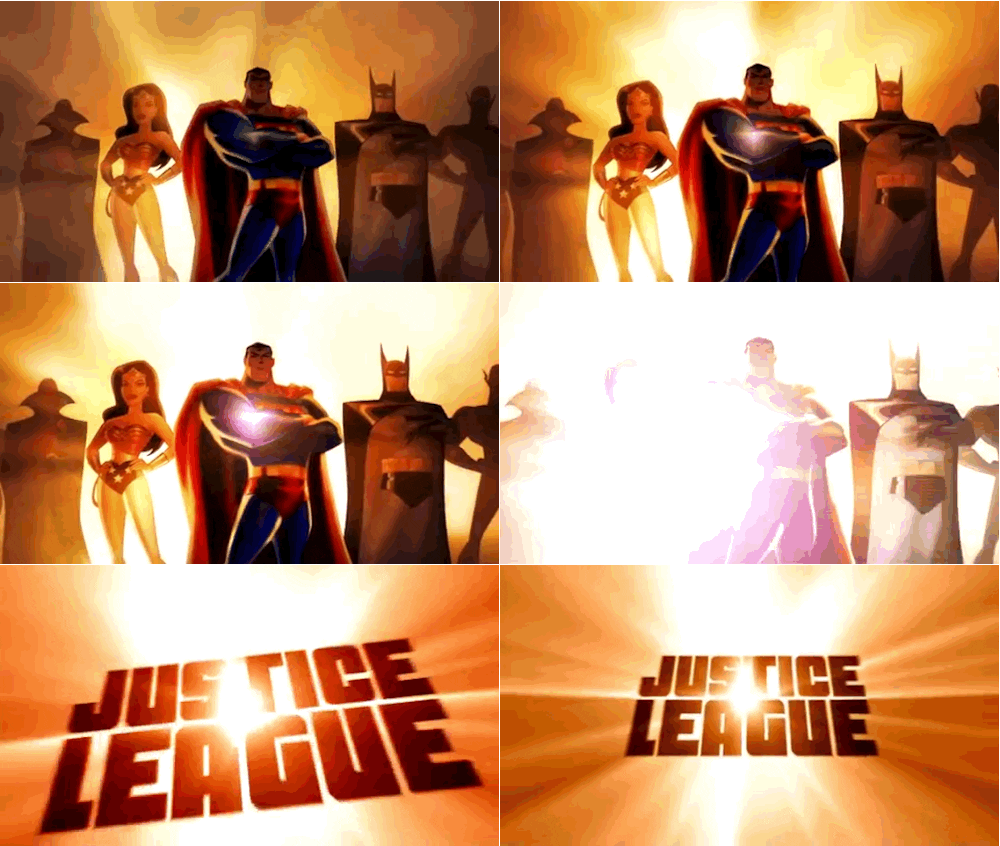
Or we could discuss a friend (a primary source for me), who famously can’t stand that Aquaman is an A-list founding member of the Justice League. Visit his store on Sunday and ask him about Aquaman – “What does he bring to the team? He’s the water super. He talks to and controls fish. He swims real well and helps his friends win underwater. He’s also pretty strong. Okay, cool, until you understand who else is on the team. You have Superman, a largely invulnerable alien who survives in vacuum who is also the apex of strength plus all of his other godlike powers. You have Green Lantern, a crazy brave man given a ring limited only by his imagination. You have a Wonder Woman who pretty much has all of that strength plus the Lasso of Truth. I could go on, but we can stop here now that we have the Top Three of the League who all have powers that can be used to replace Aquaman on the team. In fact, just about the only thing he does that helps might be to summon up a tuna sandwich for lunch!”

Underneath the Comic Book Guy trash talk, listen carefully…my friend has spent a lot of time doing the tactical analysis puzzle. Superman and Green Lantern really don’t notice being underwater and the rest of the top tier can simply figure it out. An opinion I don’t completely share; I like to think I’m writer enough to figure it out knowing that Aquaman is part of the team. And fans seem to love him.

Back to my characters, the heroes pretty much rolled off my smoking word processor. I’ve already done much of the imaginings for the heroes and how they fight together. Trademark Safe Batman plots and plans. Trademark Safe Wonder Woman makes cookies and provides the emotional leadership that belies that she gets most of her power from being a retired Fury. Trademark Safe Flash adds speed and the take no prisoners attitude of a feminist school teacher.

When I feel ready to speak more directly about the archetypes I folded, spindled and mutilated for my own purposes, you’ll get to see who else I’ve looted to keep LA safe. But, fourteen heroes and two villains still is a slaughter for the good guys. The heroes don’t do well with slaughters, narrow victories will do nicely.

The easy temporary solution is to act in another sense of team builder, that of a general manager looking at a looming trade deadline. Needing at least eight villains of great enough heft to make things interesting for the reader, I simply took two heroes and sold them to the Yankees for a metaphorical $80,000, players to be named later and at least three draft picks. I hope my nonexistent mistress appreciates the starring role on Broadway.

One former hero eats data. She touches computers and flash drives and destroys the data contained within saving a copy to her regular long term memory. But, she also eats the onboard biological programming and memories built into a living brain, a mind flayer in skirt suit for those of us that play RPGs. Brains simply taste better.

And I thought she was the tortured hero sorry for killing somebody in the past trying to make do like Lestat saying, “well, you can eat rats, but they taste like shit.” Her power very easily drives her crazy, especially now that the ink just dried on the trade agreement. I did leave it open for her to be the subject of a redemption plot. You get one.

The second former hero in this trade is my Trademark Safe Green Lantern that I killed off in the backstory. My villain team slaughtered off the original heroes in the spandex version of Order 66. My Green Lantern analog went with the rest. And now he’s back from the dead as a wildcard villain with no love for the Legion of Chaos. Trades are such wonderful things.

I still need up to three more villains. I have other old notebooks to peruse from earlier passes at these characters where I tried to figure out where they fit. There might be some good villains, we’ll see. Or something will just come to me.

Throughout the whole lengthy development process, the mix and match game of what makes a good team has played out constantly with each pass of the pen and keyboard. Hopefully, you’ll do the same with your characters. With that…Go Home!