Archive for the ‘Uncategorized’ Category

© 2020 G.N. Jacobs

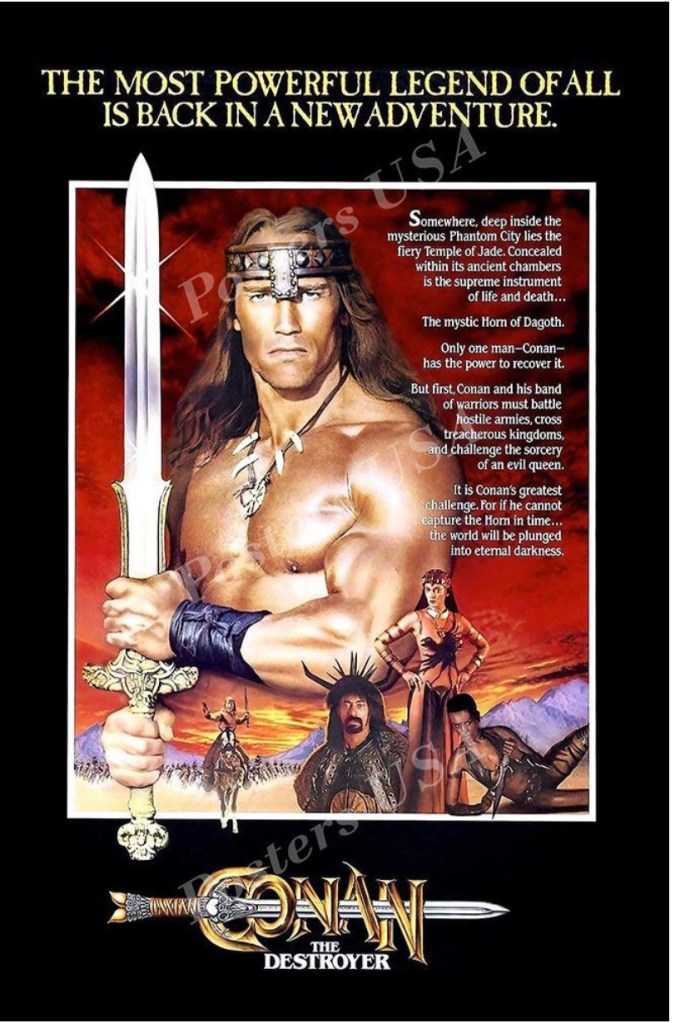
Going back to the era “between the time the time when the oceans drank Atlantis and the rise of the sons of Arius” proved generally fun in the form of Conan the Destroyer.

This time around Conan (Arnold Schwarzenegger) is just minding his own business somewhere near the fabulous city of Shadrizar. He has a new thief sidekick, Malak (Tracey Walter) has the wizard Akiro (Mako) on the Hyborian Age version of speed dial and life is good…except for still mourning Valeria (Sandahl Bergman, file footage).

Unbeknownst to Conan, Queen Taramis (Sarah Douglas) plots to send her niece Jehnna (Olivia d’Abo) on a quest to retrieve a jeweled horn sending Bombaata (Wilt Chamberlain) as protector to the virgin princess, who will then be sacrificed once the demon/evil god Dagoth is released. And Bombaata will stick Conan in the back once he’s served his usefulness.

Everyone gets on their horses and rides this way and that in the cinematic Mexican countryside doubling for Shadrizar, an ancient city that Robert E. Howard placed on his fictional Hyborian world map in what is now the Middle East. Deserts. Greenery. Lakes. Pretty landscapes galore.

Depending on how drunk or nit-picky snippy one wants to get about watching this sequel, we either really hate it or cock our heads to one side and say something like – “I see what they tried for.” Gone is the supreme bombast of the origin story of the first movie directed by John Milius who couldn’t do a Conan movie any other way than balls out R-rated. Replaced by an intentional desire to tone it down to a PG rating, while acknowledging the first movie at the hands of equally veteran director, Richard Fleischer.

The basic plot of “hire the hero as the disposable outsider to escort the virgin princess on her quest to retrieve, count ‘em, two related McGuffins and then kill both Conan and the girl” should automatically work under any circumstances and should’ve worked better than what’s on screen. Hell, I think Raymond Chandler used elements of this general plot in at least two of his Phillip Marlowe novels (or not I’ll look it up eventually).

For my money, this plot that requires the Bodyguard/Escort to start having feelings for the Princess/Protectee basically needs more on screen in this pairing of Mr. Schwarzenegger’s Conan and Ms. d’Abo’s Princess Jehnna. They went for naïve and petulant little girl against the war-hardened barbarian and the film never really finds a way for said princess to actually break through Conan’s romantic armor concerning his mythologizing of his lost love, Valeria.

The princess pretty much does everything she can, except wearing a sign – NEEDY VIRGIN PRINCESS, PLEASE MOLEST – around her neck to get Conan’s attention. An obvious way to milk the plot for more danger to the mission missed. Having Jehnna discussing the problem with Zula (Grace Jones) a warrior woman freed from a village vigilante mob by Conan doesn’t help much. It’s just kind of a flat relationship, acting, writing…blame somebody.

Part of me hopes that the cuts made to the movie to get the rating down from the R the film still had after shooting despite going trying to go family friendly are buried somewhere on my Blu-Ray’s secondary features. Having a sex scene between Conan and Queen Taramis would distract a little from the flat pairing of Princess and Barbarian. It might add more to the understanding of the evil queen lying and doing everything she can to unleash Dagoth’s darkness. But I digress…

Anyway, the movie isn’t horrible and manages quite a few interesting one-off gags, some that reference the first movie. The team enters Shadrizar. There’s a camel. Malak, despite having been recast from the previous Subotai (Gerry Lopez, not in the sequel) points out the camel. And Conan attempts to apologize for punching said beast in the first movie.  

Early in the movie, Akiro is captured by cannibals that want to eat the wizard to consume his power. He is rescued after struggling the way Han Solo comically struggled against his being tied up and cooked on a spit by the Ewoks. Malak and Akiro share a few barbs about – “why would they want to eat such a sourpuss as you?” Fun. Almost union-mandated, but still fun.

The movie gets better contemplating at least one of the two stops on Princess Jehnna’s quest. The crystal castle in the middle of a lake owned by wizard Toth-Amon (Pat Roach) proves almost worth the ticket price (disk price in my case) all by itself. Jehnna is spirited away across the water by Toth-Amon, daring the heroes across in the boat.

This leads to a visually interesting wizard fight in a hall of mirrors where Conan destroys each mirror in turn to destroy the monstrous form of the wizard. That and the having to swim to sneak into the villain base makes for a nice sequence that generally makes the movie.

And then second major stop that takes the key (a big honking grapefruit sized diamond) from the lake castle to use retrieving the jeweled horn to return to Shadrizar. Everything about this sequence that isn’t human works without question or quibble. The production found just the right tightly spaced rock formations in Mexico for a claustrophobic fear-inducing sequence. They also dressed up the studio set with a really interesting set with a lot of fire and trick locks and a lot of writing on the wall.

That last part is important, writing on the wall, because Akiro ably demonstrates the common superpower of all fantasy wizards, the ability to read. He reads the prophecy on the wall that gives away that Queen Taramis wants to unleash Dagoth and Jehnna must be killed. And we go with all of this right up to the point where a small part named Leader (Ferdy Mayne), the second evil wizard to die in this movie appears on screen. Mostly, I couldn’t stop laughing at the typewriter bell sound effects as he did his magic. Pollutes much about an otherwise acceptable scene.

 Depending on the number of bad breakfast burritos I had the morning of viewing, I’m either going to go all out asserting that basketball great, Wilt Chamberlain, doesn’t belong in this movie at the level of thespianship, or just shrug and grade on a curve. For Conan movies, I always grade on a curve. It helps having the Big Man as the final boss fight.

Similarly, I’ve gone back and forth on Grace Jones as a cinema presence since the beginning of her career. Need a semi-scary, odd wild woman in your film, Ms. Jones is your lady. As an aside, it’s a pity that her performance as Zula, which has generally grown on me over the years, couldn’t help anything about Mayday or A View to a Kill, but I digress…

This time around, Conan thrilled me at the level of needing stuff in the fantasy genre to watch on Saturday nights inserting the disk. Most of the stuff I’ve mentioned that sounds like I’m basing on the whole experience really just lands in the – “well, they did their best and it’s still generally fun” – area…except for the lack of apparent relationship between Conan and Jehnna. Thus endeth the review…
© 2020 G.N. Jacobs

“Between the time when the oceans drank Atlantis and the rise of the sons of Arius…”

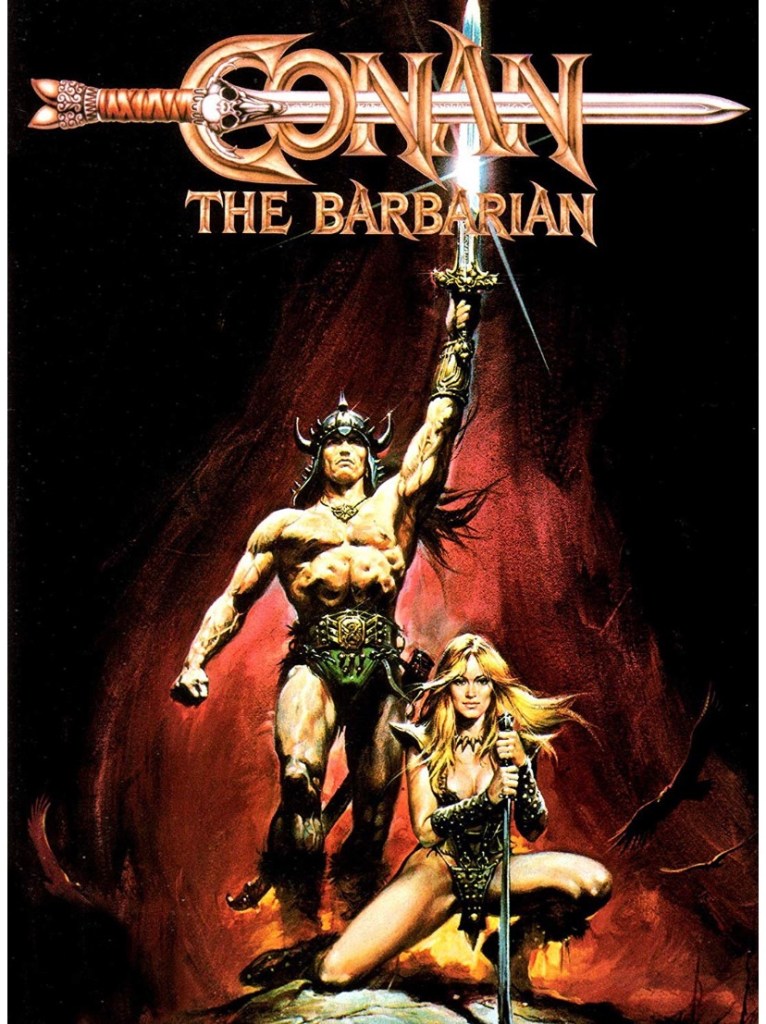
So begins the filmed version of the world’s most popular barbarian, Robert E. Howard’s Conan the Barbarian. An empirically fun movie and that’s all it needs to be.

We begin, as with most versions, with some variation of the bad people come to mug the village and young Conan is the only or one of few survivors trope. This time Conan’s father (William Smith) is the village blacksmith with a fondness for making swords makes what seems a great blade.

His font of fatherly wisdom includes reverence for the fictional Cimmerian deity of Crom and, in what now seems like a minor writing flaw, a lot of words concerning the “Riddle of Steel.” Steel attracts the aforementioned mugging party…this time at the hands of Thulsa Doom (James Earl Jones). Daddy skewered. Mommy beheaded. Conan (Arnold Schwarzenegger) enslaved first upon the Wheel of Pain (a human-driven flour mill) and then to points further away as a gladiator until freed upon the world as barbarian, thief, soldier, pirate and lover. Soon to gain vengeance upon Thulsa Doom and his snake cult…

This movie lands so well largely because of the combined talents of two titans of cinema of the era (1970-1990), director and co-writer John Milius and co-writer Oliver Stone (imagine that!). Guided by L. Sprague de Camp (wrote a large proportion of the continuation novels) as technical advisor, the script pretty much hits all the high spots of the books and comics without actually being based on any one thing. Certainly, it gives the feel of a production that hit the cinema magic of writing to enhance what it had instead of writing to some mythical standard of what didn’t exist.

Casting a young Arnold Schwarzenegger in the lead makes absolute sense physically. The muscles, of course, and it’s a short leap of hair dye and other costuming choices to get the former Mr. Olympia to look sort of like how Robert Howard described the character. Seeing the movie reveals some of that magic that landed on paper because…

…despite a later career where we sometimes laughed at the Arnold’s casting in this or that (e.g. Mr. Freeze anyone?), this production gives us a character that fits the perceived nature of the actor. Conan sometimes just needs to be all about the presence on screen that also translates to the one-sheet poster. And keeping his emotive range to determination, anger and the fundamentally unimpressed by the magic and other folderol of his enemies…I guess we’ll be arguing for many decades whether Mr. Schwarzenegger was a good actor, or an amazing presence that it didn’t matter. Projects that create that kind of ambiguity are, by definition, well written.

There are other ways in which this movie was destined to go well from the script stage like choosing snakes as the villain motif. True, the snakes of the Stygian (pseudo-Egyptian) god Set run all throughout the entirety of the mythos whether written by Howard, L. Sprague de Camp, Lin Carter or even on the comic book side, Roy Thomas. And yes, we as a species don’t really like snakes with the easy harken back to Genesis 2 and later.

However, I speak about the practical reasons you go with snakes as the villain motif in a movie filmed in about 1980-1981, the puppets. In context, the production came just a few years after Bruce the Animatronic Shark scared the bejesus out of the average beachgoer greatly aided by a now famous music cue, but looked kinda animatronic and fake when actually seen on screen. The absolutely terrifying believability of the snakes here (one a giant pet, the other something Thulsa Doom transforms into) is just something to be seen. Either the art of animatronics advanced into the stratosphere, or snakes are just easer to pull off. Awesome result!

The movie landed well with casting across the board. Max von Sydow as King Osric who sends Conan, Valeria (Sandahl Bergman), Subotai (Gerry Lopez) and later Akiro (Mako) all help make a story about an angry father hiring disposable goons to retrieve a wayward daughter from a cult shine. Von Sydow eats up the scenery telling the wayward adventurers “all that remains is a father’s lover for his child.”

Let’s shout out for James Earl Jones as Thulsa Doom. Filmed roughly between Empire Strikes Back and Return of the Jedi this performance chose to just put Mr. Jones on screen as the villain strutting around creating his snake based religious cult after realizing his answer to the “Riddle of Steel,” that steel is nothing compared to the hand that wields it. Good choice.

There are a few moments that play out simply on Thulsa Doom’s face that alternately show the character’s otherworldly creepiness, much like the snakes he favors. Or we get to see the charisma of the snake charmer that simply asks a follower to jump off the ledge to prove his point about the power of flesh. That the actor pretty much managed all these variations of evil, greed and contempt without breaking a sweat just speaks to your casting director. We must remain eternally grateful that Mr. Jones only used his powers for good as an actor, instead of forming his own religion…

This does bring up a quibble. Young Conan is told about the “Riddle of Steel.” Older Conan brings it up that he has to say what the riddle is or be booted out of Valhalla. I never really got to hear what Messers. Milius and Stone thought the riddle was, at least in terms of Conan’s perspective on the matter. To this observer’s way of thinking, this leaves a large conceptual hole in an otherwise great script.

At a metallurgical level, the riddle is fairly simple…add charcoal in just the right amount to the iron to get steel in the first place. Of course, we aren’t going to sit through a treatise on blacksmithing and swords, even though much know-how went in at the front end where sometimes the core of the blade was shaped differently than the edge. Sorry this whole bit is boring after a few sentences even here in the review.

The movie remains silent as to the other aspects of the riddle. So, a pseudo-Viking/samurai bushido philosophy about making the warrior worthy of his weapon that destroys the previous bronze weapons? Conan in his original conception is surprisingly well-educated as depicted in the sequences set in pre-historic Asia where he is trained with what look to be katanas without the fancy hilt decorations. He would’ve read the works of Sun-Tzu if Howard hadn’t specifically set his world before even ancient China rose out of the Stone Age. So, what is the riddle, Guys? Or is that the point, that it’s ultimately meaningless…a spiritual MacGuffin? You decide kids.

One of my favorite film composers has always been Basil Poledouris, largely because if you wanted a drums, brass and choral heavy score during the era this is who you hired. I can’t tell if the best music in the score made the scenes it was placed under, a green stew of human body parts (Yeeesh!), attacking the tower, falling in love with Valeria etc., or if the scenes were already strong and just needed music worth the trip. Either way, music and visuals knit together to make everything work. Okay, so I got bored and just wanted to see a movie from my youth the four-zillionth time to see if it held up. Yes, it does. I’m a sucker for sword and sorcery and movies that turn out better than expected. Well worth the $3.99 to rent this from Apple.

Ethical and perhaps boring…

© 2020 G.N. Jacobs

“Any sufficiently advanced technology is indistinguishable from magic.” – Arthur C. Clarke.

Absolutely UN-ethical, but definitely not boring.

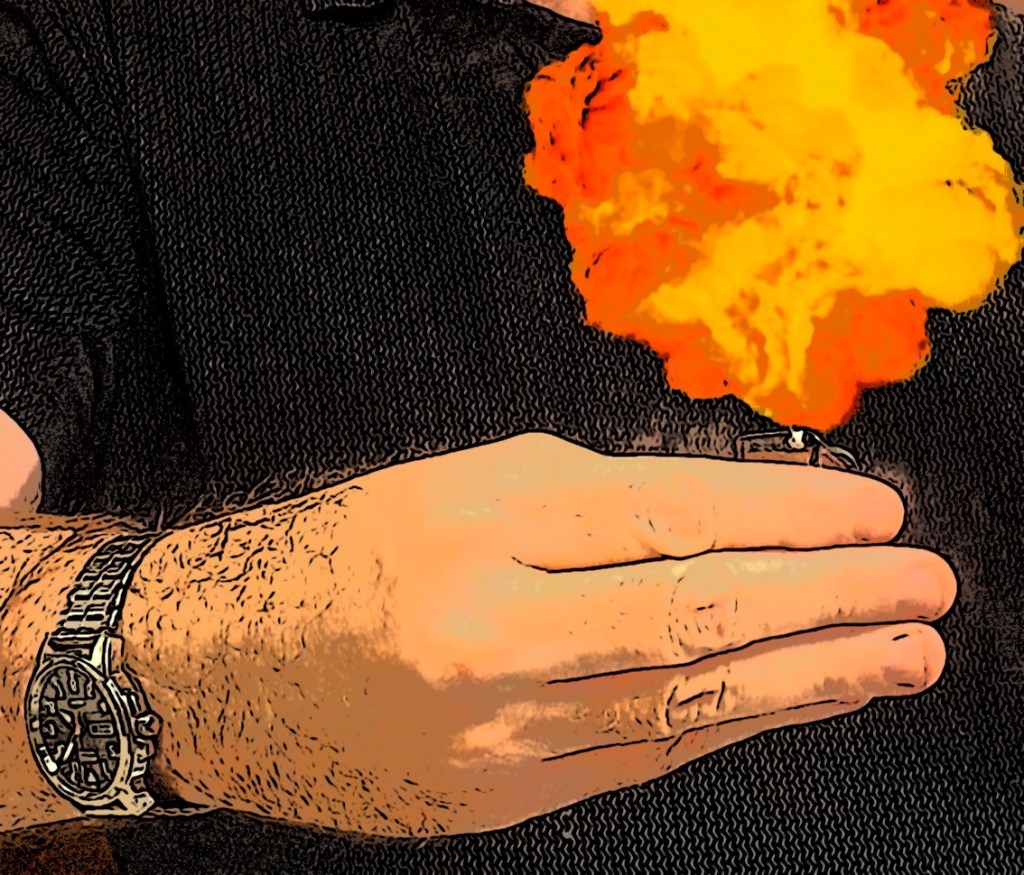
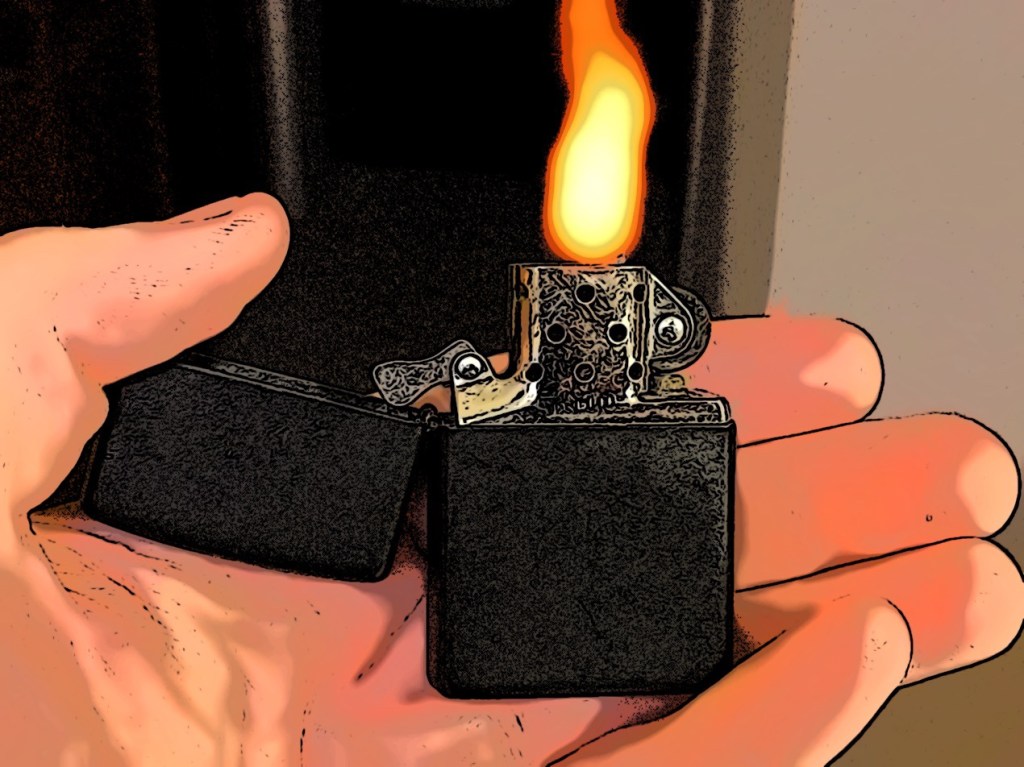
By the time I reached middle school in 1980, this statement about knowledge and perception was common enough that Mr. D’Amato explained it in seventh grade Social Studies (an overview class with elements of Anthropology and Archeology). He used the example of some douchebag going into the Amazon and waving a lit Zippo around among the tribesmen from whatever uncontacted society fit the hypothetical discussion. Makes total sense…if you don’t see something previously and the person showing off the magic doesn’t carefully open up his/her hands to reveal the wires, well, what else is it, but magic and likely dark magic at that?

 Over the many years since I’ve become a writer and now actually retroactively care about the things I was taught; I’ve had a lot of time to consider the statement. And start asking the questions that go over a twelve-year-old’s head. And to see how some of my favorite books and shows did amazing toe dances with the concept long before Mr. Clarke put it in writing.

My first read of J.R.R. Tolkien’s Hobbit and Lord of the Rings roughly coincided with the Social Studies class mentioned above, maybe eighteen months before. Wonderful book. Great movies (even the Ralph Bakshi version that everyone else seems to have hated). And if you read closely…is it magic or technology?

Case in point. Gandalf is being a douchebag scratching the Thief Seeking Employment symbol on the freshly painted door at Bag End. Bilbo waxes quite craptologically about Gandalf’s fireworks remembering fond times when the wizard blew a lot of cool shit up at one of the Old Took’s parties. This later pays off at Bilbo’s Eleventy First (111) birthday when having Gandalf back for a command performance proves an excellent distraction for the worthy Hobbit taking the runner to Rivendell and, with a little bit of encouragement (arm twisting), leaving the Ring to Frodo.

Is Gandalf a wizard or just a really skilled chemist with a taste for pyrotechnics and showmanship?

If we judged only from Gandalf’s fire and other blowing shit up “magic,” we can’t tell. He carries Glamdring, a presumably magicked up elf blade, for all the times when there might not be enough orcs on the board to use up a spell. Does he have stamina issues where it’s just easier to cut orcs in half most days?

At Minas Tirith, the White One was seen behind the wall working up a big one. Yes, villains do blow up on a regular basis through the course of the story. But once we start re-reading these passages with this question in mind…grenades prepared in advance and kept in a hidden pouch or great and terrible magic that coalesces hydrogen out of the air ready for a spark? That I suppose is up to the reader. FYI, Saruman sends a fairly small orc on a kamikaze sapper mission to take out the drainage culvert at Helm’s Deep with a barrel of black powder.

To be fair, Gandalf’s real magic seems to fall into the Leadership, Strength of Character and Morale categories. This is harder to dismiss, especially when given various halo and light effects in the movies.

Have a king wasting away from having to listen to the kind of advisor that only maybe certain unpopular presidents could love? Send in the wizard to do the long-distance exorcism and fistfight leaving Saruman a little roughed up on his tile floor.

Need to buy time for everyone else as they run out the back door? Well, there were quite a bit of bright white lighting cues anytime Gandalf stood up to the really bad monster. Harder to dismiss as fakery and people did have more hope…for a time. Yes, he bats about .500; the Balrog killed him and the Witch King of Angmar decided to pick the fight later on better terms.

Fakery. As I got older, I realized that Mr. Clarke had the beginnings of wisdom, but not the end of it. How much of the example of the Zippo in the Amazon depends on the actions of a stage illusionist, possibly an unscrupulous one? Someone who knows how to hold the lighter so the less advanced observer can see the Behold, I Make Fire trick without seeing the metal lid to the lighter or burning one’s fingers.

Gandalf is a showman. The description of practically having a Beavis & Butthead sense of – “heh, heh, coooool!” – when it comes to blowing up his fireworks gives it away. This means he also knows how to palm a lighter or, more to the point, a firebox. This means he knows how drive eyeballs over here, while – “ignore the man behind the curtain!”

Let’s take a few other examples from our shared narrative database. Moses? Direct line to God, or a cranky magician with a better local calendar than the Egyptians? Various waterways that presumably went blood red during the Plagues have gone crimson since…iron ore deposits stirred up and red tides being the main explanations. To be fair, the one good argument for Work of God is the except in Goshen rider to most of the middle Plagues. Yeah, how do you pull that off without a lot of help that still might not exist in current technology? I’ll get back to you when someone burns the trick for the next Fox Special, “Breaking the Magic Code Pt. 5003, Egypt.”

Do you get more out the swarm simply knowing when the locusts are due and timing the pitch to Pharaoh (your half-brother) accordingly? And did he make up some mumbo jumbo about lamb’s blood on the lintel and the Angel of Death to provide cover for a small dedicated team of guys with nothing left to lose running around the countryside putting the First Born to the sword? We weren’t there and the rest is simply what we choose to believe.

Mark Twain understood Clarke’s Law a hundred years before its publishing. He has his protagonist in A Connecticut Yankee in King Arthur’s Court blow up Merlin’s Tower with black powder, lightning rod and outguessing the next storm. The rest was all about – “I need several days to prepare the spell, Your Majesty.”

And convincing Merlin to vacate. Really? It’s a good idea to bunk out for several days while some pipsqueak newcomer says he going to level your house? That alone suggests the con-artistry of the average stage magician. Hell, it’s straight up performance art!

Clarke’s Third Law also comes into play in the average Star Trek episode where a Prime Directive violation becomes inevitable and must be managed instead of avoided. The character that made the mistake opens up his/her hands and shows the box, tells what it does, apologizes for the intrusion, but only to the smart local who seems like they understood the most. Essentially, Captain Archer/Pike/Kirk/Picard/Sisko/Janeway shows off the cigarette lighter…

“See here, my good man, this is a cigarette lighter. It makes fire.” Opens lid. Flicks striker wheel. FIRE. Awe. “This wheel thingy is made of flint. There is a flammable gas held in this cotton part. Spark. Fuel. Air. And…” “Fire, Boss.” “Right, fire. Now the lid also…” SNAP CLOSED. “…takes away the air. Would you like to try it?” “Yes, Boss.” “Okay, there’s a little bit of a trick to it so you don’t burn off your fingers, but it’ll take a couple seconds to show…”

Ah, the wonderful ethics of Star Trek. On the downside, there are almost no stage magicians and other showmen left in the Federation. It shows in the ugly civilian clothes common to all the shows, until recently.

The Continuing Mission also gets us to ask the really good corollary question to Clarke’s Third Law – is there a point where the observer is sufficiently advanced that instead of believing in magic, they simply go looking for the wires or the cigarette lighter?

Looking for the wires turned Ardra the Mighty into a joke when Picard’s team uses his distraction of the arbitration hearing to find her starship. One more con man scratched off.

This ethic of “it’s not magic, we just haven’t found the wires” runs all throughout Picard’s dealings with Q. Go back to the episodes. How many times does Picard just ask Q to drop the stupid showmanship and theatricality, usually with a non-verbal cue? In one episode, Q claims to be God. In another later one, Q backtracks to “I knew him.” Neither time does Picard seem very much impressed and asks Q to get to the part where he says what he wants. He’s found too many cigarette lighters in his time.

What stories might originate here?

© 2020 G.N. Jacobs

Dark ruined castles. Faraway sand swept plains dotted with evaporator towers. Orbital debris fields that are just one bad breakfast burrito away from an abandonment order like the Somme Battlefield. Cities cut by extreme tide surges out of basalt and obsidian. All of these places that mostly exist between my ears are exactly that places and if I could I’d open them up to travel agents and sell tickets…oh, right, write the F@$&ing book.

These imaginary places are also a convenient excuse for discussing how choosing the right locations changes the story.

Let’s take my most recent usage of dark ruined castle that time seems to have passed by. I watched the animated Beauty & the Beast again. I start asking questions the way I sometimes have to ask funny questions of all of my fan enthusiasms…

HOW MUCH FOOD WAS IN THE FREEZER? (see post)

GOLDFINGER’S PLOT TO IRRADIATE THE GOLD VAULT, COULD THE US GOVERNMENT RENDER ITS EFFECTS MOOT WITH A CAREFULLY CONSTRUCTED BIG LIE? (post pending…maybe)

The question I had for the both the Disney movies highlighted by a dance in a yellow dress was this – “the sleepy little French village where Belle lives before going into the woods seems walking distance from the Beast’s castle, wouldn’t there be a built up legend about the dark woods and the monster reputed to live there?”

This question rattled around in my subconscious along with the other more consciously derived elements when I started playing around with goofing on a sequel/not sequel describing what happens after the kiss, fireworks and the assertion without proof that they lived happily ever after. I know I’m going to throw in an element where Belle (sorry, renamed Helena-Linda Aranajeuz de Feo) gets so freaking bored after reading every book in the Beast’s considerable library that she starts writing her own books to keep sane. I know I’m going to need something more than the lady of the house yelling at poor Lumiere to bring more ink and clean up the pile of false starts on the floor. And I know I need a location for the castle that makes the time passed it by quality of the original story.

I can’t claim my solution to the last question was entirely conscious. I started giving Helena-Linda her vaguely Spanish nature as a way to have her be named Belle without being named Belle. Thus, I changed languages to Spanish and go with Helena (prettiest woman in Ancient Greece), Linda (pretty in Spanish) and a made-up surname that sounds like a concerto by Rodrigo I happen to like and hear a lot. And de Feo (ugly) is a good married surname for the Beast’s wife in French.

Without even consciously addressing the question of how the Beast in his castle is completely unknown to the villagers in the nearby community, by picking languages I backhandedly solve the problem…The Pyrenees. A border area between France and Spain, the mountain range also has the tall confusing mountain trails where you might get lost and find a castle that time has forgotten only to never find it again on the second try. Places where the magic required, doesn’t have to work as hard to say hidden.

I would’ve had to answer the question eventually. And I would get to the same place where once I have the answer to – “where do they live?” – I also have part of the answer to who these people are. Suddenly, I’m writing a few pages where Belle refers to the Beast as Señor and the Beast calls her Madame and I can sort of justify that most of their words rendered in English for the benefit of the reader as a common in between dialect that’s neither French nor Spanish.

Let’s talk about the Obsidian City. This place I’m really hoping to put on the metaphorical surf safari for you all. Sources for the city include whichever nature show talked about the Bay of Fundy with its forty-foot tide shifts last. Or the since abandoned story in which the city first appeared, an interstellar fairytale with quite a few shared elements with several traditional tales. The even more pie in the sky sequel would’ve had the title, “Sleeping Beauty Don’t Surf!” (thank you, Major Kilgore). When I realized I needed to rewrite another book centered on a great city, I just did the fold, spindle mutilate job all writers do and ported the city over.

Unpacking these mostly subconscious decisions leads you to all kinds of revelations that branch out in all directions. More basalt, a gray-black volcanic flow rock, is created by the nearby volcano, than true obsidian, a volcanic glass good for early spears and killing ice zombies. I get to comment about a city calling itself the Obsidian City for branding purposes…sounds way cooler.

I’ve also as a matter of narrative just created a volcano. Wow! At some point the savvy reader will ask when the writer gets bored of the place and just have Vesuvius blow the hell up and bury Pompeii already. Have I just created opposing religious cults, one for appeasing the volcano goddess and the one for nihilistically encouraging said next eruption? And how will these story elements show up in the everyday speech and patterns of doing business in the city?

A volcano on top of the already fantastic tide surge, I must either really hate the Obsidian City or, unlike the Chinese Emperor I see some value in – “May you live in interesting times.”

And with an eye towards being plausible, deciding on the Obsidian City as my city also affects other nearby places on the map, specifically the blighted land of Crodol. My city is a stand-in for Minas Tirith, which means that the bad guy abode is going to be the same distance away as Mordor is from Minas Tirith. It follows that the tide surges that turn Obsidian City into the kind of place where everyone runs upstairs twice a day to avoid hell and high water also afflict Crodol, described as reclaimed from the sea/tidal basin by sea walls. Gee, different engineering solutions to the same geographical problem. How does this affect…

Truthfully, I just came up with the place so my hero from California could do a little urban surfing to impress his queen. Choose a location and watch how it affects many other elements of your story, because where and how we live is part of who we are as anything else.

I don’t just have to answer these types of questions with the fantastic and faraway. Some of my stories are clearly about Los Angeles suburbia where I got to grow up and had to leave once it became clear I couldn’t afford to live there as an adult. A place of wide streets and tall trees to accommodate football games that end when I punt the ball into the treetops.

And yes, there are apartments and condos with slightly different vibes. Where do you set the fistfight on page four? Did you have a really good gag for the Petersen Auto Museum? What is the feel of the place? How much road rage do your characters exhibit because – “wow! Shit just got real!” The point of this seemingly random mix of nostalgia and overarching weird serves a purpose…to help you think of the locations you choose for your stories become integrated into the story. That if you choose the Pyrenees for a fairytale update, suddenly one character speaks Spanish while her husband speaks French. That a cool city driven by a nearby volcano is a powder keg that will change the story while you aren’t looking. And you can find magic everywhere…   

Plato’s Stepchildren – why we sometimes hide in Metaphor

© 2020 G.N. Jacobs

Jeanine Cummins…what a mess! The politics of the American Dirt situation will largely take care of themselves elsewhere. There is one possible future remedy for other similar books (in this case the book is irrevocably the book, as it should be)…do the Science Fiction version. And that we can discuss here.

Let That be Your Last Battlefield – six weeks later, a possible respite from the hate mail….

As much as we would like to hear about every author fighting for their books in every circumstance, we do still need readers. The eternal balancing act between vision and the audience. In that regard, Science Fiction as a genre has a long history of acting like the safety valve for all kinds of stories Larger Society deems too radioactive. And the next book with lofty intentions like this could come out as SF and likely escape notice.

Far Beyond the Stars – Sorry, Benny, the issue isn’t in the rearview, yet…

Why? First off, there’s all kinds of real bias against the genre. To my limited knowledge awaiting final video proof, Oprah has never in her thirty years as Queen of TV used her book club platform to promote a real Science Fiction property that wasn’t made huge elsewhere. Oprah doesn’t have to promote anything she doesn’t like and in a classic case of confirmation bias will design her show and empire initially to attract viewers with similar views as herself. And to do the best she can to broaden her appeal by sending out professionals to do market surveys.

If we assume that Oprah is the sort of woman put off by the rockets, lasers, ships, lightsabers and really huge explosions common to the genre, then it follows that enough of her viewers and readers react the same way. Certainly, we’re describing my mother who never really got my enjoyment of the genre. What this means is that people who do mainstream novels need Oprah for their anointing and the rest of us need to figure how to land about a tenth the money and wait years, if ever, for the movie deal.

There are other factors determining how Science Fiction became one of publishing’s more interesting redheaded stepchildren. Originally marketed to boys, the genre gave them what they wanted which was the ships, rockets, lasers, lightsabers and explosions. I’m hearing St. Paul in First Corinthians – “when I was a child I thought and spake as a child, but when I became a man, I put aside childish things” – in the oddity of how my favorite books that didn’t have spies in them were suddenly derided as being for children.

Here’s what we learned from classic Science Fiction while getting called geeks. Environmental concerns? Phillip Wylie pretty much played out every nightmare scenario in one book called The End of the Dream. Reactors boil rivers. Other rivers catch fire (I’m guessing inspired by that real-world time when the Ohio River ignited near Cleveland). Carbon monoxide inversion events pretty much wipe out Manhattan. You get the idea…a spectacular book, especially when your first experience of it is the book on tape.

And we pair this with Harry Harrison taking a break from The Stainless Steel Rat to give us Make Room! Make Room! later filmed as Soylent Green. The author may have underestimated the planetary ecosystem’s ability to house and feed humans asserting 300 million Americans would be too much, but the thesis of what happens when we reach that breaking point is still worth reading.

Or I could talk about learning about Libertarianism and some nonstandard family relationships from Robert Heinlein. Generally, you might read Frederick Pohl as a Liberal antidote to Heinlein. Certainly, you have to read The Cool War for Pohl’s two-point takedown of the CIA and as a thematic counterpoint to, say, Starship Troopers.

All of this was and is possible because when you deride the genre as juvenile or low culture, no one cares. A related phenomenon is that with all situations being deemed imaginary and relying heavily on metaphor instead of coming out and directly stating a controversial opinion the easily offended can be brushed off saying – “relax, it’s just Science Fiction.”

Before going into how this would play out for the imaginary SF version of American Dirt, let’s discuss how three episodes of Star Trek handled the depiction of racism (diagonally related to the current issues). Some used metaphor. Others went straight at it to varying degrees of success getting in under the radar.

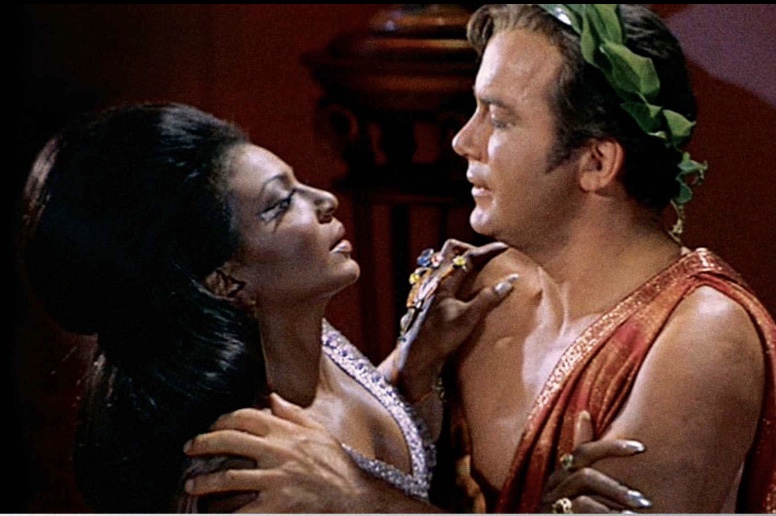
We start with the TOS episode “Plato’s Stepchildren.” One of the photos for this post shows why the episode was and is important. Uhura (Nichelle Nichols) kissed Kirk (William Shatner) onscreen at the end of 1968. Predictably directly addressing the issue with what is now deemed the second ever interracial kiss on English speaking TV (a BBC show asserts having done it six months earlier) caused a lot of people to lose their shit.

The hate mail flowed in from the South. The supporting mail from everywhere else also landed heavy. Nichelle Nichols has since then continuously retold her favorite piece of hate mail from that time. A gent from the South wrote in leading with I don’t approve, but then finishing with, if I may paraphrase, “but, Uhura’s hot!” John Sayles expressed a similar amusement in his movie Lone Star – “what a wonderful thing it is that it sometimes takes one prejudice to combat another.”

Exactly six weeks later in the dreaded and much derided TOS Third Season (fans love to bash the season about like we also like bashing Star Wars: Phantom Menace, tips for fitting in FYI), we got a more metaphorical approach to – “Hey, racism is bad and stupid to boot.” The TOS episode “Let That be Your Last Battlefield.” Again, the photo says everything.

No one then or now was ever fooled that The Five-Year Mission had suddenly changed tack. People are smarter than we look. The beauty of an episode about two guys who are both black and white at the same time fighting to the death because they have nothing else left is all metaphor. Heavy reliance on metaphor is a hallmark of Science Fiction and if that same southern gent was as equally pissed off by the follow up, History doesn’t record him writing a second hate letter. I like to think that he told himself that the second anti-racism episode in six weeks was all imaginary and he would wake up from the dream in due course.

Lastly, we come to my favorite regular hour of Star Trek, a DS-9 episode “Far Beyond the Stars.” Captain Benjamin Sisko (Avery Brooks) is whisked away by his later revealed cousins and other relatives among the Bajoran Wormhole People, aka the Prophets, to 1950’s New York. He takes the place of Benny, a science fiction writer at a pulp magazine tasked with writing the story of the space station.

When Benny gets his ass beat by two cops played by the actors normally playing the series villains, we learn that in 1999 the franchise clearly believes that the coast is clear. We don’t have to use metaphor to discuss racism instead just choosing to tell a story about the issue. Times had changed so it seemed.

As for how writing an SF novel helps the next American Dirt. First off, the author doesn’t have to worry about the main part of the backlash that might leave only Oprah standing if it breaks gloomy. Once it becomes SF, the story ceases to be about Hispanics and Anglos and a border described as tragic all around.

Sure, the people who piously police our books saying variations of – “this protagonist doesn’t reflect any of my immigrant relatives.” – or – “this author purports to want to humanize us, but relies on every stereotype about Hispanics that we’re tired of.” – are going to know immediately what Ms. Cummins is trying to say. But, the reply will always be – “yes, but replacing Hispanics with ________s allows the author the wiggle room to get X, Y and Z wrong about everything because the story is now about how two fictional societies with similar economic and cultural disparities interact across the short interstellar distances between the planets.”

The shift into SF also allows the protagonist to remain as is. According to the liner notes (I’ll get back to you when I read the book, possibly when the dust settles), the woman owns a record store and comes from a socioeconomic class that wouldn’t normally go across the border. She makes the mistake of flirting with the wrong cartel drug lord while her husband writes unflattering journalism about him, which results in a mass family wipe out at a quinceañera. I recognized this character archetype immediately.

This woman shares thematic space with every Disney princess that must be driven into the forest and seek protection from the Dwarves or be raised in secret by the Fairies to protect her from Maleficient. Or you could bring up Mark Twain’s Prince and the Pauper where a fictional Edward VI switches places with a pauper lookalike, losing status to regain it and become a better king. And I’ll give you a coin toss between the Biblical Book of Job or Alexandre Dumas’ Count of Monte Cristo as the last example of the protagonist that starts out comfortable and loses everything in order to gain more at the end of the story.

It becomes obvious that the detractors may be right according to one point of view, a woman that has more in common with Snow White really won’t reflect their cousins. By design. However, Ms. Cummins isn’t just writing to reveal the immigration situation from a point of view of things as they are.

She’s also trying to get people that look a whole lot like me to ease up and be nicer because normal people don’t cross dangerous borders on the merest of whims. Therefore, it makes sense to subconsciously tap into a more fairytale character archetype of the person whom we don’t expect to cross the border. Why? Because the thousand-year-old storytelling tradition I saw immediately because I do know how to read has always worked in the past.

In hindsight, this is where the imaginary SF version helps out. When the story ceases to be about Hispanics and Anglos, the detractors might just go with it because the fairytale princess escaping Planet Y for greener and safer pastures on Planet X makes for a potentially great story (It still could suck, we’ll see). Could Ms. Cummins have shifted gears learning from past blowups, though? Hard to say.

I’ve pretty much buried the lead here because there are a few skills that Ms. Cummins hasn’t had to practice. Worldbuilding, for instance. The two planets or nearby star systems with such disparate economics have to be thought out, named and put onto the page in order to disguise and prevent offense. Let’s see that means Planet________ has just recovered from Social Ill_______ and her people jealously eye the perceived wealth of nearby Planet_________.

For your information, the underlines are more about a failure of imagination than sensitivity, the names initially proposed read like Roald Dahl taking someone’s piss on a hangover day. If I had to actually write it, I’d come up with something…I always do. My point, I do worldbuilding every day and I still might draw blanks at first. What could Ms. Cummins do, coming new to the genre? Basically, you write like you read in so many ways.

There you have it, how it might’ve worked if American Dirt had been reworked as Science Fiction somewhere in the middle of the process. Less sales. No Oprah, unless I’m wrong. No presold film deal. And no one cares, unless Ms. Cummins really trips over her shoelaces trying SF when it doesn’t come naturally to her. All for a story that slips under the radar to influence people in unexpected ways, which sometimes just has to do.

As for what good SF races sound like, especially Roald Dahl at the top of his game…VERMICIOUS KNIDS! Enjoy that mic drop and have a good evening.