Archive for the ‘Uncategorized’ Category

img_4055

© 2020 G.N. Jacobs

Okay, for this one I’m just going to let you in on several related little secrets…my mother asserted car as my first word. Love driving them, except when I have to deliver your pizza or proof of service (a story for another day and another blog). Slightly know what I’m talking about when the hood’s up; comes from that one time it was still possible to change out an alternator on a motor where said part was at the top of the block.

Get gently yelled at over the size of my Matchbox/Hot Wheels collection by that sister sort of acting like Marie Kondo right now pretty much daily. Went kart racing just enough times to fake it for the story. Used to know the Indy Car guys backwards and forwards, less so F1 and Endurance. Whined really loudly when Mom decreed Speed Racer (unless it’s a G-Damn slow news day and I’m loaded respect for the anime says I’ll never comment on the live action here) to be too violent.

Have pulled Reverse J-Turns during my misspent youth. Have Deathrace 2,000 memorized even to the level of laughing at all references to – “the evil French.” And my first major series protagonist didn’t go pro because she liked writing better.

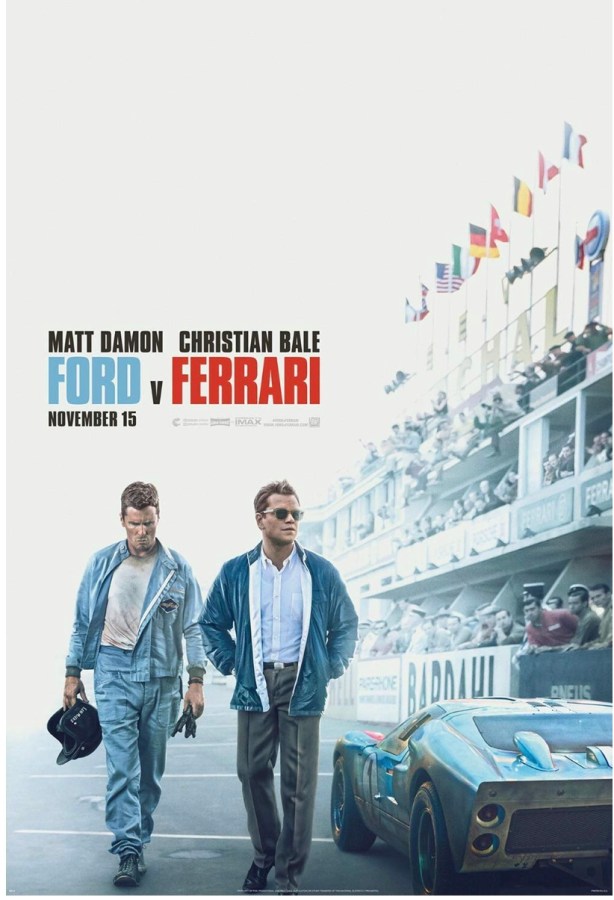
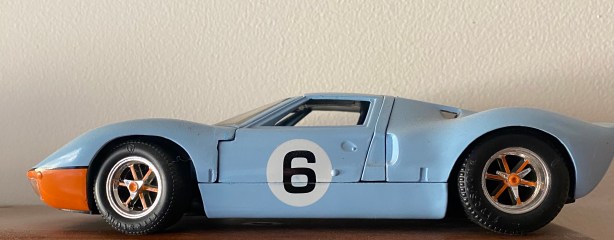
Oh, and did I forget to mention that the Ford GT-40, the subject of the movie Ford V. Ferrari is my single favorite closed-wheel car that didn’t appear in Speed Racer? From your perspective, objectivity just left the building with Elvis. Good thing, it’s verifiably a great movie…
IMG_4079

There isn’t really anything bad to say about this mostly true semi-tragic buddy movie about a driver, Ken Miles (Christian Bale), and his good friend builder and former driver, Carroll Shelby (Matt Damon), teaming up to spend Ford Motor Company’s money to give the hated Enzo Ferrari a metaphorical punch in the nose in the pasta rocket manufacturer’s home break sport of endurance racing, specifically the 24 Hours of Le Mans. All because the Italian gentleman called Henry Ford II (Tracy Letts) fat and his cars and factory ugly when Lee Iacocca (Jon Bernthal) reports back from the failure to woo Ferrari from Fiat.

And so it’s a story about boys and their cars. Complete with that special gleam we get when we have the wagon just so. And the somewhat difficult personalities associated with doing cars at the top of the game. A movie where two headstrong personalities throw wrenches and fists at each other all to get that last ounce of performance and air flow over the car body.

Matt Damon as Shelby quickly becomes the translator between the pure driver of Christian Bale as Miles and the business-oriented executives at Ford put in charge of the team. Primarily, this plays out with Josh Lucas playing Leo Beebe, a senior VP likely to insist that Ken Miles “just isn’t a Ford type driver,” during the GT40’s disastrous first year (1965) racing at Le Mans. Shelby apparently solved the problem by going around Leo Beebe and taking Mr. Ford out for a spin in the car…leaving him crying in the shotgun seat. A highlight of the movie.

All throughout 1966, problems with the car, mostly brakes bedevil the team headquartered at LAX. Solutions come from everywhere in the team including redesigning the entire braking system for easy replacement, something that had never exactly been done before under the Le Mans rules. The creative interpretation of – “gentlemen, the rulebook says part and changing out the entire brake system is a part.” – is one of the other highlights of the movie.

Of course, it being a movie and not a Wide World of Sports special, we do have to come off the track and do a little bit of storytelling in rooms, houses and cars. Mostly we get to see Ken Miles’s relationship with his wife, Mollie Miles (Caitrona Balfe), and son Peter (Noah Jupe). We get to see that Ken Miles was really too good at cars without much businessman in him to keep his garage in the Valley from going belly up.

A marriage where the wife drops the hammer on the family Ford station wagon on a lonely two-lane blacktop road revealing that professional drivers really hate being passengers is interesting in the best of times. The scenes with Peter reveal a deep abiding familial love where the idea is to share passion and perhaps a few skills.

And then we finally get to Le Mans 1966, where Ford takes three separate GT40 teams to the endurance race. Once the race officials agree with the Ford interpretation of the rulebook concerning ripping out the whole brake assembly, it’s almost a foregone conclusion that all three Fords will take the top three finishes at the race, especially with all the Ferraris killing themselves before the finish.

Even at this late date, all is not perfect in the race. The cars were driven differently with some teams keeping to the company directives as to how fast and hard to drive the car. Meanwhile, Carroll Shelby puts 7,000+RPM on the chalkboard for Ken Miles, letting him drive full out. Leo Beebe then hits on a “great idea” to slow Miles down so the other Fords can catch up for the great picture of all the Fords crossing the finish line at the same time. I remain surprised that this character agreed.

Anyway, Ford v. Ferrari is exactly what you expect, a racing movie with all the crashes, cool maneuvers and drama in the pits where people do sometimes die. Filmmakers know all the tricks like getting the right music and making the cars look beautiful even disintegrating after pranging in Turn 3. Good thing the real story happening off the appears to have been as equally able to hold the viewer’s interest. A worthy rental…
© 2020 G.N. Jacobs

Pop quiz. What effect will the current emergency have on various literary genres like Noir or the larger category of Crime? Don’t know, it’ll be interesting either way when we live long enough to see.

The LA Times (see post) recently asked this question of several LA based Crime writers known for writing Noir stories. Fascinating read about things I already generally know including that writers who create in this field tend to use their personal experiences, fears and hang-ups to create their themes, characters and plots. To be fair, all writers do this regardless of the genre we choose, whether Noir to directly face our demons raging behind our eyeballs or, say, Fantasy when it’s time to get running and do anything else anywhere else.

The article highlighted various authors and explained how and why they developed their characters, settings and themes. One lost friends to the AIDS crisis. Others might develop a ‘Sherlock in the hood’ property. You get the idea…

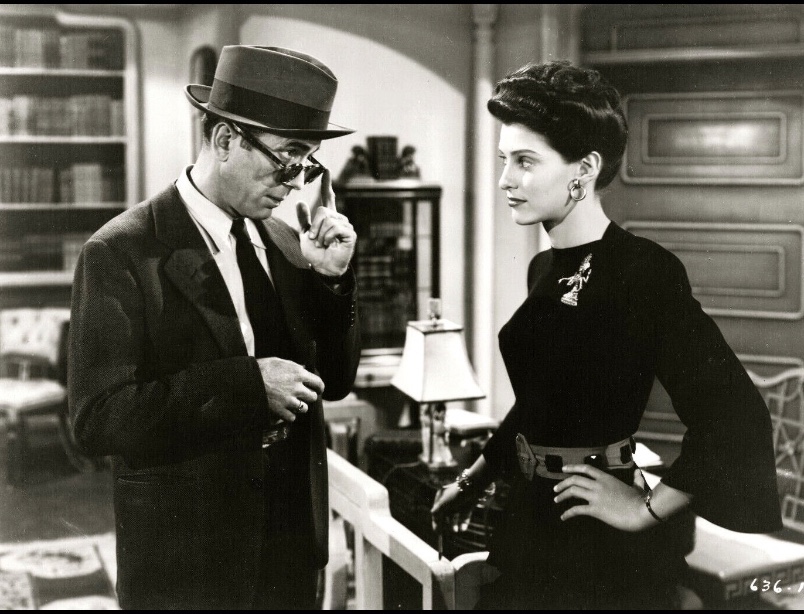
What is Noir? It’s a style of Crime fiction that emphasizes the emotional despair inherent in our bad acts to each other. People do bad things to each other out of need, hate, jealousy, you name it. These acts happen in a milieu of indifference set against a paladin always out for justice and becoming bitter in the process. Symbols of hope, like children or Phillip Marlowe finding the right woman and retiring to Poodle Springs (Palm Springs in the real world) are typically extirpated off the page or saved for the last book in the series.

At least one author asserted that the current emergency wouldn’t affect the genre per se, but that the books set post-lockdown would go nuts and totally off the chain. I agree right up until I don’t. The main reason for this statement is we’re all inside. Inside equals less crime until we’re released by the societal hall monitor to hang out in our favorite restaurants. And then we might see hardboiled characters getting mugged in the parking lot at Lawry’s setting off a chain of tragedy…

The small part of this assertion that I don’t quite buy into is the implication that the emotional turmoil driving Noir runs in waves. The original classics (Phillip Marlowe among them) are rooted in the Great Depression. Dig deep enough and you’ll find stories set in the 1960s with the change from trust society to question authority. Other characters exist as a result of drug wars and so on.

I’ve been alive and able to read the newspaper for a few decades now. I just don’t remember the bullshit coming in waves. It always feels like it’s there lurking under the surface waiting for the right person in a presently fearful, depressed or angry state to rake it up and vomit it onto the page. Finding the Noir is thus a personal choice. My other thought is that Noir is the literary equivalent of the Blues where you sing about your worst day and feel better because you shared it with people lessening the hurt.

In my youth, we had child molester living in the unit over the garage in a house three doors north from my house. The scumbag liked little girls and so I was blissfully immune, but the younger sister next door wasn’t. I was told about it by my mother because she told me almost everything, but I was then instructed not to speak about it casually because it just wasn’t polite conversation.

Looking back, this incident is relevant because without therapy the girl next door would grow up like Evelyn Mulwray, the ultimate Noir femme fatale with an agenda. More importantly, my memory of the time (late 1970s) was of a cocoon where we’d gotten used to the changes of the previous decade and were just getting on with life. Yes, other perspectives from that time might have more to say that somewhere in the world someone is always getting fucked over.

Another example that began earlier and went later well into the 1990s, the neighbors on my first street were really messed up despite presenting the façade of the perfect Catholic family. The father was an alcoholic resulting in the usual emotional douchebaggery conducted behind closed doors. The mother cheated rather than getting divorced waiting out her husband dying of natural causes to marry her long-term lover. Yet another case where my perception of the era would’ve landed between the sturm und drang moments of our recent history.

As I read the article, I also had the thought that I’m just the sort of contrarian to challenge the wait until after the lockdown mindset.

I immediately thought of all over us being locked down as a taunt to indulge in the Locked Room murder. In the real world the body in the Locked Room is always a suicide, but it’s been fascinating to image the possibilities as a thought experiment. Barney Collier (Greg Morris) in Mission Impossible famously used a gear driven screwdriver to open an air vent grate from inside the shaft. And we have yet to set MacGyver on the problem.

Another possible way around the ‘we’re all inside’ limitation of the moment is to make being inside part of the story. And to reiterate the immortal truth of ‘don’t open the fucking door!’ Yes, suddenly we’ve just crossed The Big Sleep with Key Largo (everybody is inside for the hurricane), but I bring it up just to spark the creativity of seeing a limitation as a challenge.

Another way I might set a Noir during the emergency instead of after is to cheat and steal from other genres. I’ve already created concepts of surrogates like flesh droids in which a mindless body exists for people who can pay to ride around pretending to be firefighters and such. Easily repurposed so that the flesh droids shoot and betray each other.

And in another incomplete brain fart I took one of the darker fan theories about Disney’s Cars franchise – the anthropomorphic cars were self-driving AI vehicles that bonded directly to the sick bedridden humans to which they gave care by adopting their last driver’s personality after they died. My slight variation on this concept assumed the humans were still alive at home being told about their cars’ doings at the end of the day. Ripe for some kind of Virus Noir stories.

I’m also waiting for the Noir that takes place in the narrow spaces online between, say, The Sims or Second Life on the one hand and all the mayhem we imagine we can unleash on Zoom. I don’t know…come up with some means for the killer to hack our smart houses to kill people in the physical world. I agree that these thoughts might be too much SF for some people, but then I’m the guy that sometimes comes up with wacky player pitches reaching everywhere in our shared database.

We’re inside now. Give it a few months and we’re going to start writing about it. The world is different than a mere ten days ago. Some will charge head on into our fears with a modern Noir for the age. Others will seemingly avoid it going for the latest and greatest Fantasy, Romance or whatever. I’m also kinda waiting for a Lord of the Rings knockoff where the quest McGuffin causes diseases (yes, I went there). But, that is another brain fart for another post.

The emergency will change everything. Be safe.

img_0625

© 2020 G.N. Jacobs

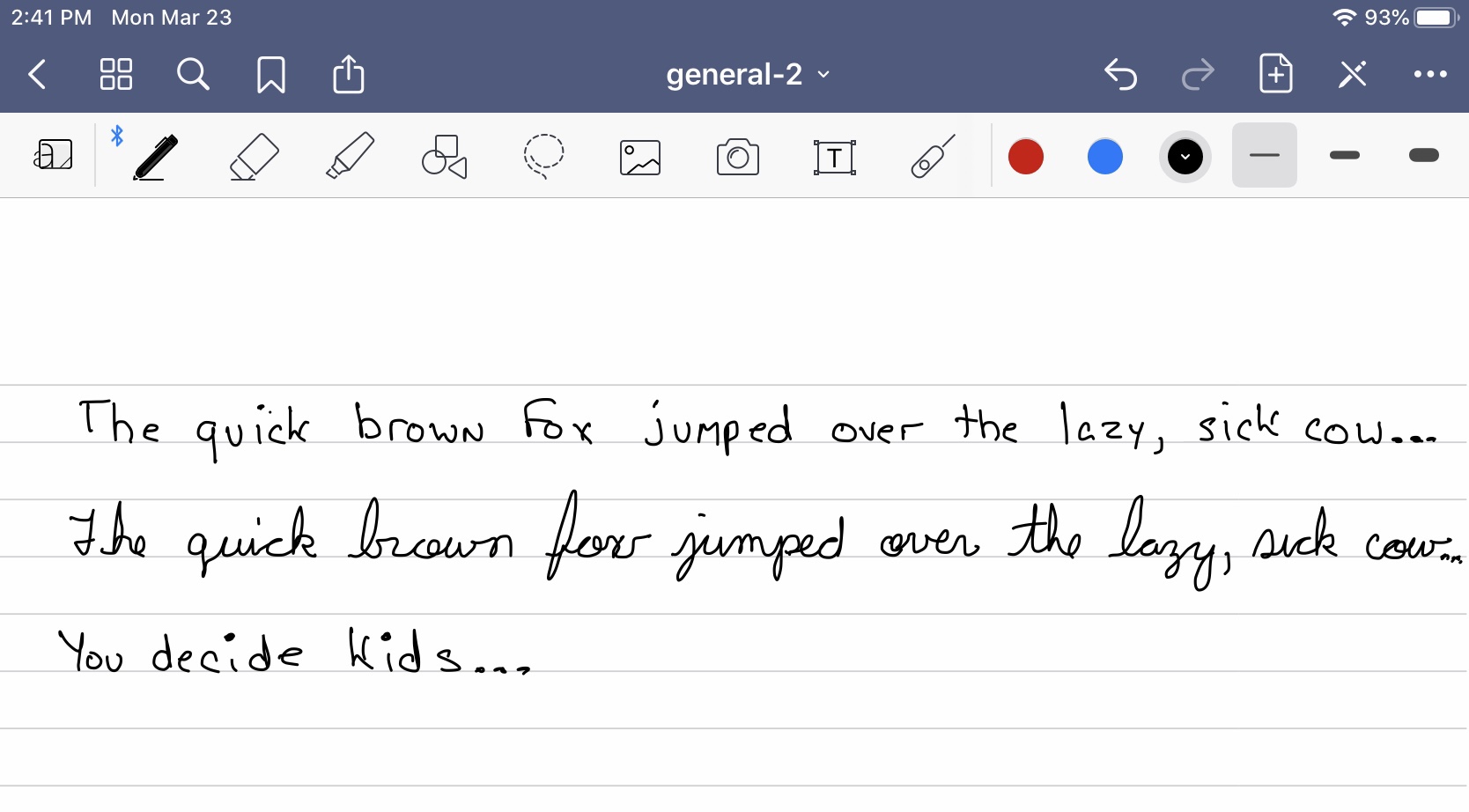
People my age or older who don’t write are sometimes a trip and a half. One common refrain to raise its ugly head in discourse is the one about handwriting…specifically cursive. Few schools teach it. No one under the age of tadpole seems to know how to read it and I’m not sure I care.

The arguments go like this…

  1. “You lose the ability to read the original citizenship documents and other great works of our past that are handwritten, which means that unscrupulous people can trick you by changing those words in the dead of night.”
  2. “It’s an important discipline to teach the student how to mentally organize their thoughts or…”
  3. “Science shows that teaching cursive is better for a developing mind and…”
  4. “How else will a student learn to create a distinctive signature?”
  5. “It’s a good backup skill for when the power goes out.”

There might be a few more, but I think that covers it for now.

Option 1 also known as The Animal Farm Argument sounds like a reasonable concern. The Pigs did change the Farm’s Constitution in the dead of night to the infamous dicta – “Some animals are more equal than others.”

I might gently ascribe to this thinking when the subject is English instruction as a whole asserting a visit to the Library of Congress as an American civil variation of the Hajj to Mecca. That as long as the original documents exist and we learn English the bad guys can’t change the copy printed in the back of the Eighth Grade Civics textbook, which is the version we actually read…or not.

I’ve already conducted that civil hajj. In the late Seventies, I took the trip to Washington. The Constitution and Declaration were at the time kept in their matching argon-filled bullet-resistant polycarbonate vaults at the Library of Congress. Cool…except for the part about not getting closer than twenty feet.

The logic of the Animal Farm Argument requires a ten-year-old to jump the rope line with textbook in hand to compare texts. I didn’t think of it at the time, in part because we don’t really teach the Original Documents in class until you are in the eighth grade and get issued the aforementioned Eighth Grade Civics textbook. Also, this was long before tablets and Kindles…the textbook in question is a lot to lug in the line for a ten-year-old only about two bad breakfast burritos away from – “Fuck the old parchment! Show me the planes and rockets a couple doors down at the Air and Space Museum!”

Bringing things around to the specific argument for cursive, the above makes even less sense. The documents in question may have been handwritten, but with an eye towards public display. This meant that what is actually protected by the vault is written carefully with a script that isn’t block printing, but isn’t the average handwriting, then or now, either.

When they let people get close enough to take pictures for the Wikipedia article, we see they’re far more decipherable than we sometimes credit as we bemoan the loss of cursive. And let’s face it, no other handwritten document in English matters except to the historians who in the future will take college level classes on reading cursive. The same way that people who want to teach Greco-Roman Classics and other Old And Presumably Important Cultural Documents at the college level take Ancient Greek, Classical Latin, Sanskrit and other such languages…as electives. Who then make decent livings translating for the rest of us.

The people espousing Option 2 scare the shit out of me. I didn’t have any traumas associated with learning cursive the way I might’ve landing in that one high school English class with the hippie-dippy teacher. You know, she never met a Baghwan she didn’t love and went out of her way to kill enjoyment of Hamlet due to an overreliance on symbolism and “what it all means” in her teaching method.

But I do remember a huge amount of tedium tracing the letters, just so, early on. And then you grow up a little and they just tell you to write your five-paragraph essay. I was never dinged nor praised for my handwriting. I turned in some of my papers with printing or a mix of print and cursive. My grade was the same…I either spelled my words correctly and made a logical argument while demonstrating that I’d read the source material or I didn’t. Sometimes I didn’t do the essay…another form of a lack of discipline that cursive practice didn’t solve.

I have friends who teach and may quit as soon as their health benefits and pensions vest. The common refrain for the current spate of not liking the job is that students don’t read, don’t do homework, don’t write and don’t even do the work when time is given in class, because homework is frowned on. So, teaching cursive will magically solve this?

Seems to me that the people who lead with Option 2 are like the old-timey doctors that resisted the move in medical school for shorter less crushing intern shifts in the teaching hospital – “I survived it, so you have to do it too.” Almost like abusers passing their curse down through the generations.

Despite the fact that while we haven’t completely eliminated paper, we’ve come close. We send documents back and forth using PDF files that you either print out, sign and rescan or there are apps that create a digital signature with the same legal effect. We send emails, texts and social media links.

As a GenX in-betweener, I can talk about feeling a strange joy getting a card recently from my biological mother who still trusts pen and paper. Yes, I can read her words. On one hand, I speak piously about just doing my first draft at the keyboard, or on the converse that I fill up notebooks either paper or digital by the score because moving the stick we call Pen or Stylus helps me work out my more stupid ideas.

However, none of that handwriting is in cursive and hasn’t been for a long time. You’d think the idea of working out certain ideas on paper or the notetaking app in need of an Apple Pen would mean I would be in the cursive camp. Not when I have printing for that.

All through my school years, I might start an essay question in cursive and finish in printing. Never really figured out the why. They tell us that cursive which keeps the pen nib on the paper saves time. I personally never noticed it, especially since my hands, wrist and elbow still ache and the same general amount of time elapses between Blank Page and Done. And I nearly always ended the essay or blue book test in printing.

Writers accumulate the wreckage of our collective writing pasts. Boxes of notebooks. Copies of this or that, some with markups. So, if I do become important enough for people do some literary archeology on my box (slowly migrating to Dropbox) and I end up printing anyway without noticing any lost time or quality, it makes sense to just print to make my detritus more readable from jump. You know, indulge a bit of ego to make it easy for scholars to understand me in the future. It’s an ego driven avocation to think I have a story to tell that you want to hear.

The science argument. This disposes easily – “cite your sources.” I haven’t seen any citations. Maybe cursive helps young minds develop. And maybe the content on that piece of paper does the same thing. The teachers that wanted me to write whatever I liked as extra credit are the teachers I remember as being my personal Mr. Holland (just without the music). The draft of my magnum opus about Jesus rolling up to Mount Olympus to demand the keys was delivered mostly in printing and then typed and saved my grade for the semester. Which has more impact?

Moving on to the signature argument. Makes sense, I suppose. Mine is derived from my leftover cursive when I intentionally just took my signature from how I would just write my name. But then I’ll put my dad’s signature in juxtaposition, a squiggle that barely has a R, a J and an S in it that has no other relationship to cursive. Why? He believed forgers would freak out getting his right trying to steal checks. Seems to me that we can put any old thing down on the credit/debit slip as long as we do the same thing every time.

As for the power going out. I print. Got it covered. There you have it. I don’t like cursive, not then and less now when it really doesn’t matter to society. Thus endeth the opinion.

© 2020 G.N. Jacobs

Stop me if you’ve seen this movie before – “A long journey up the metaphorical river undertaken by an isolated protagonist to confront a missing metaphorical father figure over the consequences of his isolation from civilization brings dangers and greater wisdom to the protagonist.”

If your reply is to ask – “Yeah, kinda, isn’t that, like, the plot to Apocalypse Now, the preeminent movie about Vietnam?” – then you’d be right. If your similar reply is to ask – “Yeah, that’s, like, the plot to Apocalypse Now Redux, right?” – then you’d also be technically correct, though subject to me being a douchebag about your liking a bloated early draft of an otherwise great movie.

Anyway, enough trash talk upon Francis Ford Coppola, how was Ad Astra, the space movie with the same plot? It held my interest on average dark night in front of my TV. On a different night after many bad breakfast burritos, I might’ve hated it. It’s that kind of movie.

Astronaut Roy McBride (Brad Pitt) works on a SETI antenna array tall enough to reach just above the atmosphere, requiring astronauts with parachutes to work the upper decks. Power surges coming from Neptune orbit start blowing up all things technological across the Earth, including the array. McBride saves the array with a timely pull on a kill switch and then has to fall.

Thus, begins a movie in which Major McBride, the very model of what Tom Wolfe asserted was the common personality of astronauts and test pilots: buttoned up, always calm and unlikely to reveal very much personal or emotional…at least until long after they retire, must journey to confront his “heroic” father, H. Clifford McBride (Tommy Lee Jones) in Neptune orbit.

Plot wise, the movie proceeds very much along the lines of the Coppola movie. The protagonist takes the long journey. Nearly everyone who helps gets blasted out of the boat on the way. There is even a tiger scene, well, okay not a scene with an actual tiger, but would a pair of scared and pissed off baboons on a derelict research boat do nicely as a substitute, ya bloodthirsty mugs? You know, to reinforce – “Dear Mom, today we got attacked by a motherf@#king tiger, teaching me one important thing…never get out of the f*@king boat!”

The baboon scene begins with Major McBride trying to assert his authority as Classified Passenger to get the captain of the ill-fated USS Cepheus to ignore the distress call, we see filmmakers who have absolutely seen the Coppola movie go for concise. Consolidating the Tiger Scene with the Tragic River Interdiction Scene, yup, this is how a three-hour movie (the good version of Apocalypse Now) becomes a more manageable two-hour movie and get to the same place. This is always good.

The movie improves when we take the discussion out of the purely plot and into the much better characters and worldbuilding. Yes, Roy McBride has trouble relating to his wife, Eve (Liv Tyler) and is the sort of man who doesn’t have to take mood stabilizer pills before the mandatory psychological evaluations that the subject must pass every time before the next big task in space. He doesn’t end up that way.

We start with a man who is so Astronaut of All Astronauts that we might imagine Chuck Yeager and Neil Armstrong, both famously reserved on the job, shaking their heads and saying – “Guys, the man is borderline psychotic!” We end with a kinder gentler man who can smile at the end of the movie upon seeing his estranged wife enter the door at the coffeehouse giving hope of reconciliation.

We have no word if Major McBride quit Space, like his metaphorical uncle Captain Willard (Martin Sheen, not in the movie) quit the Army, or if he figured out how to do Space for the benefit of his country and still be a good husband. Something to discuss at a dinner party that the answer I suppose depends on how romantic one is.

Regardless, the move plays out in a narration very similar to the one in the Coppola movie. I thought this arc from buttoned up and angry over the abandonment to wise, human and caring as it plays out on Mr. Pitt’s face worked and was worth the price of admission. However, the arc isn’t solid enough for someone else with a different perspective (bad breakfast burritos) to see the same movie and not hate it. It’s that kind of movie.

I found Tommy Lee Jones doing well with his small part as the obsessed man willing to sacrifice everything on a fruitless search for extraterrestrial intelligence. When confronted with the in-story assertion of We Are Alone, he can’t let go and previously killed people mutinying over what should logically be the end of the mission. It means he has to go the way of Colonel Kurtz (Marlon Brando, really not in the movie). At least, this time the nutter father figure has the realization to unhook the tether himself.

I mentioned worldbuilding. Where director and co-writer James Gray really went right was creating the world (well, Solar System) in which the many set pieces that serve to wipe out people on the boat. The mission starts from the Moon where you land in the nice neighborhood areas presumably on the Near Side, but have to travel by rover to the launch facility on the Far Side. A route beset by crater pirates in their own moon-buggies.

Yes, you could deride it as a way to have the PBR Streetgang (yeah, it’s a lot of Coppola references) get mugged…killing everyone but Roy McBride. But it also serves as a launching point for all kinds of fan fiction and other movies about how the crater pirates got their start and, more importantly, if the United States military might send in the space-qualified Delta Team to clean up the pirate base? You know, Against All Flags meets The Guns of Navarone set in Space?

You’ll read in a lot of places about how this movie fits into the Real SF tradition that includes Gravity and so on. Certainly, the movie handled zero-G decently well as I didn’t get the sense of actors on wires having to act like Earth Normal at Sea Level still isn’t pulling them to the bottom off the access tunnel set. But there are things I still want to hear about from the current crop of TV physicists and science presenters …paging Neil deGrasse Tyson and Bill Nye.

The Tiger, sorry Baboon Scene, resolves with the last baboon getting shut into an airlock and the protagonist hitting the Red Button (air vent). Said simian splatters all over the interior side of the window in the hatch, a nice crowd-pleasing SPLAT of Strawberry Jam (what the mess looked like), or Chunky Salsa (the common metaphor among science explainers for the same thing). Problem, other sources assert rapid decompression is more likely to result in freeze-dried bodies and boiled away fluids. Still messy, but not quite the cinematic pop we bloodthirsty filmgoers love so much.

Next we have the Suborbital HALO, actually a Suborbital High Altitude High Open jump if we are to judge from when the stuntman doubling Mr. Pitt pulled the ripcord. Looks good on the surface. Real life nutjobs with endorsement deals with Red Bull have gone up in balloons to the edge of space (you get astronaut wings going into the very thin parts of the atmosphere, not vacuum as is believed) and jumped out. The devil’s in the details. Roy McBride wore what looked like a standard issue orange spacesuit/flight suit that say a Shuttle crewmember might wear to survive launch. The record setting Red Bull nut wore a suit more like a Mercury astronaut, a more robust garment.

Lastly, the plot revolves around antimatter. We have Star Trek to thank for our misconception of this substance as the end all be all fuel source cum convenient detonation to end movies that seem have a union mandate for a big explosion at the end. However, ask a real Trekkie and you’ll get this answer…by itself antimatter colliding with matter (proton and antiproton) doesn’t power the warp drive. In addition to needing a scarce We Could Run Out of Gas substance to drive the Cold War conflict metaphors of the original show, lots of physicists wrote in explaining how antimatter couldn’t provide enough energy to crack dimensional barriers without the unobtanium of dilithium crystals to act as fuel additive.

Bringing this thread back around to Ad Astra and the antimatter reactor on the Lima Project boat/space station, we might learn that the threat of ending the whole Solar System is overblown. Matter and antimatter collide releasing vast energies related to the calculated values for protons and the nearly identical antiprotons essentially annihilating two protons into energy.

This means that the Lima Project ship has to bring enough antimatter to blow up the whole Solar System on a one for one basis, or in layman terms drag along enough mass of antimatter equivalent to the mass of the Solar System. Which is clearly not how the model/CGI departments built the boat. Keep the threat to random power surges causing disruptions to all things tech and you have more plausibility.

Anyway, driven by an interesting acting performance to play out the arc of the isolated protagonist who needs the one last bad mission to recapture his humanity, the movie is fun and interesting to watch. This takes the movie well out of the cellar where we like to laugh at our entertainment because we have otherwise seen the story before. There are worse ways to spend an evening at the TV.

© 2020 G.N. Jacobs

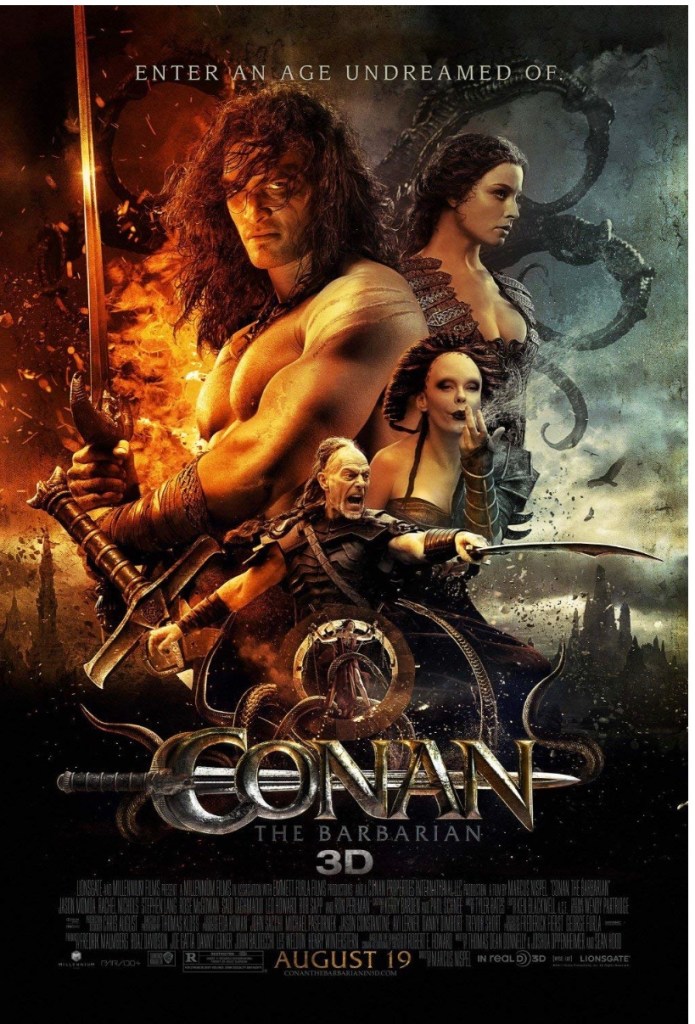
Conan is back. Morgan Freeman does the “Between the years when the oceans drank Atlantis…” preamble and doesn’t appear in the movie. Okay, the hypothetical wizard he might play can’t be named Akiro, but…never mind.

Anyway, if you’ve watched the previous Conan movies (see post) (see post) you’ve seen this movie as the main points here are a blend of the previous two movies. Born of battle, a.k.a. pregnant mommy slashed open, gives birth, names Conan, dies. Daddy is the village blacksmith making the swords spouting Iron Age bushido. Orphaned in a later battle. Set loose upon an unsuspecting Hyborian-age world as Conan the Barbarian. Seeks revenge against the warlord that rumbled the village and took his father’s sword, in this case by way of a mission to accompany a special woman intended as a sacrifice to the evil gods on a long journey.

Sounds like I hated the movie like everyone else that turned this one into a bomb. Well, hate being such a strong word. I land it between the Schwarzenegger films and I do try to find things to like about everything I see.

This time around we have Khalar Zim (Stephen Lang) doing the Warlord who Mugged Conan’s People at the Beginning of the Movie duties. He seeks the many pieces of the Mask of Acheron, a vile example of Magi-Tech that operates on blood from the daughters of the Acheronian necromancers. Gives the usual control over the spirits of the dead power. The many Cimmerian tribes rose up and broke the mask, each taking a piece to hide so that it never resurfaces to trouble the world.

Corin (Ron Perlman, how did he not get this role in 1981?) is a kind father and village chieftain spouting a less crazy version of the Cimmerian/Viking warrior ethic – “a warrior is not afraid of death, but neither does he foolishly rush to meet it.” He sends out the boys with robin’s eggs in their mouths as a test of fitness to be part of the village’s first rank of warriors.

Conan arrives late because Daddy assigned chores possibly to protect his son a little longer. But Conan either finished early, or, we can hope, pulled a Tom Sawyer and delegated to other kids in the village. Corin relents and gives his son an egg and sends him out.

Khalar Zim chooses now to send his scouting wave against the village, a force staffed by appropriately growly dudes that kind of remind me of Mohawks or Iroquois in war paint. Well, it is the mythical Hyborian Age that essentially asserts that all things from history happened far earlier and humanity had to relearn many things over and over: cultures, steel, etc. Anyway, most of the boys on the egg-race turn back to warn the village. Conan turns and fights bringing back three heads…and an intact egg.

In the lull between waves, Corin takes the time to make sure Conan has finished his education in steel, swords and being worthy to carry both. The Iron Age bushido is more muted. The sword that eventually comes out is a worthy king-sword, but Conan isn’t quite worthy of it.

And then several months later, Khalar Zim shows up with his main force, a multinational bad guy operation that works on a “lose to me and if I like how you fight, you get to live and join me” basis. The village gets rumbled. Conan is left holding a bucket of molten steel to keep it from landing on his father’s head. Corin takes the bucket instead of seeing his son die. Khalar Zim’s witch daughter, Marique (Rose McGowan) finds the shard of the mask, steels the king-sword and now we’re ready for Adult Conan (Jason Momoa).

What follows is a perfectly acceptable romp through the wilds of Bulgaria doubling as Hyborian places that never really existed except in Robert E. Howard’s imagination. And it’s a lesson that filmmakers can trick the viewer into making the assumption of being anywhere in the world. The foliage is what it is, but drop in a temple that sort of looks like Ankor Wat and suddenly you’re asking – “did they find the budget to go to South East Asia?” No. Movie magic.

However, another way to phrase perfectly acceptable is Man, they could’ve gone so much cooler. We remember the big set pieces in these movies. This movie bats about .500 here.

A windswept Stonehenge-like ceremonial site conveniently near the evil snake dude’s tower of power? Well, no, but then I am making a reference to a great movie. We did get a decent moment with Marique creating a pack of sand monsters at what appears to be a Hyborian Age construction site.

Okay, cool-ish. Personally, I think the filmmakers dropped the ball slightly on the metaphor of creating warriors out of sand with which to mug the heroes. We have other franchises like Spider-man to instruct us that a sand beast can’t be killed with swords or guns. They break apart and reform until the hero figures out the writer’s choice of…

  1. Dunk the beast in water to make mud
  2. Zap it with lightning that melts it into glass
  3. Have your not in the movie wizard friend cast a wind spell for dispersion
  4. Drop the beast into the more convenient of steel forge, potter’s kiln, bread oven, glassblower’s hearth or sacred fire to melt it down and make glass
  5. Spray the beast with some kind of serious epoxy/resin (superglue) to freeze the beast into shape

There’re a couple things here. Maybe there are other creative ways to knock off sand monsters and I would like to hear any thoughts (try to find me at my comic book store for this nerd fight) that aren’t on this list. But, none of these solutions appear in this fight.

Conan whacks these guys with swords. They die crumbling back into the sand and they come back, but each new CGI-enhanced stuntman that arises from the ground is a different guy. Yes, it’s sort of my job to pay attention to the closeups of the sand encrusted faces trying to kill our fearless hero.

 The movie has a bigger success with a tentacled almost Lovecraftian squid monster blocking entry into Khalar Zim’s city. Big, appropriately scary, and hard to kill and a good way to get some mileage out of Conan’s earlier making friends with a thief, Ela-Shan (Said Taghmoui), who has the keys to every city in Hyboria…until the squid monster causes him to drop them into the water.

Of course, everybody in Fantasy does squid beasts since H. P. Lovecraft articulated the Elder Gods like Cthulhu. Lovecraft and Howard were friends, the letters still exist and they agreed to share concepts. Even Tolkien dropped in a squid beast in front of the Mines of Moria. We don’t have information whether American pulp magazines made it across the Atlantic to Britain, or maybe squid beasts are, like sharks, things we have nightmares about even if we have never seen the sea.

Here, it’s a great scene because the squid beast is always a great scene, unless we’re talking about the crappy hunk of rubber that Ed Wood made Bela Lugosi roll around with…oh never mind.

The movie gets a little better contemplating the moments in between the big stuff. Jason Momoa doesn’t get blamed here because someone in the writing room pretty much wimped out. Putting an enemy on catapult to send a message to the Big Bad, yeah, this also works every time I see it…and it’s something all versions of Conan would do.

There are wagon chases. Interludes on Conan’s pirate vessel. He frees slaves. Celebrations after battle that kind of remind me of a few college parties that I absolutely don’t want to tell the future She Who Must Be Obeyed, or any of my sisters for that matter, about. You know: beer (actually mead, the one nod to our known historical timeline of when humans learned to do stuff), arm wrestling, loud music and so on.

Which brings us to the core of a Conan movie with the plot of Conan escorts and protects the special young lady from the warlord that wants to be a god…how are they on screen together? Jason Momoa and Rachel Nichols as Tamara are actually, in a different version of this movie, a great screen adventure couple.

Trying to avoid getting yelled at by people who yell at movies over things like representation of women, the production made Tamara a monk at the peaceful Cambodian style temple. Monk usually means: reading, Kung Fu, riding horses and generally doing better for herself than, say, a certain princess draped on a different Conan’s arm. And she just works, though there was a moment I wanted to see slightly expanded.

Conan says Tamara dresses like a harlot. She replies he’s never met any other kind of woman. Conan mentions that Cimmerian women dress like warriors. Conan leaves to do other things. Conan’s seafaring buddy, Artus (Nonso Anozie), says Conan likes her. Leading to the part that isn’t in the movie – “what, he wants me to dress up like his mommy, how weird is that?”

I could go on a bit mentioning Rose McGowan being fun to watch as the creepy witch daughter, but really this is a movie with lots of things where stuff was almost great. We would’ve needed more from her character in a context of not holding back on screen.

Actually, that kind of describes the whole experience of this movie. There you have it, a movie I can enjoy at the level of if it’s on a streaming service for which I already pay I’ll watch.